


Fashion is having a Russian moment. Miu Miu has done village headscarves and flowery, embroidered skirts. Anna Sui and Costume National are both channe-lling Julie Christie in Dr Zhivago, with lashings of blond hair under huge fur hats. Yves Saint Laurent is full of winter white. Nearly every label has a nod to the Red Army, with military references at Michael Kors, Eley Kishimoto and Balenciaga. And the look is already on the British high street: a Russian-inspired jersey dress with folk embroidery.
And it is hardly surprising. Russian women -- most visibly the Chelski wives, of whom the queen is Irina Abramovich -- have made a huge splash on the London fashion scene in recent years.
"The fashion world has been so influenced by this Russian theme because now most of the serious clients are Russian," says Marina Prokopiva, 37, the London-based designer of Voltage, her own label. "In the 1980s it was the Arabs; now it's us."
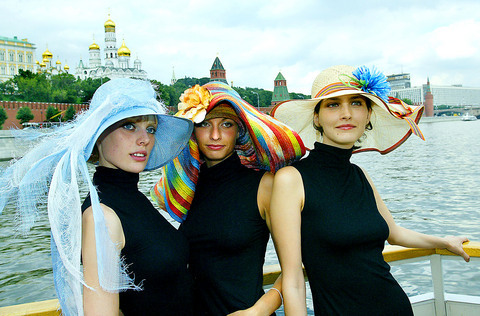
Prokopiva is originally from Novorossiysk, a town in southern Russia near Putin's favorite Black Sea holiday resort, Sochi. Russian women are fashion's new muse, she says. Russians buy the clothes and Russians also sell the clothes, on the catwalk. The girls backstage at the shows are as much an influence as those on the front row: Natalia Vodianova, Euguenia Volodina, Natasha Poly and Valentina Zelyaeva all recently featured on a Vanity Fair cover heralding "the new supermodels from behind the iron curtain."
And they also exert an influence from afar. For the past five years, the majority of designer Julien Macdonald's sales have been in Russia.
"Russians are every designer's dream. They are the savior of almost every glamorous fashion brand in the world. Without them, a lot of us would have gone bankrupt a long time ago. They are the only women in the world who are buying luxury designer items."
So no wonder that the fashion industry has chosen to pay homage to all things Russian. It's a wasted tri-bute, though, says Macdonald.
"They're probably flattered, but they would never wear it. I mean, would you have an Eiffel Tower model in your living room if you lived in Paris?"
A lot of the designers showcasing the Russian trend are not necessarily bought by Russians, he says, "They're trying to entice the Russian market; they're teasing them to make them look at that brand."
But Russians are more interested in red-carpet glamor than edgy references, he says.
"The Russians with money are young and glamorous. They hate avant-garde and grunge. They spend a huge amount of money on their bodies, and they want to show them off. They are fabulous, glamorous women who buy the most expensive things -- they don't even look at the price tag."
Vogue Russia has dedicated its entire September issue to the Russian trend, much of it shot around Red Square. But fashion editor Lidia Korneva thinks that her readers -- while being very flattered and interested -- will not necessarily be sporting the look as seen on the catwalk.
"We are very delighted that designers would look to Russia for inspiration, but Russian women are more European-oriented." Many of the looks are a caricature for her. "I was at the Jean-Paul Gaultier show and it was fun with all the Russian music. But the last model came on carrying vodka, pretending to be drunk and dropping the glass. I was, like, `Hmm, we don't behave like that.' But then everyone has the right to interpret Russia the way they imagine."
"There is just a massive boost for anything Russian at the moment," says Muscovite Natalie Simpson, 32, who moved to London a year ago and runs an introductions agency. Russians are every bit as stylish as French or Italian women, she says, and finally the fashion world has woken up to this.
"Russian women will get up several hours early to do their hair and makeup. We believe in sacrifice for beauty. When I was growing up, I would see women walking down icy roads in high heels. We don't wear hats even in the freezing cold, because we don't want to spoil our hair."
Gyunel Boateng, 27, the Russian wife of designer Ozwald, is a model currently studying management at the London College of Fashion.
She has been in London since 1998. "Yes, there are a lot of Russian clients now, but they are not going to be interested in Russian- inspired collections. Russians want to buy something exotic, and that means French. You wouldn't want to wear your national costume, would you?" Elements of it are clever and beautiful, she says: the Tsarina- style pieces, some fur and floral items. "But it's not something I would want to wear. When I'm in Russia I wear a to-the-floor white mink. That's about as nostalgic as I get."
There is a consensus on who has been most accurate, though. All the Russian women are impressed that Kenzo obviously knows its boyars (hereditary nobles from the 14th century). Marina Prokopiva says that Diane von Furstenberg has used a specific folk pattern of knitting and lace from Orenburg, south-east Russia, famous for its shawls.
Anna Sui has picked up on the sarafan -- a peasant pinafore dating from the turn of the 18th century. The less popular looks are the recent
references.
"My sister had one of those Costume National coats in the 1970s," says Prokopiva, laughing. "The hats by Costume National, Michael Kors and Prada have a lot of bad memories connected with the 1970s," says Lidia Korneva. "For us this was the time of stagnation under communism."
Referring to the Soviet era is definitely not cool. Growing up in the 1970s, Prokopiva remembers wearing the universal school uniform.
"Ugly brown dresses with black aprons and white collars. At home I wore homemade and second-hand clothes. Everything in the department stores was brown and dark blue. That was it."
She still remembers the first western clothes she got from a tourist in exchange for a matrioshka (Russian doll).
Natalie Simpson recalls the incredible prestige of going to a factory as a teenager to choose what color and style of boots she wanted.
"My father was in the military, so we were quite comfortable by Soviet standards."
So what will we wear this winter, if not the Russian look?


It’s only half the size of its more famous counterpart in Taipei, but the Botanical Garden of the National Museum of Nature Science (NMNS, 國立自然科學博物館植物園) is surely one of urban Taiwan’s most inviting green spaces. Covering 4.5 hectares immediately northeast of the government-run museum in Taichung’s North District (北區), the garden features more than 700 plant species, many of which are labeled in Chinese but not in English. Since its establishment in 1999, the site’s managers have done their best to replicate a number of native ecosystems, dividing the site into eight areas. The name of the Coral Atoll Zone might
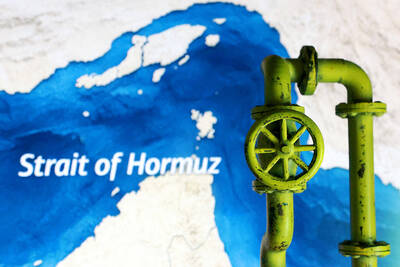
The US war on Iran has illuminated the deep interdependence of Asia on flows of oil and related items as raw materials that become the basis of modern human civilization. Australians and New Zealanders had a wake up call. The crisis also emphasizes how the Philippines is a swatch of islands linked by jet fuel. These revelations have deep implications for an invasion of Taiwan. Much of the commentary on the Taiwan scenario has looked at the disruptions to world trade, which will be in the trillions. However, the Iran war offers additional specific lessons for a Taiwan scenario. An insightful
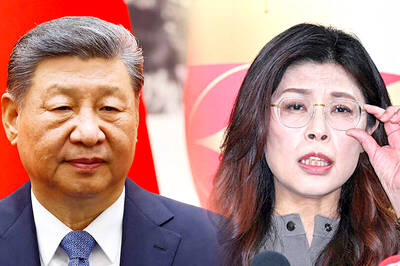
On Monday morning, in quick succession, the Chinese Communist Party (CCP) and the Chinese Nationalist Party (KMT) released statements announcing “that the Central Committee of the Communist Party of China and General Secretary Xi Jinping (習近平) have invited KMT Chairwoman Cheng Li-wun (鄭麗文) to lead a delegation on a visit to the mainland” as the KMT’s press release worded it. The KMT’s press release added “Chairwoman Cheng expressed her gratitude for the invitation and has gladly accepted it.” Beijing’s official Xinhua news release described Song Tao (宋濤), head of the Taiwan Work Office of the CCP Central Committee, as
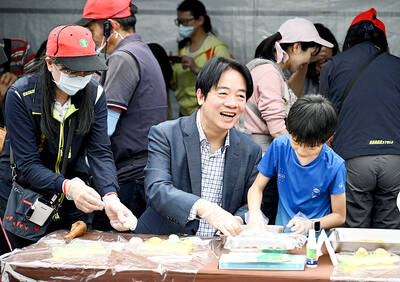
Polling data often confirms what we expect, but sometimes it throws up surprises. When examined over time, some patterns appear that speak to something bigger going on. In this column, whenever possible, Formosa’s polls are used. Despite the sometimes cringeworthy antics of Formosa’s Chairman, Wu Tzu-Chia (吳子嘉), the data produced includes detailed breakdowns crucial for analysis. It has also been conducted monthly 11-12 times a year for many years with many of the same questions, allowing for analysis over time. When big shifts do occur between one month and the next it is usually in response to some event in


 RSS
RSS