


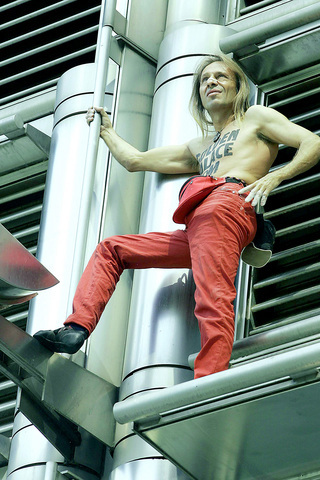
Spiderman sits in a Hong Kong coffee bar and talks excitedly of his latest daredevil climb up another of the world's tallest skyscrapers using only his hands and feet -- no ropes, lines or harnesses.
"There is a feeling when you are that far up and you have your life in your fingertips, literally," enthuses stunt-man Alain Robert, known throughout the world as the "French Spiderman," throwing back his wild mane of hair.
"At that moment I am just a slip or a footfall away from death. There is no way to explain that feeling unless you are in that situation," he says.
PHOTOS: AGENCIES
Under a baking hot sun last week, Robert added Hong Kong's gleaming glass and steel Cheung Kong Centre to his list of conquests that includes New York' Empire State Building, Kuala Lumpur's Petronas Towers and Taipei 101, the world's tallest building at 508m.
As with most of his unauthorized climbs he was greeted at the summit by police officers, but escaped with a talking to rather than a few days in jail as has happened in some countries.
After climbing Tokyo's Shinjuku Metro Centre he was locked up for seven days -- the harshest punishment meted out so far.
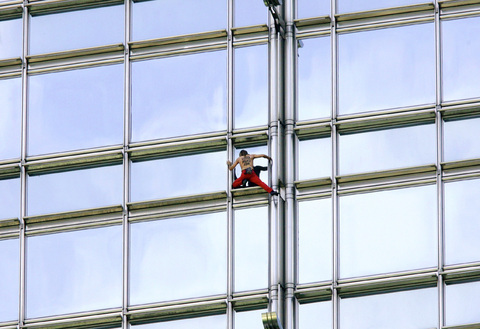
"I slipped once or twice because there were wet patches I hadn't expected," a breathless, bare-chested Robert told reporters after the stunt in Hong, which took about 45 minutes and drew crowds of onlookers in the city's busy finance district.
A week of heavy rain in the city had almost forced the climber to cancel his assault on the 283m 63-storey Cheung Kong Centre and he admitted feeling more apprehensive than usual.
"I'm not sure why but I was more tense than usual," said the clearly relieved stuntman.
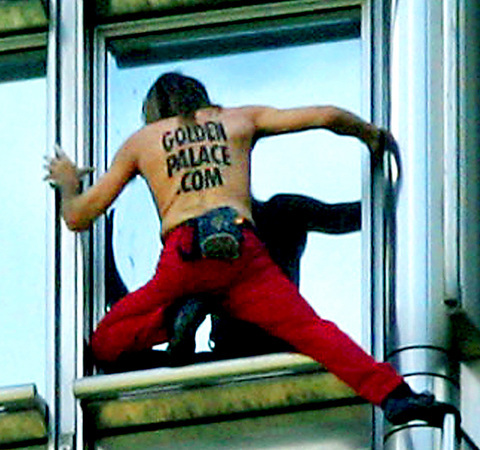
Robert, whose red leather trousers are as close as he gets to the red satin suit of the famed Marvel superhero, had kept the name of the target building a closely guarded secret for fear the police or security may be tipped off and prevent his ascent.
The diminutive climber -- he is just over five-feet tall (1.5m) -- is slender and has hands that look wrought from iron, strong and sure, the only piece of equipment that separates him from death.
"When you have been climbing as long as I have, this becomes the only way to climb," said Robert, speaking over a caramel latte on the eve of the climb, with a loud laugh.
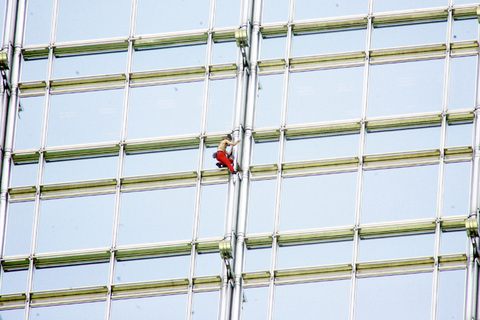
Robert, now 42, began climbing at the age of 12 and within a couple of years was climbing solo in the ravines, cliffs and mountains of France.
He turned his passion to buildings in 1994 when he was asked to climb for a TV show. The producers quickly found there was nobody willing to let him up the side of their edifice, so he agreed to an illegal climb. That took place in Chicago and so began a love affair.
"I cannot do any normal job," he said with a huge grin, insisting he did it entirely for the money, not the glory. "You can live okay doing this -- I get sponsors who cover my costs and pay me a small fee to do it."
Unsurprisingly the Spiderman nickname came quickly and he even took to dressing as the comic book hero for some of his climbs.
No building is impossible to climb, Robert insists. Even modern glass and steel structures often have just deep enough grooves and fittings for him to find an adequate hand or foothold. Given the right weather conditions, he will climb a 110 storey mammoth like Chicagos Sears Tower in just over 90 minutes.
"I plan the climb so I know what to expect," he said. "It is rare I can't climb a building -- its only the law that will stop me, not the building."
He will make at least one visit to his intended climb before scaling it. The Hong Kong climb was planned a month ago on a previous visit. The Cheung Kong Centre was not built when he made his first climb here in 1996, when he climbed the Far East Finance Centre.
The climb will be a precursor to a series of five legal climbs on different buildings in each continent to help promote UNESCO projects.
"I will have to use ropes for those -- it is against my soul, but it is for UNESCO. How can I say no?" he said.

Following the rollercoaster ride of 2025, next year is already shaping up to be dramatic. The ongoing constitutional crises and the nine-in-one local elections are already dominating the landscape. The constitutional crises are the ones to lose sleep over. Though much business is still being conducted, crucial items such as next year’s budget, civil servant pensions and the proposed eight-year NT$1.25 trillion (approx US$40 billion) special defense budget are still being contested. There are, however, two glimmers of hope. One is that the legally contested move by five of the eight grand justices on the Constitutional Court’s ad hoc move
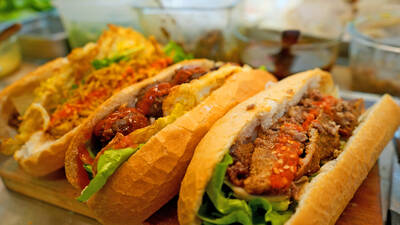
Stepping off the busy through-road at Yongan Market Station, lights flashing, horns honking, I turn down a small side street and into the warm embrace of my favorite hole-in-the-wall gem, the Hoi An Banh Mi shop (越南會安麵包), red flags and yellow lanterns waving outside. “Little sister, we were wondering where you’ve been, we haven’t seen you in ages!” the owners call out with a smile. It’s been seven days. The restaurant is run by Huang Jin-chuan (黃錦泉), who is married to a local, and her little sister Eva, who helps out on weekends, having also moved to New Taipei

The Directorate-General of Budget, Accounting and Statistics (DGBAS) told legislators last week that because the Chinese Nationalist Party (KMT) and Taiwan People’s Party (TPP) are continuing to block next year’s budget from passing, the nation could lose 1.5 percent of its GDP growth next year. According to the DGBAS report, officials presented to the legislature, the 2026 budget proposal includes NT$299.2 billion in funding for new projects and funding increases for various government functions. This funding only becomes available when the legislature approves it. The DGBAS estimates that every NT$10 billion in government money not spent shaves 0.05 percent off
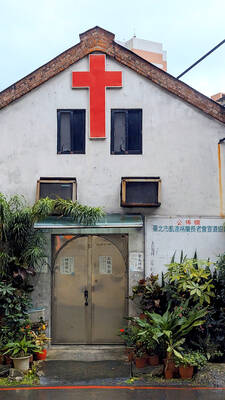
Dec. 29 to Jan. 4 Like the Taoist Baode Temple (保德宮) featured in last week’s column, there’s little at first glance to suggest that Taipei’s Independence Presbyterian Church in Xinbeitou (自立長老會新北投教會) has Indigenous roots. One hint is a small sign on the facade reading “Ketagalan Presbyterian Mission Association” — Ketagalan being an collective term for the Pingpu (plains Indigenous) groups who once inhabited much of northern Taiwan. Inside, a display on the back wall introduces the congregation’s founder Pan Shui-tu (潘水土), a member of the Pingpu settlement of Kipatauw, and provides information about the Ketagalan and their early involvement with Christianity. Most


 RSS
RSS