


Sometimes, Sainkho Namtchylak sounds like an opera tenor, with a clear and bright voice. At other times, her voice is like the singing of birds, or the prattle of a baby. Then she can chat like the crying of a crow, letting out exotic and intense feelings. That kind of variety in her vocals has earned her comparisons to artists such as Bjork, Zap Mama, Patti Smith, Nina Hagen or Maja Ratkje.
Yet her unique throat-singing technique and her experimental spirit, combining various music genres, has made her stand out as one of the few artists influential in both world music and electronic music.
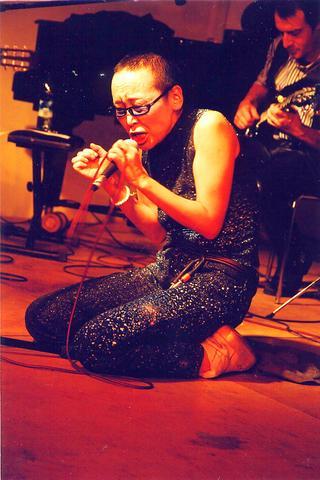
Namtchylak hails from Tuva and comes this week to Taipei for two concerts -- one at the Zhongshan Hall and another at Corridor Cafe in the NTU Gymnasium -- and one music workshop, starting tomorrow.
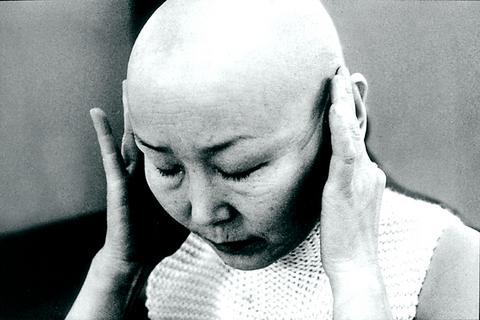
PHOTO COURTESY OF THE ARTIST
For Taipei audiences, her show will be a rare chance to enjoy music while imagining the broad coniferous woods, the grasslands and the deserts of Tuva without flying all the way to the remote country located at the border of Siberia and Mongolia.
"For me, music has no boundaries. Especially for a time like now, it becomes more possible for us to let music dialogue with each other, crossing the realm of time, space and cultures," Namtchylak said in an interview from China.
Born in the Republic of Tuva in a family of nomadic ancestry, Namtchylak grew up singing and later studied vocals in Moscow. Apart from classical training, she also learned traditional Tuvan throat-singing (khoomei) and Tibetan Buddhist singing. In 1989, she first crossed into the European avant-garde improvisatory music scene, dedicating herself to expanding the potential of throat-singing in combination with various musical styles. The same year she worked and toured with former Soviet Union avant-garde jazz band Tri-O.
Since then, she's spent the past 15 years traveling around the globe spreading her unique sound that combines Tuvan throat-singing with various vocal techniques under the broad framework of jazz, improvisation, experimental and electronic music.
Namtchylak, who has 30 albums to her name, has worked with many outstanding musicians such as Peter Kowald, Ned Rothernberg, Evan Parker, William Parker, Hamid Drake, Djivan Gasparian, Otomo Yoshihide and Hakutobo.
Being one of the pioneers bringing Tuvan music to the Western world, Namtchylak is ironically not embraced by all her Tuvan countrymen.
Throat-singing is a special technique in which two notes are sung at the same time. There is a very strict gender taboo on throat singing in Tuva, restricting it traditionally to men only. In Tuva, Mongolia and Central Asian countries, it is believed that throat-singing leads to sterility in women.
Namchylak not only broke the tradition of "no throat-singing for women," but also having spent two decades living in the West, she is viewed at home as somewhat of a traitor of her country's traditional values.
In 1997, a few days before her 40th birthday, Namtchylak was physically assaulted and hospitalized in Moscow by a group of people claiming to be Tuvans.
The 2001 album Time Out was released after her rehabilitation from the assault. She wrote in the CD that the album is dedicated to Tuva and its people.
"I hope one day my fellow countrymen can understand, that I am an artist belonging to the whole world. The music I create has no boundaries," she said.
In a way, the allure of Namtchylak's music does not lie in her vocal virtuosity but her remaining true to the spirit of experimentation and breaking boundaries. For her two Taipei concerts, audiences will be able to appreciate just such a spirit. She is expected to perform tunes from her two well-received albums, Stepmother City (2000) and Who Stole the Sky (2003).
Performance Notes:
What: Sainkho Namtchylak
When: Tomorrow 7:30pm
Where: Zhongshan Hall, Taipei, 98, Yanping S Rd (
Tickets: NT$800 (available at Arts Ticketing outlets)
When: Sunday, 8:30pm
Where: Corridor Cafe of NTU Sports Center
Tickets: NT$500 (at the door from 8:00pm includes one drink)
Sainkho Namtchylak Masterclass:
When: Sunday, 2pm to 4pm at T305 Experimental Theater, Department of Theater, Taipei National Arts University, 1, Xueyuan Rd, Beitou, Taipei (

Michael slides a sequin glove over the pop star’s tarnished legacy, shrouding Michael Jackson’s complications with a conventional biopic that, if you cover your ears, sounds great. Antoine Fuqua’s movie is sanctioned by Jackson’s estate and its producers include the estate’s executors. So it is, by its nature, a narrow, authorized perspective on Jackson. The film ends before the flood of allegations of sexual abuse of children, or Jackson’s own acknowledgment of sleeping alongside kids. Jackson and his estate have long maintained his innocence. In his only criminal trial, in 2005, Jackson was acquitted. Michael doesn’t even subtly nod to these facts.

Writing of the finds at the ancient iron-working site of Shihsanhang (十 三行) in New Taipei City’s Bali District (八里), archaeologist Tsang Cheng-hwa (臧振華) of the Academia Sinica’s Institute of History and Philology observes: “One bronze bowl gilded with gold, together with copper coins and fragments of Tang and Song ceramics, were also found. These provide evidence for early contact between Taiwan aborigines and Chinese.” The Shihsanhang Web site from the Ministry of Culture says of the finds: “They were evidence that the residents of the area had a close trading relation with Chinese civilians, as the coins can be

The March/April volume of Foreign Affairs, long a purveyor of pro-China pablum, offered up another irksome Beijing-speak on the issues and solutions for the problems vexing the People’s Republic of China (PRC) and the US: “America and China at the Edge of Ruin: A Last Chance to Step Back From the Brink” rang the provocative title, by David M. Lampton and Wang Jisi (王緝思). If one ever wants to describe what went wrong with US-PRC relations, the career of Wang Jisi is a good place to start. Wang has extensive experience in the US and the West. He was a visiting

The January 2028 presidential election is already stirring to life. In seven or eight months, the primary season will kick into high gear following this November’s local elections. By this point next year, we will likely know the Democratic Progressive Party (DPP) candidate and whether the Taiwan People’s Party (TPP) will be fielding a candidate. Also around this time, the Chinese Nationalist Party (KMT) will either have already completed their primary, or it will be heading into the final stretch. By next summer, the presidential race will be in high gear. The big question is who will be the KMT’s


 RSS
RSS