


Commercial hunting of baby seals is back and even bigger than when it stirred a global outcry two decades ago.
Horrified by the clubbing of adorable infant harp seals, animal rights advocates swayed public opinion against the hunt. Environmentalists joined the campaign, fearing the species was being depleted. World sales collapsed. Even Canada reacted with revulsion and began stiffening regulations on the kill.
Now, Canada has lifted the quota to a rate unheard of in a half century, buoyed by brand-new markets in Russia and Poland, and changing environmental calculations. A recovering market has turned into a quiet boom.
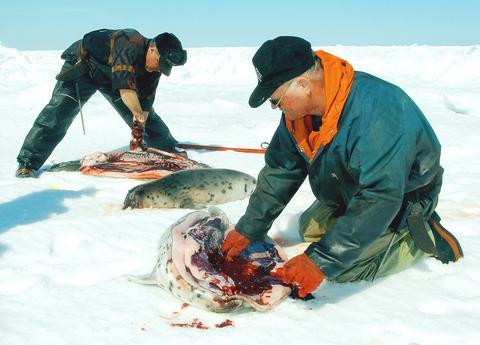
PHOTO: NY TIMES
Here on ice patches of the Gulf of St. Lawrence, the hunt looks nearly as brutal as ever. For as far as the eye can see, dozens of burly men bearing clubs roam the ice in snowmobiles and spiked boots in search of silvery young harp seals. With one or two blows to the head, they crush the skulls, sometimes leaving the young animals in convulsions. The men drag the bodies to waiting fishing vessels or skin them on the spot, leaving a crisscross of bloody trails on the slowly melting ice.
On the trawler Manon Yvon, one hunter, Jocelyn Theriault, 35, said, "My father hunted for 45 years, so I was born with the seal." His fellow hunters utter a sarcastic "Welcome aboard" as they throw the fresh skins on their 20m boat. "We do it for the money," Theriault said, "but it's also a tradition in our blood."
Animal rights advocates aroused the world in the 1970s and 1980s with grim films of Canadian seal hunters clubbing white-coated seal pups not yet weaned off their mother's milk and then skinning some alive. That campaign -- complete with photographs of Brigitte Bardot snuggling an infant seal -- succeeded in shutting down American and European markets and forcing a virtual collapse of the hunt.
But over the last six years, Canada's seal hunt, by far the world's largest and commercially most valuable, has undergone a gradual revival that has virtually escaped world attention. That trend is making an extraordinary jump this year, when the federal government will allow the killing of up to 350,000 baby harp seals, or more than one in three born, largely for their valuable fur.
That is an increase of more than 100,000 from recent years and the largest number hunted in at least a half century.
Tough new rules
Rising prices for the skins, and contentions that the growing seal population is contributing to a shrinking fish population, have eased the revival of an industry once roundly seen as barbaric. Meanwhile, tougher hunting rules, including stiffer regulations to avert skinning the seals alive, have muted the effort to stop the hunt and eased the consciences of Canadians.
"This slaughter that everyone thinks has disappeared is back with a vengeance," said Rebecca Aldworth, an anti-hunt advocate with the International Fund for Animal Welfare.
A majority of the seals killed are under a month old, she said, and "at that age, the seals haven't eaten their first solid foods and have not learned to swim, so they have no escape from the hunters."
The seal hunt never completely shut down. After the US banned the importation of all seal products in 1972 and the European Union banned the importation of the white pelts of the youngest pups in 1983, killings fell to as low as 15,000 harp seals in 1985, mostly for meat and local handicrafts.
Embarrassed by all the publicity accusing Canada of inhumane treatment of animals, the government banned killing whitecoats -- the youngest pups up to 12 days old. Now only the seals who have shed their white coats and become "beaters," at about three weeks old, are killed in these waters for their black-spotted silvery fur. The killing of these young seals has so far raised fewer hackles, although critics say hunting methods have not been substantially changed.
The surprising rebound of the hunt off the Iles de la Madeleine and the northern coast of Newfoundland, where the harp seals migrate south from the Arctic every spring to give birth and then mate again, results in large part from a robust revival in the price of sealskin.
Seal products remain banned in the US, and they find only limited acceptance in most of Western Europe. But new markets have emerged in Russia, Ukraine and Poland, with a fashion trend for sealskin hats and accessories. Fur experts expect the Chinese market to grow, perhaps raising prices even higher.
"Markets are good, acceptance is growing and prices are well up," said Tina Fagen, executive director of the Canadian Sealers Association. She said the price for a top-grade harp sealskin had more than doubled since 2001, to the equivalent of US$42, approaching the prices of the early 1970s.
But the revival is also made possible by a Canadian seal population that was replenished during the long hunting slump. The Canadian harp seal population has tripled in size since 1970, according to the Department of Fisheries and Oceans, to more than five million today.
Fishermen contend that the abundance of seals is hindering a revival of shrinking cod stocks since each adult seal eats an estimated tonne of sea life annually. The fishermen get support from politicians who want to help revive economically depressed regions of Canada, and some scientists say their position is reasonable.
Muted outcry
Animal rights advocates are revving up a campaign against the hunt, reviving calls for a tourism boycott of Canada and flying journalists in a helicopter over the breaking ice fields to photograph hunters killing the seals.
A new generation of celebrities has taken up the cause, including Paris Hilton, Christina Applegate and Nick Carter of the Backstreet Boys pop group. At the last Sundance Film Festival, some people wore a new T-shirt that said, "Club sandwiches, not seals."
But so far the outrage has not echoed the way it once did, in part because Canada outlawed the killing of the youngest pups to follow Western European import guidelines and stiffened regulations and enforcement to ensure that seals are killed quickly and not skinned alive. The government requires novice seal hunters to get an assistant's license and train under the supervision of veteran hunters for two years before qualifying for a professional license.
The government this year added a requirement that hunters thoroughly examine the skull of the seal or touch the eyes of animal to test for reflexes to guarantee that a seal is brain dead before skinning.
"The industry needed to be cleaned up and it was, though perceptions persist," said Roger Simon, the Department of Fisheries and Oceans area director for the Iles de la Madeleine.
Some prominent environmental groups that opposed the hunt in years past because of concerns over the sustainability of the Canadian harp seal population have dropped their active opposition. Greenpeace, once one of the most active groups against the hunt, now says it is satisfied that Canada is not allowing infant whitecoat seals to be killed.
But Mads Christensen, a Greenpeace seal expert, said he was concerned about this year's large hunt. "We don't have enough science, and that calls for caution," he added.
Canadian officials say they will regularly review the seal population and adjust the hunt accordingly. "If you are going to have an annual harvest you have to maintain a sustainable number," said Geoff Regan, the minister of fisheries and oceans, in an interview. "We are going to come up with these numbers on the basis of what the herd can sustain."
Seal hunting is worth about US$30 million annually to the Newfoundland economy, which has been punished by the collapse of the cod fishery. About 5,000 seal hunters and 350 plant workers who process skins rely on the industry. Hundreds more hunting jobs are created in Quebec and Nova Scotia.
"I love it that the market is back," said Jason Spence, the 32-year-old captain of Ryan's Pride, a fishing boat that set sail from Newfoundland a few weeks ago for the seal hunt in the Gulf of St. Lawrence.
Arguing that hunting seals is no worse than "people taking the heads off chickens, butchering cows and butchering pigs," he added, "People are just trying to make a living."

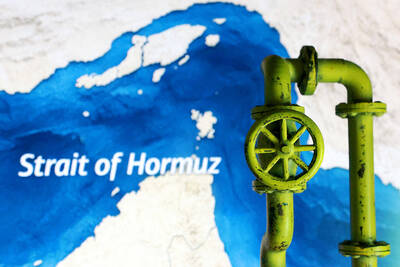
The US war on Iran has illuminated the deep interdependence of Asia on flows of oil and related items as raw materials that become the basis of modern human civilization. Australians and New Zealanders had a wake up call. The crisis also emphasizes how the Philippines is a swatch of islands linked by jet fuel. These revelations have deep implications for an invasion of Taiwan. Much of the commentary on the Taiwan scenario has looked at the disruptions to world trade, which will be in the trillions. However, the Iran war offers additional specific lessons for a Taiwan scenario. An insightful

The problem with Marx’s famous remark that history repeats itself, first as tragedy, the second time as farce, is that the first time is usually farce as well. This week Chinese Nationalist Party (KMT) Chair Cheng Li-wun (鄭麗文) made a pilgrimage to the People’s Republic of China (PRC) “to confer, converse and otherwise hob-nob” with Chinese Communist Party (CCP) officials. The visit was an instant international media hit, with major media reporting almost entirely shorn of context. “Taiwan’s main opposition leader landed in China Tuesday for a rare visit aimed at cross-strait ‘peace’”, crowed Agence-France Presse (AFP) from Shanghai. Rare!

What is the importance within the Chinese Nationalist Party (KMT) of the meeting between Xi Jinping (習近平), the leader Chinese Communist Party (CCP), and Cheng Li-wun (鄭麗文), the leader of the KMT? Local media is an excellent guide to determine how important — or unimportant — a news event is to the public. Taiwan has a vast online media ecosystem, and if a news item is gaining traction among readers, editors shift resources in near real time to boost coverage to meet the demand and drive up traffic. Cheng’s China trip is among the top headlines, but by no means

Sunflower movement superstar Lin Fei-fan (林飛帆) once quipped that the Democratic Progressive Party (DPP) could nominate a watermelon to run for Tainan mayor and win. Conversely, the DPP could run a living saint for mayor in Taipei and still lose. In 2022, the DPP ran with the closest thing to a living saint they could find: former Minister of Health and Welfare Chen Shih-chung (陳時中). During the pandemic, his polling was astronomically high, with the approval of his performance reaching as high as 91 percent in one TVBS poll. He was such a phenomenon that people printed out pop-up cartoon


 RSS
RSS