


While the nation's poor showing on the international sporting scene continues to flummox sports-minded folk, athletics committees could do a lot worse than look at and learn from Taiwan's special needs sports associations that constantly manage to build medal winning teams.
Whether it's a regional table tennis competition, or an international athletics meet, Chinese Taipei's paraplegic, deaf and mentally handicapped athletes rarely come home empty handed.
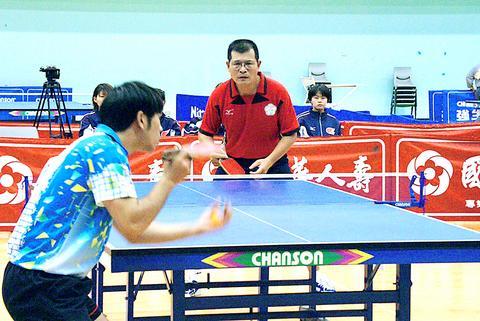
PHOTO COURTESY OF THE CHINESE TAIPEI SPORTS ASSOCIATION OF THE D
Since 1992 -- the year the International Olympic Committee (IOC) recognized Taiwan's handicapped sports associations -- the Chinese Taipei Sports Association of the Deaf (
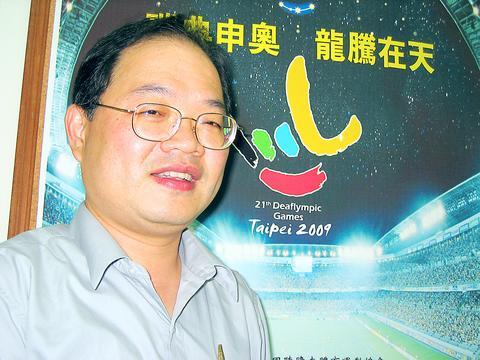
PHOTO: GAVIN PHIPPS, TAIPEI TIMES
The most recent of these successes took place at the Special Olympics World Games, which were held in Dublin, Ireland, in August. A 43-member squad brought home 10 gold, 13 silver and 11 bronze medals. The team's strongest fields proved to be bocce, aquatics and bowling.
"We started a special five-stage training program a year before we left for Dublin and it certainly paid off," said James Chang (
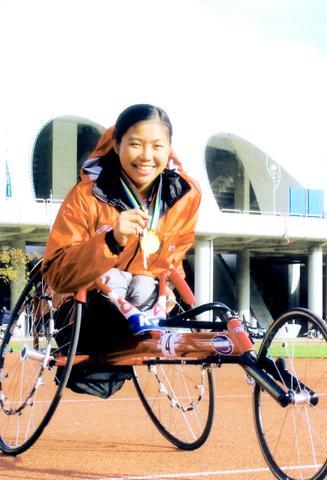
PHOTO COURTESY OF CHINESE TAIPEI PARALYMPICS COMMITTEE
However impressive these achievements, maybe they are being overlooked. Not that this has stopped the nation's handicapped sports men and women from building up a reputation as some of the finest physically and mentally impaired athletes in the world. This is a status that, according to Lai Fau-hwan (
"The biggest problem has always been the fact that non-handicapped [Taiwanese] put far too much emphasis on being a hero and winning rather then simply participating," Lai said. "I look at it differently. It's not about winning, it's about physical well-being, enjoyment and involvement."
A graduate of Taiwan Normal University's faculty of Physical Education, Lai lost his left leg in motorcycle accident in 1979. His prosthetic limb didn't stop him becoming one of the nation's first paraplegic gold medal winners.
Lai entered the record books at the 1989 Far East and South Pacific Games for the Disabled (FESPIC) in Kobe, Japan, winning gold in the discus and javelin and silver in the shot putt. On his return to Taiwan, Lai was greeted to a hero's welcome and even honored at a special reception by then president Lee Teng-hui (李登輝).
On taking over as director of the Chinese Taipei Paralympics Committee in 1992, Lai's first task was to secure funding for the cash-strapped organization.
Although government funding was not forthcoming for the first three years of Lai's tenure, in 1995, the government finally caved in and donated NT$10million to the committee for training and education programs and travel expenses.
"It was a real fight to get the funding in the beginning. I don't think the government considered [handicapped] sports worthy of funding," said the committee director. "It's gotten a lot better. Society's opinions about us and what we can achieve, given the right support, has changed for the better."
According to Lai, since President Chen Shui-bian (陳水扁) began his term in office, acquisition of annual funds for the paralympics team has got easier. Instead of an annual budget, funding is based upon the committee's sporting calendar.
Due to its participation in the upcoming Wheelchair Games in Christchurch, New Zealand, in October, this year's budget weighed in at just over NT$20million. With the cash, Lai said he was confident Taiwan's paralympic team would continue to prove its medal winning mettle in track and field events, table tennis and power lifting.
"There might be no fixed annual budget, but the funding we do get is enough and enables us to attend more competitions, which in turn means we are in a constant state of improvement," Lai said.
Receiving slightly less funding -- roughly NT$5million per annum -- the Chinese Taipei Sports Association of the Deaf has also made its mark on the international sporting scene; athletics, aquatics and table-tennis being the three areas in which the associations excels. Deaf athletes are not permitted by IOC rules to participate in sports that involve physical contact such as judo and wrestling for safety reasons.
Deaflympic success might have eluded the team, but after participating in only three Asian Pacific Games for the Deaf since 1996 the Chinese Taipei Sports Association of the Deaf is currently lying second in the overall Asian standings. Its behemoth cross-strait rival China is third with 22 gold medals to Taiwan's 24.
"When you look at the numbers of those eligible to participate in deaf games in China for example, then Taiwan's achievement is fantastic," said Chao Yu-ping (
Along with beating China into second place in the Asian rankings, Taiwan's deaf athletes have also enjoyed the prestige of hosting the Deaflympics. In 2000 the sixth Asian Pacific Games for the Deaf was held in Taipei. The event saw Taiwan placing second to Japan by a margin of only three silver medals.
The association was recently given another boost after Taiwan won the rights to host the 2009 Deaflympics, which will be the first time the event has ever been held in an Asian country since its inception in 1924.
Although Taiwan's handicapped athletes are all amateurs, those athletes chosen to represent their country still take international competition very seriously. Along with its regular coaching sessions, the Chinese Taipei Paralympics Committee has recently taken to using sports psychologists in order to enhance performance. Also, members of the paralympic squad have been visiting the Chinese Culture University's Graduate Institute of Sport Coaching Science (
Wired up to an array of specially adapted exercise machines, faculty members such as Professor Jasson Chiang (
"We have specially adapted machines on which we can plot the handicapped athletes' physiology. With the coaches present we map out a training schedule that best suits each particular individual," said Chiang. "Unlike non-handicapped athletes, each one has his/her restrictions and own needs. We haven't been doing it long and we're still learning, but it's certainly made a difference, especially to the younger athletes."
Regardless of their physical disparities and amateur status, Taiwan's paraplegic, deaf and mentally handicapped teams haven't avoided the irksome shenanigans of Beijing that take place at international sports meets. Old rivalries still run deep, as Taiwan's paralympic team discovered nine years ago.
The slap in the face took place at the 1994 FESPIC Games in Beijing after a stadium announcer at the awards ceremony referred to Taiwan as "China Taipei" as opposed to the officially IOC recognized moniker of Chinese Taipei.
"I told them in no uncertain terms that if they didn't correct the mistake and announce [our] name in accordance with IOC rules that we would boycott the awards ceremony," said the paralympic committee director with a smirk. "Whether it was deliberate or not I don't know. They said it again properly, though and we took to the podium with the other teams."
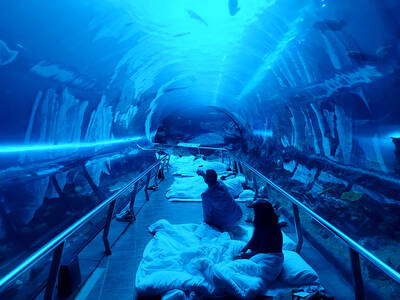
We lay transfixed under our blankets as the silhouettes of manta rays temporarily eclipsed the moon above us, and flickers of shadow at our feet revealed smaller fish darting in and out of the shelter of the sunken ship. Unwilling to close our eyes against this magnificent spectacle, we continued to watch, oohing and aahing, until the darkness and the exhaustion of the day’s events finally caught up with us and we fell into a deep slumber. Falling asleep under 1.5 million gallons of seawater in relative comfort was undoubtedly the highlight of the weekend, but the rest of the tour

Youngdoung Tenzin is living history of modern Tibet. The Chinese government on Dec. 22 last year sanctioned him along with 19 other Canadians who were associated with the Canada Tibet Committee and the Uighur Rights Advocacy Project. A former political chair of the Canadian Tibetan Association of Ontario and community outreach manager for the Canada Tibet Committee, he is now a lecturer and researcher in Environmental Chemistry at the University of Toronto. “I was born into a nomadic Tibetan family in Tibet,” he says. “I came to India in 1999, when I was 11. I even met [His Holiness] the 14th the Dalai

Following the rollercoaster ride of 2025, next year is already shaping up to be dramatic. The ongoing constitutional crises and the nine-in-one local elections are already dominating the landscape. The constitutional crises are the ones to lose sleep over. Though much business is still being conducted, crucial items such as next year’s budget, civil servant pensions and the proposed eight-year NT$1.25 trillion (approx US$40 billion) special defense budget are still being contested. There are, however, two glimmers of hope. One is that the legally contested move by five of the eight grand justices on the Constitutional Court’s ad hoc move
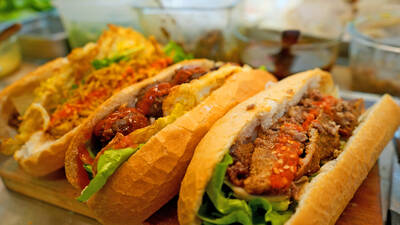
Stepping off the busy through-road at Yongan Market Station, lights flashing, horns honking, I turn down a small side street and into the warm embrace of my favorite hole-in-the-wall gem, the Hoi An Banh Mi shop (越南會安麵包), red flags and yellow lanterns waving outside. “Little sister, we were wondering where you’ve been, we haven’t seen you in ages!” the owners call out with a smile. It’s been seven days. The restaurant is run by Huang Jin-chuan (黃錦泉), who is married to a local, and her little sister Eva, who helps out on weekends, having also moved to New Taipei


 RSS
RSS