


Opened 11 years ago by Yang Man-yun (
Which is not really surprising, as Yang is a native of Malang, which according to Yang, is the home of Indonesian cooking. So genuine and highly regarded is the food that comes out of the Sate House's kitchen, in fact, that the place is a favorite with many of the better-connected Indonesian expats. On any given day high-ranking officials from the Indonesian Chamber of Commerce and the Indonesian Trade Office can been seen chowing down on traditional dishes in Yang's simple, yet comfortable dining area.
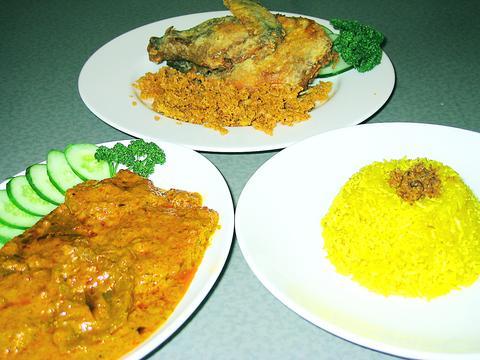
PHOTO: GAVIN PHIPPS, TAIPEI TIMES
In stark contrast to the multitude of SE Asian restaurants that litter Taipei with their glitzy interiors and same-same menus, the Sate House goes for a more homely look and an original menu.
A handful of obligatory Indonesian nick-knacks such as photographs and puppets adorn the walls, but apart from that the Sate House's interior is relatively sparse. Unlike the menu, which is packed with all sorts of mouthwatering Indonesian fair and the contrasting flavors of lemon grass, coconut milk, cilantro and various types of curry.
While there is no English on the menu -- preferring instead to use Chinese and Indonesian -- large photos of all the dishes make choosing your meal hassle-free. The menu is packed with everything from popular sates, which range in price from NT$180 to NT$250 and which come served with Yang's special sate dip, to lesser known dishes like udang pete (shrimp with rather potent Indonesian beans, NT$380).
To ensure all the dishes served up at the Sate House are as fresh as possible, Yang imports the multitude of spices needed on a weekly basis. All of which ensures that the food, be it ikan bakar (baked fish, NT$380 -- NT$450), rendang sapi (spicy beef, NT$220), ayum bumbu rujak (hot and spicy chicken, NT$220) or gado gado (Indonesian salad, NT$160), all tastes genuine.
Some of the Sate House's more popular dishes include udang goreng mentega (fried shrimp in black bean sauce, NT$380), Bali sapi (Bali beef, NT$220), tahu telor (egg and tofu salad, NT$160) and ayam goreng mentega (chicken in bean sauce, NT$280).
An interesting and highly unique way to finish off any meal at Sate House is to sample some of Yang's homemade durian-flavored ice cream (NT$80). While possibly not everyone's first choice of desserts, the Sate House's notoriously stinky fruit-flavored iced cream is, thankfully, odorless and remarkably tasty.

“China wants to unify with Taiwan at the lowest possible cost, and it currently believes that unification will become easier and less costly as time passes,” wrote Amanda Hsiao (蕭嫣然) and Bonnie Glaser in Foreign Affairs (“Why China Waits”) this month, describing how the People’s Republic of China (PRC) is playing the long game in its quest to seize Taiwan. This has been a favorite claim of many writers over the years, easy to argue because it is so trite. Very obviously, if the PRC isn’t attacking Taiwan, it is waiting. But for what? Hsiao and Glaser’s main point is trivial,

May 18 to May 24 Gathered on Yangtou Mountain (羊頭山) on Dec. 5, 1972, Taiwan’s hiking enthusiasts formally declared the formation of the “100 Peaks Club” (百岳俱樂部) and unveiled the final list of mountains. Famed mountaineer Lin Wen-an (林文安) led this effort for the Chinese Alpine Association (中華山岳協會). Working with other experienced climbers, he chose 100 peaks above 10,000 feet (3,048m) that featured triangulation points and varied in difficulty and character. The list sparked an alpine hiking craze, inspiring many to take up mountaineering and competing to “conquer” the summits. A common misconception is that the 100 Peaks represent Taiwan’s 100 tallest

Yesterday, the Democratic Progressive Party (DPP) nominated legislator Puma Shen (沈伯洋) as their Taipei mayoral candidate, the Chinese Nationalist Party (KMT) put their stamp of approval on Wei Ping-cheng (魏平政) as their candidate for Changhua County commissioner and former legislator Tsai Pi-ru (蔡壁如) of the Taiwan People’s Party (TPP) has begun the process to also run in Changhua, though she has not yet been formally nominated. All three news items are bizarre. The DPP has struggled with settling on a Taipei nominee. The only candidate who declared interest was Enoch Wu (吳怡農), but the party seemed determined to nominate anyone

In a sudden move last week, opposition lawmakers of the Chinese Nationalist Party (KMT) and Taiwan People’s Party (TPP) passed a NT$780 billion special defense budget as a preemptive measure to stop either Chinese leader Xi Jinping (習近平) or US President Donald Trump from blocking US arms sales to Taiwan at their summit in Beijing, said KMT heavyweight Jaw Shaw-kong (趙少康), speaking to the Taipei Foreign Correspondents Club on Wednesday night in Taipei. The 76-year-old Jaw, a political talk show host who ran as the KMT’s vice presidential candidate in 2024, says that he personally brokered the deal to resolve


 RSS
RSS