


"Unidentified Artistic Objects Invading Taipei In Droves" is the slogan of the new Taiwan Avant-garde Documenta exhibition (前衛文件展), or C02, as it's been nicknamed. The phrase is appropriate in the sense that the exhibition is unprecedentedly big and many of the works are so baffling in form, expression and intention, that one does not easily know what to make of them.
The exhibition sprawls across five venues in Taipei, and consists of 150 uncategorized works from 250 participants all over the country. Seventy-seven of the works were recommended by organizers, while the rest were selected from 135 submissions. As an open-submission exhibition, the participants are mostly young aspiring artists, with many undergraduates and first-time exhibiting artists among them. The media they use include film, performance, interactive installation, and whatever else one can think of.
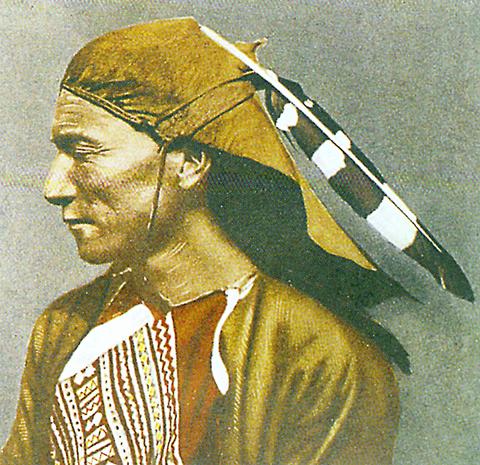
PHOTO COURTESY OF THE NATIONAL CULTURAL ASSOCIATION
The large scale of the first-time event, its timing, which coincides with the 2002 Taipei Biennial at the Taipei Fine Arts Museum, and its strong non-curatorial stance make it seem like a conscious rival to the Biennial. C02's organizer, the National Cultural Association (文化總會) and convener Lin Man-li's (林曼麗) apparent political affiliation with the DPP president as opposed to the Biennial's being organized under the administration of a KMT-led Taipei city government, only strengthen this suspicion.
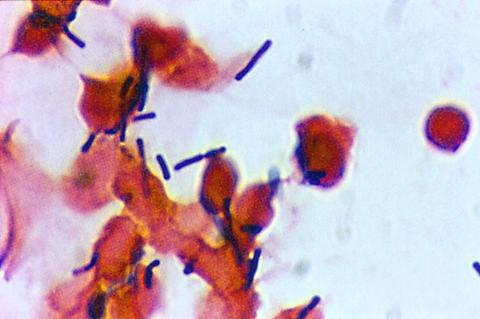
Politics aside, C02 does complement the Biennial well in providing those interested with an alternative selection of works which are not likely to show at the far more selective TFAM anytime soon.
One the interesting surprises is Green Corner's (綠色角落) Take a Rest at the Corner (落腳角落), a project by two art majors. For the piece, the group designed a logo, uniforms and advertisements for a cake and instant coffee stall, the kind so common you can find one on every block in Taiwan. Conceptually, it's probably the ideal work of art -- highly interactive, self-financing, and potentially an integral part of life. But is it a work of art?
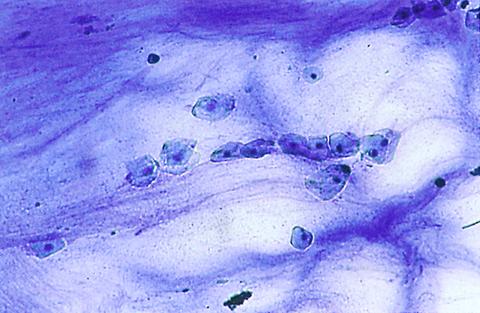
G8 Public Relationship and Consultation of Art Corp's (G8
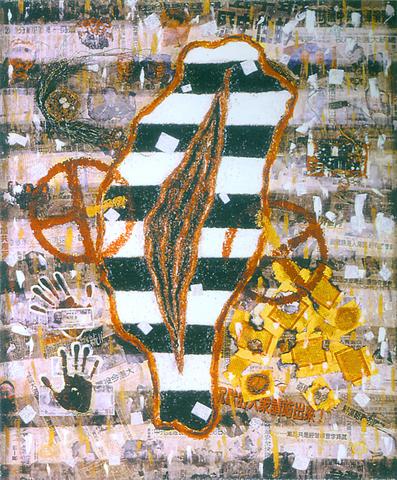
One of the more conceptually mature pieces is Diing-Wuu Wu Walis' (吳鼎武瓦歷斯) Invisible Project IV -- Taimerican Indian (Virtual Aboriginal People) (隱形計劃Ⅳ -- 虛擬原住民計劃), a subtle wake-up call to the disappearance of minority cultures in this age of globalization. Digital animation Gu (Grains) (穀) by Michael Eschenbach and Lin Chuan-chu (林銓居), of the Oob Interdisciplinary Group, is an intense meditation on the timeless theme of the human condition.
It's a shame that these are placed among works of various (and often dubious) quality, confusing viewers as to what the organizers' standards were in selecting them.
In fact, the sheer number of works, arranged in confusing mixtures of diverse styles, media and subjects, would easily exhaust the average viewer. Those who are patient enough to get through the strenuous task of viewing all of them are sure to find some jewels, as when people occasionally find treasures at a flea market. But is it worth the trouble?
To be sure, CO2's documentary function should be given due credit. In addition to encouraging public participation by providing free info cards of the woks for viewers to collect, the exhibition has set up an ambitious Web site: agora.tad.org.tw. The first of its kind in Taiwan, the site allows participating artists to take their work online with technical assistance from the organizers. Visitors can communicate with the artists via email. However, the end result remains to be seen as the Web site is still under construction.
C02 is also one of the few occasions in Taipei where artists from central and southern Taiwan participate with equal gusto. The presence of Tainan's alternative space Paint House (文賢油漆行) and Hsinchu's student group Chi-cry (七塊), among others, provides a much-needed cross-section of contemporary art in Taiwan.
Although C02's presentation is a bit messy and its selection excessively eclectic, its primitively liberal sprit is worth nurturing as an alternative to the sometimes factional curatorial exhibitions.
What: Taiwan Avant-garde Documenta (
Where: Huashan Arts District (華山藝文特區), the former American Culture Center (原美國文化中心), the former National Taipei Normal College's culture center (北師藝文中心) and the ground floor of the National Cultural Association (
When: Until Jan. 12, 2003
On the Web: www.tad.org.tw

As mega K-pop group BTS returns to the stage after a hiatus of more than three years, one major market is conspicuously missing from its 12-month world tour: China. The omission of one of the group’s biggest fan bases comes as no surprise. In fact, just the opposite would have been huge news. China has blocked most South Korean entertainment since 2016 under an unofficial ban that also restricts movies and the country’s popular TV dramas. For some Chinese, that means flying to Seoul to see their favorite groups perform — as many were expected to do for three shows opening
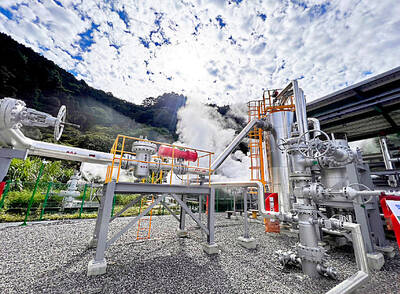
Taiwan’s semiconductor industry consumes electricity at rates that would strain most national grids. Taiwan Semiconductor Manufacturing Co (TSMC) alone accounted for more than 9 percent, or 2,590 megawatts (MW), of the nation’s power demand last year. The factories that produce chips for the world’s phones and servers run around the clock. They cannot tolerate blackouts. Yet Taiwan imports 97 percent of its energy, with liquefied natural gas reserves measured in days. Underground, Taiwan has options. Studies from National Taiwan University estimate recoverable geothermal resources at more than 33,000 MW. Current installed capacity stands below 10 MW. OBSTACLES Despite Taiwan’s significant geothermal potential, the

In our discussions of tourism in Taiwan we often criticize the government’s addiction to promoting food and shopping, while ignoring Taiwan’s underdeveloped trekking and adventure travel opportunities. This discussion, however, is decidedly land-focused. When was the last time a port entered into it? Last week I encountered journalist and travel writer Cameron Dueck, who had sailed to Taiwan in 2023-24, and was full of tales. Like everyone who visits, he and his partner Fiona Ching loved our island nation and had nothing but wonderful experiences on land. But he had little positive to say about the way Taiwan has organized its
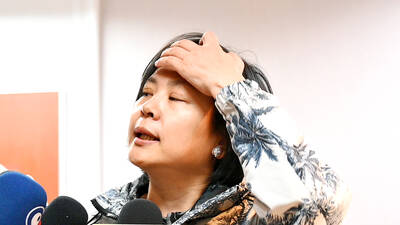
The entire Li Zhenxiu (李貞秀) saga has been an ugly, complicated mess. Born in China’s Hunan Province, she moved to work in Shenzhen, where she met her future Taiwanese husband. Most accounts have her arriving in Taiwan and marrying somewhere between 1993 and 1999. She built a successful career in Taiwan in the tech industry before founding her own company. She also served in high-ranking positions on various environmentally-focused tech associations. She says she was inspired by the founding of the Taiwan People’s Party (TPP) in 2019 by Ko Wen-je (柯文哲), and began volunteering for the party soon after. Ko


 RSS
RSS