


People do like to talk about the customs one is suppose to observe on Lunar New Year, but then that is probably because so few of them are now observed anymore. There is a quality of nostalgia about the quaint customs that gave the Lunar New Year its significance. But it is nostalgia that tends to emphasize how much of the complex symbolism, ritual and taboos have become irrelevant for the majority of modern Taiwanese.
But as with the many family reunions that are taking place all over the island, there is a little space for some nostalgia here about what Lunar New Year once entailed.
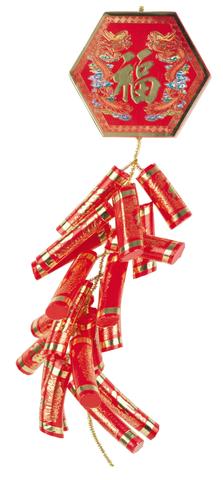
It is naturally important to get off to a good start, for your luck during the whole year may depend on it. Getting a horoscope was important for determining your actions on the first day of the New Year. Firecrackers would be lit at the "correct" time, and offerings of sweets placed at the family shrine. In order to make sure all this was done at the exact moment, families would stay up all night -- although this has become more an excuse to play mahjong all night.
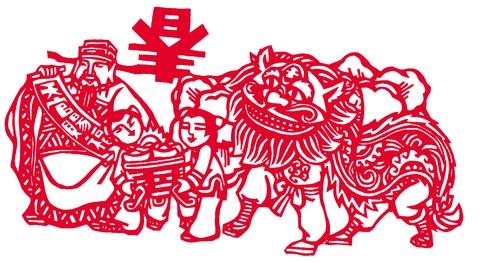
The next step is to make sure that you leave the house by the correct door. The correct direction is determined by your horoscope, but in these days of high-rise apartment, compliance can be problematical. The serving of sweets and "auspicious" foods such as red dates to relatives and friends is prescribed through this day, as is the repetition of auspicious phrases such as "eat red dates for a prosperous year" (
Taboos are also a big part of Lunar New Year's day, with bad luck associated with the accidental breaking of crockery. Most cooking of festival cakes is done before this day as burning these cakes by accident will bring bad luck. The use of white sugar is considered unlucky (white is a funeral color).
A wife's return to her family home comes second in importance only to a son's return to his. But, superstition has it that for a woman to return home on the first day of the New Year will make her family poor, this visit is normally avoided until the second or on the 12th day, which is specially set aside for this visit. Elaborate gifts were once given by the man's family to his wife's, all with abstruse symbolic meanings -- but much of the gift giving has now been replaced by the one gift serves all red packet and hongpao (
Traditionally, the third day of New Year was a "red dog day" (赤狗日), considered unlucky for doing virtually anything other than sleeping or gambling at home. Leaving the house at all was to doom the family to penury for ever -- but with many company's opening for business on the fourth day, few now can afford the luxury of this enforced confinement and you'll see plenty of people out and about.
The third day of New Year, according to fable, is also the day of the mice's wedding (老鼠娶親), and in order to give the rodents a little privacy for their nuptials, an early night is prescribed for all. In some families, rice and salt would be scattered about the floor in a kind of red packet for the mice, although why you wanted to encourage the things has yet to be explained.
One the fourth day, the kitchen god, who was sent off to make his report to the emperor of heaven on the 24th day of the previous month, is welcomed back with due ceremony. In a traditional song about the New Year -- in the style of "On the first day of Christmas" -- "on the fourth day you eat your fill" (初四頓頓飽), but how this is distinguished for the excessive eating and drinking of the previous days isn't clear. In any case, the kitchen god is generally welcomed in the afternoon, as his arrival returns the family to a state of divine oversight.
It is on the fifth day of New Year that shops traditionally open for business after the festivities, in a flurry of firecracker explosions.
The sixth and seventh day pass in a relatively low key fashion, but this is just the run up to the nativity of the King of Heaven (天公生) on the ninth day, one of the most public events of the Lunar New Year -- which for much of its duration focuses on the home. The rites for the king of heaven are very solemn, and to make up for this, the tenth day is customarily also given over to feasting.
The 11th day is the day for the son-in-law to visit his wife's family (子婿日) and the 12th day the wife returns to the bosom of her family (歸寧). This formal visit to the in-laws naturally entails the consumption of much food and drink, so the 13th day is set aside for recovery and the eating of congee. But this is only the briefest of breaks before the commencement of the lantern festival (元宵節) on the 14th, which brings the almost month-long celebrations of the Lunar New Year -- which began at the winter solstice -- to an end.
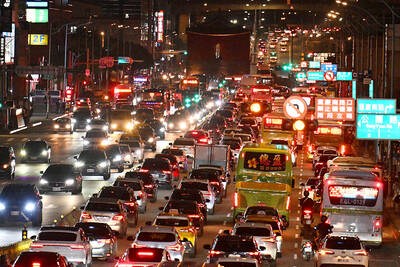
By global standards, the traffic congestion that afflicts Taiwan’s urban areas isn’t horrific. But nor is it something the country can be proud of. According to TomTom, a Dutch developer of location and navigation technologies, last year Taiwan was the sixth most congested country in Asia. Of the 492 towns and cities included in its rankings last year, Taipei was the 74th most congested. Taoyuan ranked 105th, while Hsinchu County (121st), Taichung (142nd), Tainan (173rd), New Taipei City (227th), Kaohsiung (241st) and Keelung (302nd) also featured on the list. Four Japanese cities have slower traffic than Taipei. (Seoul, which has some
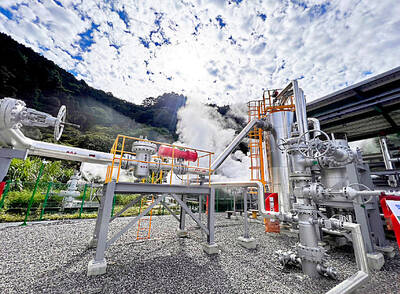
Taiwan’s semiconductor industry consumes electricity at rates that would strain most national grids. Taiwan Semiconductor Manufacturing Co (TSMC) alone accounted for more than 9 percent, or 2,590 megawatts (MW), of the nation’s power demand last year. The factories that produce chips for the world’s phones and servers run around the clock. They cannot tolerate blackouts. Yet Taiwan imports 97 percent of its energy, with liquefied natural gas reserves measured in days. Underground, Taiwan has options. Studies from National Taiwan University estimate recoverable geothermal resources at more than 33,000 MW. Current installed capacity stands below 10 MW. OBSTACLES Despite Taiwan’s significant geothermal potential, the

In our discussions of tourism in Taiwan we often criticize the government’s addiction to promoting food and shopping, while ignoring Taiwan’s underdeveloped trekking and adventure travel opportunities. This discussion, however, is decidedly land-focused. When was the last time a port entered into it? Last week I encountered journalist and travel writer Cameron Dueck, who had sailed to Taiwan in 2023-24, and was full of tales. Like everyone who visits, he and his partner Fiona Ching loved our island nation and had nothing but wonderful experiences on land. But he had little positive to say about the way Taiwan has organized its
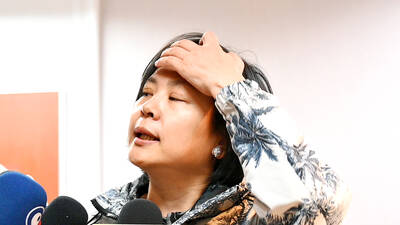
The entire Li Zhenxiu (李貞秀) saga has been an ugly, complicated mess. Born in China’s Hunan Province, she moved to work in Shenzhen, where she met her future Taiwanese husband. Most accounts have her arriving in Taiwan and marrying somewhere between 1993 and 1999. She built a successful career in Taiwan in the tech industry before founding her own company. She also served in high-ranking positions on various environmentally-focused tech associations. She says she was inspired by the founding of the Taiwan People’s Party (TPP) in 2019 by Ko Wen-je (柯文哲), and began volunteering for the party soon after. Ko


 RSS
RSS