


Buddhism, even the branch of it called Ch'an (禪) that is the subject of this book, mustn't be allowed to get away unchallenged with its implicit claim to be the most aristocratic of religious systems. It's true that it does seem to be ultimately serene. With its dedication to a sublime nothingness, and its absence of any creed involving miracles or angry gods who need to be placated with blood sacrifices, it presents relatively few obstacles to the modern mind.
But there are other views. Evelyn Waugh, the Catholic novelist, had a character in Helena, his story set in the Roman empire in the early years of Christianity, saying that Byzantium was full of fashionable teachers from the East peddling different ways of controlling your breathing. This could be California today, where Buddhism is a New Age cult, and Ch'an no doubt a particularly exclusive version of it. It may appear charmingly uplifting at first, but the reality of its practice is hard indeed, and involves the rejection of a vast range of other mental activities and attitudes to life.
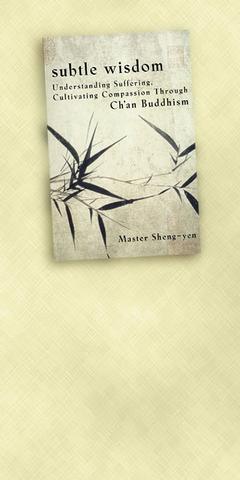
Master Sheng-yen (聖嚴法師) is among Taiwan's most celebrated citizens. A renowned Ch'an master, he has, for many devotees, an eminence and authority equivalent to that of the Dalai Lama.
Most Westerners know Ch'an under its Japanese name of Zen, associated in the popular mind with abbots striking meditating devotees with wooden planks to induce instant enlightenment, and contemplation of such mysteries as the sound of one hand clapping.
So what is the real essence of Ch'an? What distinguishes it from Buddhism as a whole? Simple answers in such an esoteric area are not easy to come by, even in a clear and plain-speaking handbook such as this one. But it would seem that Ch'an simultaneously simplifies and seeks to go beyond traditional Buddhist practice, valuing meditation as a route to ever greater freedom from attachment, and always keeping open the possibility of enlightenment directly achieved in a single moment of supreme vision.
Needless to say, Ch'an is very austere, and Westerners especially are likely to misunderstand it. As Master Sheng Yen puts it, "Sometimes the mind experiences something that it takes to be enlightenment, but it is just the ego in a very happy state. It is not necessarily the narrow, selfish ego. The ego may even be identified with the universe as a whole or with divinity. But it is still the ego and not Buddha nature, which is the nature of emptiness."
There are interesting autobiographical elements in this book. Master Sheng-yen relates how, as a child in China, he was both sickly and a late-developer. He did not speak until he was seven, and didn't start learning to write until he was nine. As a student monk in Shanghai in 1949 when the communists were approaching, he had the option either of joining their army or the Kuomintang's. He chose the latter, and soon was crossing with them to Taiwan.
Sheng-yen spent ten years in the Taiwanese army. There he managed to maintain a vegetarian diet, and avoided the possibility of having to shoot someone by opting for the Signals Corps. After demobilization, he entered on a solitary retreat in the south of the island that was to last six years. He lived in a hut (in which he wrote two books), with a small yard looking out over a cliff. His one meal a day was of wild potato leaves which he grew himself.
This degree of abnegation, though exceptional, isn't unique. The Indian monk who brought the meditation techniques of Ch'an to China in the fifth century is reputed to have meditated in a Chinese mountain cave for nine years.
More recently, Master Sheng-yen has been active in expanding and promoting the Dharma Drum Mountain (
The author (or a translator -- a number of people, many from the Ch'an Meditation Center in New York where Sheng-yen teaches, are credited in the book, one with doing "much of the translation") does use one rather annoying writing technique. This is to alternate "he" and "she" when writing about an unidentified or typical person. It's something gender radicals have been encouraging for some time, in the ostensible interests of justice to women, but it is most unnatural in English. Traditionally, "he" can in some contexts carry the meaning "anyone," and even "they" is preferable to the usage this book employs.
Otherwise, this is a lucid text, entirely lacking in obscure religious jargon. The English is unaffected and direct, just like Ch'an itself, you feel.
Nevertheless, intrinsic to the Buddhist system is a belief in reincarnation. The poor are poor largely because they are atoning for sins committed in an earlier existence -- a belief Master Sheng-yen repeats, though with qualifications. Not many modern educated people are going to be happy with this. Meditation, therefore, may be a useful practice to lift us out of the confusion of life, and reconcile us to some degree with our inescapable mortality. But we aren't, as a result, obliged to buy the entire package.
And attractive as Buddhism is, it shouldn't be forgotten that unbelief has its heroes as well. It takes bravery to think that only oblivion awaits us after death. Though few people will admit to it, this has claims to be the main Western tradition of modern times, say the last 300 years.
Georges Perec, a modernist French novelist, once left a note outside his room in the Himalayan region of Ladakh for the English writer Andrew Harvey, who was at the time becoming involved with Buddhism. Don't get drawn into all this negativity and non-being, was his advice.
This didn't mean that Perec was advocating despair, or cynicism, or even anything approaching a conventional life. He had, for example, himself just completed the self-imposed task of writing an entire novel without once using the letter "e." His point instead was that there are many different kinds of nobility in the world. This is worth remembering, and a truth with which wise men everywhere would surely all agree -- the admirable and venerable Master Sheng-yen not excluded.
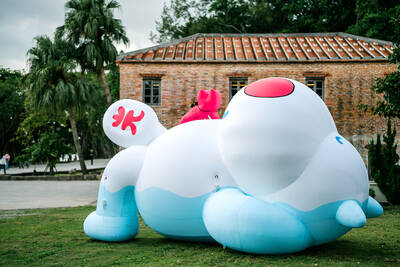
The primaries for this year’s nine-in-one local elections in November began early in this election cycle, starting last autumn. The local press has been full of tales of intrigue, betrayal, infighting and drama going back to the summer of 2024. This is not widely covered in the English-language press, and the nine-in-one elections are not well understood. The nine-in-one elections refer to the nine levels of local governments that go to the ballot, from the neighborhood and village borough chief level on up to the city mayor and county commissioner level. The main focus is on the 22 special municipality
The People’s Republic of China (PRC) invaded Vietnam in 1979, following a year of increasingly tense relations between the two states. Beijing viewed Vietnam’s close relations with Soviet Russia as a threat. One of the pretexts it used was the alleged mistreatment of the ethnic Chinese in Vietnam. Tension between the ethnic Chinese and governments in Vietnam had been ongoing for decades. The French used to play off the Vietnamese against the Chinese as a divide-and-rule strategy. The Saigon government in 1956 compelled all Vietnam-born Chinese to adopt Vietnamese citizenship. It also banned them from 11 trades they had previously
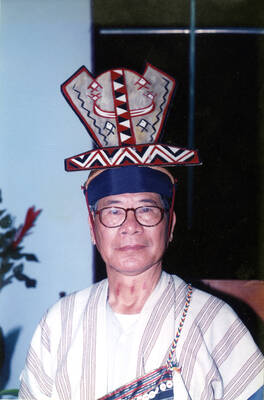
Jan. 12 to Jan. 18 At the start of an Indigenous heritage tour of Beitou District (北投) in Taipei, I was handed a sheet of paper titled Ritual Song for the Various Peoples of Tamsui (淡水各社祭祀歌). The lyrics were in Chinese with no literal meaning, accompanied by romanized pronunciation that sounded closer to Hoklo (commonly known as Taiwanese) than any Indigenous language. The translation explained that the song offered food and drink to one’s ancestors and wished for a bountiful harvest and deer hunting season. The program moved through sites related to the Ketagalan, a collective term for the

As devices from toys to cars get smarter, gadget makers are grappling with a shortage of memory needed for them to work. Dwindling supplies and soaring costs of Dynamic Random Access Memory (DRAM) that provides space for computers, smartphones and game consoles to run applications or multitask was a hot topic behind the scenes at the annual gadget extravaganza in Las Vegas. Once cheap and plentiful, DRAM — along with memory chips to simply store data — are in short supply because of the demand spikes from AI in everything from data centers to wearable devices. Samsung Electronics last week put out word


 RSS
RSS