


The past is a foreign country; they do things differently there.
We can see just how alien the past can be by taking my time machine for a short spin back 20 years.
For many readers, especially younger ones, time tourism will be a shock.
Illustration: Mountain people
In 1998, Amazon is a company struggling to convince people that there is a profitable future selling books online.
Facebook doesn’t exist. Neither does the iPhone.
The Russian intelligence service is run by Vladimir Putin.
Some things have not changed then.
Also in 1998 — and this will really surprise some people — Tony Blair is the most popular prime minister Britain has ever had.
He and other center-leftists of his type are dominant in the Western democracies.
Then-US president Bill Clinton, a “new” Democrat, is in his second term at the White House.
“New Labour” has recently surged to power with a parliamentary landslide in Britain. It will go on to win two further elections.
The neue mitte — the word new is much loved by this generation of social democrats — has been a winner for the Social Democratic Party of Germany’s (SPD) Gerhard Schroeder, who is embarking on the first of two stints as German chancellor.
The moderate left is in government in two-thirds of the nations that are members of the EU.
Their successful offer is broad support for free markets combined with good public services, a decent welfare state, internationalism and social liberalism.
This seems to be a magic formula both for the taking of power and the exercising of it.
At about this time, one of Blair’s senior advisers told me that they represented “a new common sense” so potent that neither the traditional conservative right nor the old socialist left could hope to compete with it.
How archaic that sounds when we return to this year. Just about everywhere you look, social democrats are being pulverized.
The latest example has been furnished by the populist earthquake in Italy, where Matteo Renzi’s Partito Democratico was smashed down to less than a fifth of the vote and the center-left came in third behind a right-wing bloc fronted by former Italian prime minister Silvio Berlusconi, who is banned from taking public office, and the Five Star Movement, which was founded by a man who is, literally, a comedian.
An even more dismal fate befell the French socialists when their candidate for president finished fifth with less than 7 percent of the vote.
They then went on to lose 250 of their 280 seats in the National Assembly.
When Germany went to the polls in the fall last year, the SPD, for decades the most powerful center-left party in Europe, recorded its worst result since the creation of the federal republic in 1949.
Even though its junior role in the previous “grand coalition” with German Chancellor Angela Merkel was electoral hemlock, the SPD has gone back into another one for fear that a fresh election would produce an even more dire result.
It is true that center-right parties have also been hemorrhaging support to the various insurgent brands of illiberal populists, demagogic nationalists and fascists.
The troubles of the center-right are scant consolation for the center-left because its crisis looks much more existential.
Social democrats neither head the government nor lead the opposition in Germany, Britain, France or Italy — Europe’s four largest economies.
The center-left was thrown out of power when Austria went to the polls and fell to a historical low in the most recent Spanish contest.
In Scandinavia, traditional heartland of European social democracy, they are in charge in just one nation.
The Czech social democrats and the Dutch Labour party have been marginalized by the voters. There are no social democrats at all in the Polish parliament.
Portugal’s social democratic government stands out because it is such a rarity.
Britain has exhibited this trend in its own eccentric way.
The social democrats who used to control the Labour Party have been replaced by people hailing from much further left along the spectrum.
Jeremy Corbyn’s leadership cadre has an ideology sufficiently to the taste of the Communist Party of Great Britain that it says it will not run candidates against Labour at the next election.
There is one thing to be said for the bleak place in which social democrats find themselves. They have time to reflect on what went wrong.
They were too often managerial and metropolitan with the result that they lost connection with segments of traditional support that felt condescended to by a cosmopolitan elite.
After the scarring electoral defeats at the hands of the right in the Thatcher-Reagan era, the center-left overcorrected in its approach toward markets.
They were too indulgent of the excesses of high finance in the buildup to the Great Crash of 2008 and have been duly punished since.
They were too mesmerized by the power of globalization and the dividends to be had from it; they paid too little attention to those who lost out or felt left behind.
Throw in stagnant incomes for many combined with conspicuous, and sometimes obscene, gains for those lucky enough to be rich in assets. Stir in surges in immigration and it has been a perfect storm.
Some argue that it is even grimmer.
Social democracy is not just in distress — it is defunct.
Hegemonic in 1998, it has become essentially obsolete. It is contended that the “third way” of the Blair era was only viable in “good times.”
The formula depended on strong and stable economic growth to satisfy the public desire to enjoy better services and welfare provision without paying too much more in tax.
That formula does not work when growth is anemic, money is tight and choices are much more stark.
Another gloomy view is that social democracy is the victim of a realignment that is replacing the traditional division between left and right with a politics more driven by identity and values.
A split between “open” and “closed” views of the world is polarizing population groups and opinion between nativist authoritarians and globalist liberals.
This is agony for social democrats because it cleaves their historical voting coalition of the working class and middle-class liberals.
Understanding their plight has been easier than finding ways to put themselves back in contention.
One approach is to try to woo voters away from populists by echoing elements of their messages.
Sweden’s ruling social democrats, who face an election this year, are fighting to stay in power with a strategy entitled: “Better welfare, law and order, and faster integration.”
The center-left in Denmark is taking this experiment further.
The Danish social democrats have made a hard swing to the right on immigration in an attempt to stop blue-collar voters going over to nationalists.
If-you-can’t-beat-the-populists-join-them is a strategy freighted with a lot of risks.
It is a sign of desperate times for the center-left that this is happening in Scandinavia, once the bastion of tolerant and open European social democracy.
In Britain, the Labour Party has just about managed to straddle the open/closed divide, but it helps to be in opposition where you can fudge the harder choices.
Labour will find it much tougher going if it should find itself in government.
There is a paradox about this crisis for social democracy.
The broad formula of the center-left still has appeal to many millions of voters.
There is little evidence that the modern electorate wants to embrace the heavy-metal socialism of a super-statist society. Nor can we detect a great clamor to live in a state-shrunk society of unfettered markets and devil-take-the-hindmost.
Many voters might have given up on social democrats, but they still like the idea of a regulated market economy with good public services and decent welfare protection.
This is the western Europe that social democrats were so influential in creating in the decades after the end of World War II.
Progressive taxation, equality of opportunity and the idea that the strong have a responsibility toward the weak are basic tenets of the center-left that have become embedded.
It was so successful that it could make social democrats of Conservatives as when Britain’s Conservative Party accepted the Labour-created National Health Service.
Witness also the rather social democratic way in which British Prime Minister Theresa May’s government is proposing interventions in the energy and housing markets.
Social democrats have arguably had more influence over the development of western Europe than any rival political movement. They created a world that electorates have, by and large, come to take for granted.
This might be part of their problem.
Fewer and fewer voters are old enough to have memories of how ghastly some of the alternatives can be.
When electorates get experience of what the snake oil peddled by the populists really tastes like, social democrats might be given an opportunity to be heard again.
They had better be ready with attractive things to say and compelling leaders to articulate them.
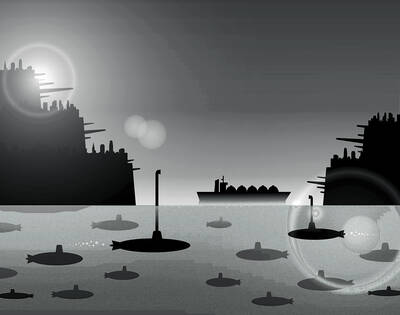
In the event of a war with China, Taiwan has some surprisingly tough defenses that could make it as difficult to tackle as a porcupine: A shoreline dotted with swamps, rocks and concrete barriers; conscription for all adult men; highways and airports that are built to double as hardened combat facilities. This porcupine has a soft underbelly, though, and the war in Iran is exposing it: energy. About 39,000 ships dock at Taiwan’s ports each year, more than the 30,000 that transit the Strait of Hormuz. About one-fifth of their inbound tonnage is coal, oil, refined fuels and liquefied natural gas (LNG),
On Monday, the day before Chinese Nationalist Party (KMT) Chairwoman Cheng Li-wun (鄭麗文) departed on her visit to China, the party released a promotional video titled “Only with peace can we ‘lie flat’” to highlight its desire to have peace across the Taiwan Strait. However, its use of the expression “lie flat” (tang ping, 躺平) drew sarcastic comments, with critics saying it sounded as if the party was “bowing down” to the Chinese Communist Party (CCP). Amid the controversy over the opposition parties blocking proposed defense budgets, Cheng departed for China after receiving an invitation from the CCP, with a meeting with

To counter the CCP’s escalating threats, Taiwan must build a national consensus and demonstrate the capability and the will to fight. The Chinese Communist Party (CCP) often leans on a seductive mantra to soften its threats, such as “Chinese do not kill Chinese.” The slogan is designed to frame territorial conquest (annexation) as a domestic family matter. A look at the historical ledger reveals a different truth. For the CCP, being labeled “family” has never been a guarantee of safety; it has been the primary prerequisite for state-sanctioned slaughter. From the forced starvation of 150,000 civilians at the Siege of Changchun
The two major opposition parties, the Chinese Nationalist Party (KMT) and the Taiwan People’s Party (TPP), jointly announced on Tuesday last week that former TPP lawmaker Chang Chi-kai (張啟楷) would be their joint candidate for Chiayi mayor, following polling conducted earlier this month. It is the first case of blue-white (KMT-TPP) cooperation in selecting a joint candidate under an agreement signed by their chairpersons last month. KMT and TPP supporters have blamed their 2024 presidential election loss on failing to decide on a joint candidate, which ended in a dramatic breakdown with participants pointing fingers, calling polls unfair, sobbing and walking


 RSS
RSS