


French President Emmanuel Macron invited Russian President Vladimir Putin to Paris as his first foreign guest, while US President Donald Trump is to attend this year’s Bastille Day celebrations. By reaching out to two world leaders who made no secret of their hope that he would never make it to the Elysee Palace, Macron has set the stage for a new and ambitious French foreign policy.
The message Macron is sending is that he will remain open to new opportunities for compromise — talking to anyone who is willing, but without glossing over disagreements. His foreign policy seeks to restore France’s central position on the world stage, while remaining firmly committed to Europe.
Macron’s foreign-policy effectiveness will depend on his ability to bring about a domestic economic turnaround — a lesson learned from Macron’s predecessor, former French president Francois Hollande.
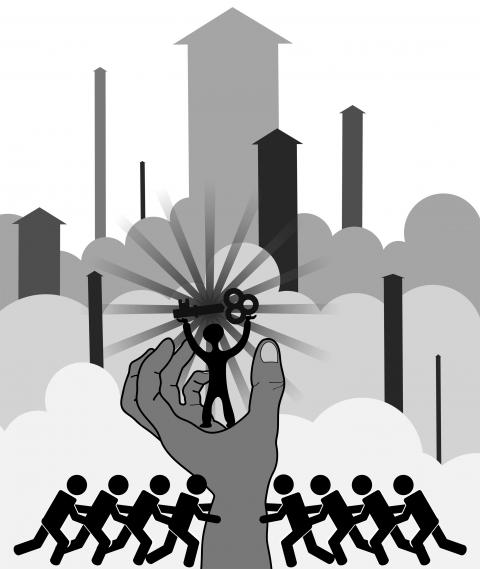
Illustration: Lance Liu
Beyond a military intervention against Muslim militants in Mali, Hollande achieved little on the international stage, precisely because he lacked credibility at home, owing to France’s economic weakness.
It is too early to tell whether Macron will succeed where Hollande failed, but it is already clear that Macron possesses some valuable skills and attributes that his predecessor lacked: undeniable charisma, an ability to connect with foreign leaders — thanks partly to his fluent English — a solid grasp of global issues and a drive to implement economic reform.
Macron will also benefit from external factors. For starters, the economic situation not only in France, but throughout Europe, has improved substantially.
Moreover, France and Germany seem to be converging on a large number of global issues. Add to that Britain’s self-isolation and Trump’s erratic “America first” polices, and Macron is in a strong position to establish himself as a key champion of multilateralism.
Of course, even if Macron does guide an economic turnaround, France will have neither the means nor the ambition to supplant the US on the world stage.
However, Macron does want France to exercise more influence over the international system — an ambition that is underscored by the way he addresses Putin and Trump.
Just a couple of weeks after his election, Macron criticized Russian state-owned media for employing “lying propaganda” to smear him during the campaign — while standing next to Putin himself. No French leader since former French president Charles de Gaulle would have dared to stand up to Russia in such a public way.
However, from Macron’s perspective, the disagreements that will shape the bilateral relationship had to be laid out and a clear power dynamic established, before dialogue with Russia could occur.
The major test of the Russia-France relationship lies in Syria — an issue that, so far, Macron has handled skillfully. He intentionally set aside the question of whether Syrian President Bashar al-Assad would remain in power (as Putin wants) or be deposed (as the US and others desire), but also made it clear that France would intervene militarily if al-Assad were to use chemical weapons again.
It is not yet clear whether Macron’s approach will succeed, but France has re-established itself, at least for now, as a player in Syria.
As for Trump, Macron’s disagreement with him mostly concerns multilateral issues. France and Europe place much stock in multilateralism, which supports burden-sharing. The Trump administration’s tendency toward trade protectionism — not to mention financial deregulation — is therefore a source of serious concern.
However, it is Trump’s commitment to withdraw from the Paris climate agreement that is most problematic to Macron, who plans to work with German Chancellor Angela Merkel to bring about a US reversal. If this effort succeeds, Macron will have established France as an effective advocate and practitioner of multilateralism.
Macron has another objective with regard to Trump — to prevent disagreements from undermining their ability to pursue shared interests, especially in the fight against terrorism.
In Syria, for example, the French and US positions are rather closely aligned, and Trump has already shown more willingness than his predecessor, former US president Barack Obama, to enforce a “red line” on the use of chemical weapons.
However, Trump’s Syria policy remains confused, with few clear lines having really been drawn, and significant discrepancies between the claims of Trump and his own Cabinet.
Of course, Trump’s threats of disengagement from NATO also worry France.
However, France has always sought to maintain a capacity for strategic autonomy and Macron hopes that the weakening of the US strategic guarantee will convince Europeans, who have long lagged on the establishment of a stronger common defense posture, to do the same.
Considerable economic, strategic and cultural obstacles to the emergence of a European defense posture no doubt remain, including among those within some French industrial circles who oppose open tenders for defense contracts, but there are signs of progress. Most notably, the European Commission has for the first time decided to offer European funding for key military programs, especially in research and development.
It will take time to marshal not just the money, but also, and more challenging, the political will.
However, rising uncertainty over the US’ reliability — together with the departure of the UK, which has long opposed European defense, from the EU — has already spurred Germany to acknowledge the need for progress and, of course, progress for Europe is progress for France, as Europe acts as a multiplier of its national power.
There is not yet a “Macron doctrine,” but his foreign policy goals are coming into focus — increase France’s credibility by reversing its economic decline; bolster the Franco-German axis in Europe; strengthen Europe’s role in the world; and engage with everyone.
It is a realist approach, but certainly not a cynical one.
Zaki Laidi is a professor of international relations at L’Institut d’Etudes Politiques de Paris.
Copyright: Project Syndicate
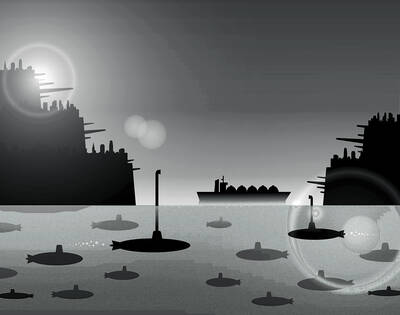
In the event of a war with China, Taiwan has some surprisingly tough defenses that could make it as difficult to tackle as a porcupine: A shoreline dotted with swamps, rocks and concrete barriers; conscription for all adult men; highways and airports that are built to double as hardened combat facilities. This porcupine has a soft underbelly, though, and the war in Iran is exposing it: energy. About 39,000 ships dock at Taiwan’s ports each year, more than the 30,000 that transit the Strait of Hormuz. About one-fifth of their inbound tonnage is coal, oil, refined fuels and liquefied natural gas (LNG),
On Monday, the day before Chinese Nationalist Party (KMT) Chairwoman Cheng Li-wun (鄭麗文) departed on her visit to China, the party released a promotional video titled “Only with peace can we ‘lie flat’” to highlight its desire to have peace across the Taiwan Strait. However, its use of the expression “lie flat” (tang ping, 躺平) drew sarcastic comments, with critics saying it sounded as if the party was “bowing down” to the Chinese Communist Party (CCP). Amid the controversy over the opposition parties blocking proposed defense budgets, Cheng departed for China after receiving an invitation from the CCP, with a meeting with
To counter the CCP’s escalating threats, Taiwan must build a national consensus and demonstrate the capability and the will to fight. The Chinese Communist Party (CCP) often leans on a seductive mantra to soften its threats, such as “Chinese do not kill Chinese.” The slogan is designed to frame territorial conquest (annexation) as a domestic family matter. A look at the historical ledger reveals a different truth. For the CCP, being labeled “family” has never been a guarantee of safety; it has been the primary prerequisite for state-sanctioned slaughter. From the forced starvation of 150,000 civilians at the Siege of Changchun
The two major opposition parties, the Chinese Nationalist Party (KMT) and the Taiwan People’s Party (TPP), jointly announced on Tuesday last week that former TPP lawmaker Chang Chi-kai (張啟楷) would be their joint candidate for Chiayi mayor, following polling conducted earlier this month. It is the first case of blue-white (KMT-TPP) cooperation in selecting a joint candidate under an agreement signed by their chairpersons last month. KMT and TPP supporters have blamed their 2024 presidential election loss on failing to decide on a joint candidate, which ended in a dramatic breakdown with participants pointing fingers, calling polls unfair, sobbing and walking


 RSS
RSS