


“America first,” thumps US President Donald Trump.
“Britain first,” say the advocates of Brexit.
“France first,” crows France’s Marine Le Pen and her National Front.

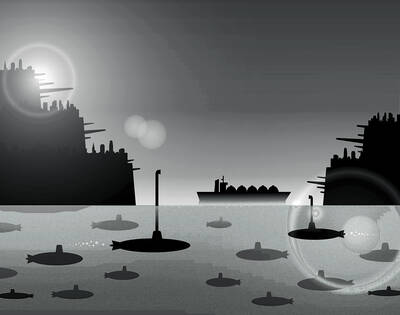
Illustration: Yusha
“Russia first,” proclaims Russian President Vladimir Putin’s Kremlin.
With so much emphasis on national sovereignty nowadays, globalization appears doomed. It is not. The struggle playing out today is not one of globalism versus anti-globalism.
Rather, the world is poised between two models of integration: One is multilateral and internationalist; the other is bilateral and imperialist. Throughout the modern age, the world has seesawed between them.
Since 1945, internationalists have had the upper hand. They advocate cooperation and multilateral institutions to promote global public goods like peace, security, financial stability and environmental sustainability.
Theirs is a model that constrains national sovereignty by binding states to shared norms, conventions and treaties.
The year 2016 tipped the scales toward bilateralists, who regard national sovereignty as an end in itself. The fewer external constraints, the better: Peace and security result from a balance of great powers.
Theirs is a model that favors the strong and punishes the weak, and that rewards competitors at the expense of cooperators.
For most of the 19th century, integration was a hybrid of internationalism and imperialism. Free trade became gospel, mass migration was welcomed and countries embraced new global norms, like the First Geneva Convention, concluded in 1864 to cover the treatment of the sick and wounded on the battlefield.
Globalizers could also be bullies: The 1842 Treaty of Nanking between Britain and China subordinated the Middle Kingdom to the West. And bilateral imperialism’s ugliest face was reflected in Europeans’ carve-up of Africa into exclusive possessions.
In the most horrific period in human history, bilateralism had the upper hand. Between 1914 and 1945, the pursuit of national grandeur led to ruinous economic rivalry and mass violence.
The Wall Street crash of 1929 kicked the legs out from under a struggling international order. Country after country turned inward; by 1933, world trade had collapsed to one-third of its 1929 level.
Fueled by racism and fears of overcrowding, globalism turned predatory: Powerful countries imposed uneven trade pacts on neighbors and partners, or simply overran them.
Japan set its sights on Manchuria in 1931 to create a puppet state and invaded China in 1937.
The Soviets dealt with Russian borderlands in the same spirit. The Nazis forced treaties on weaker neighbors and seized others, then sought to depopulate Slavic lands to make way for Teutonic settlers.
The brutality of bilateralism prompted US president Franklin Delano Roosevelt and British prime minister Winston Churchill to draft the Atlantic Charter in 1941.
A blueprint for a post-war order, it declared that freedom was the cornerstone of peace and that bilateralism had to be curbed. No more grabbing. No more tariff bullying. Freedom of the seas.
What came of the Allies’ victory in World War II and the Atlantic Charter was a Global New Deal: By agreeing to play by international rules and institutions, countries could participate in the post-war bonanza.
European integration was at the core of this experiment in multilateral globalism; with Franco-German reconciliation, Europe, a chronic conflict zone, became a region of exemplary cooperators.
Restraining national sovereignty allowed global trade, investment and migration to buoy post-war prosperity. Billions escaped poverty. Relative peace was maintained.
However, the Global New Deal seems to have run its course. For too many people, the world became messy, risky, stultifying, and threatening — the opposite of what the Atlantic Charter envisioned.
After 1980, global integration was accompanied by rising domestic inequality. While the horizon of opportunities widened for educated cosmopolitans in big cities, the bonds between citizens weakened as national social contracts were dismantled.
As the blurring of global divides deepened domestic cleavages, the stage was set for bilateralists to come storming back. In the wings, leaders like Putin yearned for a return to a world of muscular sovereignty, unrestrained by multilateral niceties. They now have more company in key countries.
Two days after his inauguration, Trump announced that the US would have “another chance” to seize Iraqi oil. He then withdrew the US from the Trans-Pacific Partnership trade deal and vowed to renegotiate the North American Free Trade Agreement.
The future of the hard-won Paris climate agreement is now in doubt. Charges of currency manipulation and threats of protectionist measures have intensified. With the UK, which gave the world free trade in the 1840s, having now decided to go it alone, the old Atlantic Charter allies are putting national sovereignty ahead of global public goods.
Now the global spotlight turns to France and its looming presidential election. At stake is the sputtering Franco-German engine that has driven European integration and kept it at the center of the post-war multilateral system.
A victory for National Front presidential candidate Le Pen in early May would spell the end of the EU, leaving German Chancellor Angela Merkel as the final pillar of a crumbling world order.
Germany, the country most refashioned by post-1945 internationalism, would be its last bastion, surrounded by bilateralists in France, the UK and Russia, with its main patron, the US, in the hands of nativists.
Imagine the scene a few weeks after a Le Pen victory, when the G7 leaders gather in a gilded hotel in Taormina, Sicily, Italy. The US and Canada are feuding over NAFTA. The UK is squabbling with France and Germany over Brexit. Japan is reeling from the demise of the TPP.
And, as they turn their backs on global commitments, refugees, drowning by the boatload in the surrounding sea, provide an epitaph for a bygone era.
Jeremy Adelman is director of the Global History Lab at Princeton University. Anne-Laure Delatte is director of the Centre d’Etudes Prospectives et d’Informations Internationales in Paris.
Copyright: Project Syndicate
In the event of a war with China, Taiwan has some surprisingly tough defenses that could make it as difficult to tackle as a porcupine: A shoreline dotted with swamps, rocks and concrete barriers; conscription for all adult men; highways and airports that are built to double as hardened combat facilities. This porcupine has a soft underbelly, though, and the war in Iran is exposing it: energy. About 39,000 ships dock at Taiwan’s ports each year, more than the 30,000 that transit the Strait of Hormuz. About one-fifth of their inbound tonnage is coal, oil, refined fuels and liquefied natural gas (LNG),
On Monday, the day before Chinese Nationalist Party (KMT) Chairwoman Cheng Li-wun (鄭麗文) departed on her visit to China, the party released a promotional video titled “Only with peace can we ‘lie flat’” to highlight its desire to have peace across the Taiwan Strait. However, its use of the expression “lie flat” (tang ping, 躺平) drew sarcastic comments, with critics saying it sounded as if the party was “bowing down” to the Chinese Communist Party (CCP). Amid the controversy over the opposition parties blocking proposed defense budgets, Cheng departed for China after receiving an invitation from the CCP, with a meeting with
To counter the CCP’s escalating threats, Taiwan must build a national consensus and demonstrate the capability and the will to fight. The Chinese Communist Party (CCP) often leans on a seductive mantra to soften its threats, such as “Chinese do not kill Chinese.” The slogan is designed to frame territorial conquest (annexation) as a domestic family matter. A look at the historical ledger reveals a different truth. For the CCP, being labeled “family” has never been a guarantee of safety; it has been the primary prerequisite for state-sanctioned slaughter. From the forced starvation of 150,000 civilians at the Siege of Changchun
The two major opposition parties, the Chinese Nationalist Party (KMT) and the Taiwan People’s Party (TPP), jointly announced on Tuesday last week that former TPP lawmaker Chang Chi-kai (張啟楷) would be their joint candidate for Chiayi mayor, following polling conducted earlier this month. It is the first case of blue-white (KMT-TPP) cooperation in selecting a joint candidate under an agreement signed by their chairpersons last month. KMT and TPP supporters have blamed their 2024 presidential election loss on failing to decide on a joint candidate, which ended in a dramatic breakdown with participants pointing fingers, calling polls unfair, sobbing and walking


 RSS
RSS