


Taiwan’s post-war political pathology has turned into a social pathology. The casualties can be seen all around. Agricultural, rural society has given way to industrial, urban society, but there has been no corresponding transformation in law and order. This has all come about in a culture of anonymity and isolation and a preoccupation with taking what you can. get. Companies exhibit precious little corporate responsibility, and many major corporations are interested only in colluding with the politically powerful, their main partner-in-crime being the Chinese Nationalist Party (KMT).
Over the past year a number of food safety scandals have affected the nation, and this makes it abundantly clear that it is not only the state that is riddled with corruption and deceit and on the verge of collapse, but society itself is in danger. There are still faint glimmers of humanity here and there, but even they are at risk of being extinguished. Unless there is a collective awareness of the problems, so that the situation can be changed and improved, this once beautiful island is going to be taken to the dogs by a colonial power with its deception of representing the “motherland” since the end of World War II.
Taiwan is not a normal country. The people living here do not enjoy the status of the citizenry of a modern state. The public are all just consumers without citizenship. It is said that there are many families in Taiwan that do not have the wherewithal, or feel the need, to cook at home, and content themselves with eating out all the time, cobbling together three meals a day, saying that it is cheap and more convenient, eating in inexpensive restaurants and from night markets. This kind of family has lost much of a sense of what family life is and they do not have the ritualized culture that informs family life. More seriously, it is no longer only cheap food that is the problem, it now extends even to more established brands.
The fact that is is cheaper to eat out compared to cooking at home creates a real problem. Price competition encourages all kinds of cost-saving strategies and measures in terms of the ingredients and additives used by food manufacturers, whether these measures are above board or not. These are all part of the supply chain for the food that will eventually find its way into people’s mouths. Look at the night markets and street food stall culture, where the streets are turned into restaurants and kitchens, all flame and rancid fats. There are few countries in the world where a night market replaces the artistic or cultural shops one would expect to see in areas adjacent to schools and universities. Far from questioning this phenomenon, the government and the public actually revel in it. Behind all this is a complex interplay of market mechanisms conspiring against unsuspecting consumers.
A company with previous history in food safety issues can return to Taiwan after establishing itself in China to do more mischief. After setting itself up as a major food manufacturer, it has gained notoriety for a string of food safety scandals. Many of the upstream producers involved in this latest tainted oil scandal also have records of previous misdeeds. This shows quite clearly that this government is either at a loss as to how to address the situation, or it has got its hands dirty and stands to benefit from the situation.
If the less aware families do not change their ways, and just want to continue relying on eating out because it is cheaper to do so, then people are going to continue getting sick because of what they put into their mouths. Upgrading the Department of Health to the Ministry of Health and Welfare appears to have been a purely cosmetic procedure.
Lee Min-yung is a poet.
Translated by Paul Cooper
On March 22, 2023, at the close of their meeting in Moscow, media microphones were allowed to record Chinese Communist Party (CCP) dictator Xi Jinping (習近平) telling Russia’s dictator Vladimir Putin, “Right now there are changes — the likes of which we haven’t seen for 100 years — and we are the ones driving these changes together.” Widely read as Xi’s oath to create a China-Russia-dominated world order, it can be considered a high point for the China-Russia-Iran-North Korea (CRINK) informal alliance, which also included the dictatorships of Venezuela and Cuba. China enables and assists Russia’s war against Ukraine and North Korea’s
After thousands of Taiwanese fans poured into the Tokyo Dome to cheer for Taiwan’s national team in the World Baseball Classic’s (WBC) Pool C games, an image of food and drink waste left at the stadium said to have been left by Taiwanese fans began spreading on social media. The image sparked wide debate, only later to be revealed as an artificially generated image. The image caption claimed that “Taiwanese left trash everywhere after watching the game in Tokyo Dome,” and said that one of the “three bad habits” of Taiwanese is littering. However, a reporter from a Japanese media outlet
Taiwanese pragmatism has long been praised when it comes to addressing Chinese attempts to erase Taiwan from the international stage. “Taipei” and the even more inaccurate and degrading “Chinese Taipei,” imposed titles required to participate in international events, are loathed by Taiwanese. That is why there was huge applause in Taiwan when Japanese public broadcaster NHK referred to the Taiwanese Olympic team as “Taiwan,” instead of “Chinese Taipei” during the opening ceremony of the Tokyo Olympics. What is standard protocol for most nations — calling a national team by the name their country is commonly known by — is impossible for
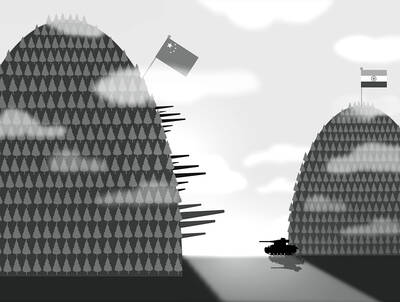
India is not China, and many of its residents fear it never will be. It is hard to imagine a future in which the subcontinent’s manufacturing dominates the world, its foreign investment shapes nations’ destinies, and the challenge of its economic system forces the West to reshape its own policies and principles. However, that is, apparently, what the US administration fears. Speaking in New Delhi last week, US Deputy Secretary of State Christopher Landau warned that “we will not make the same mistakes with India that we did with China 20 years ago.” Although he claimed the recently agreed framework


 RSS
RSS