


Share prices closed down 1.02 percent yesterday as investors took profit from early gains ahead of the signing of the Economic Cooperation Framework Agreement (ECFA) with China, dealers said.
The TAIEX fell 77.22 points to close at the day’s low of 7,423.57, off a high of 7,584.81. Turnover was NT$84.99 billion (US$2.63 billion).
The market opened 0.72 percent higher amid optimism over the economic outlook after Taiwan and China sign the trade pact. However, selling emerged later in the session, eroding the early gains as investors rushed to pocket recent profits, dealers said.
The food sector encountered the heaviest pressure, falling 2 percent. The financial sector closed down 1.8 percent, while the textile, plastic and chemical sector and the pulp and paper sector both fell 1.2 percent.
Cement shares dropped 1 percent, machinery and electronics stocks lost 0.7 percent and the construction sector shed 0.4 percent.
Foodmaker Uni-President Enterprises (統一企業) fell 1.52 percent to NT$35.55 and its competitor, AGV Products Corp (愛之味), dropped 2 percent to NT$12.25.
“While many investors have faith in the long term economic outlook after the signing of the ECFA with China, it was time for them to adjust their portfolios,” TLG Asset Management (台壽保投信) analyst Arch Shih (施博元) said.
“The reversal of the early gains was no surprise as the positive aspects of the trade pact have mostly been digested,” Shih said.
Taiwan and China signed the ECFA yesterday afternoon, after both sides finalized their lists of industries that would be eligible for tariff waivers and easy market access.
Shih said selling focused on stocks that have close business ties with China, as they have recently risen on high hopes that their bottom lines would be boosted by increasing cross-strait economic exchanges.
Among the financial stocks that scored the highest gains on Monday on hopes of easier market access to China, Hua Nan Financial yesterday fell 3.33 percent to NT$18.85 and Cathay Financial Holding Co (華南金控) dropped 2.2 percent to NT$49.
Shih said select high-tech stocks appeared resilient to the weakness of the broader market.
“It seems that funds are shifting back to the high-tech sector from old economy stocks. This sector may support the broader market in the short term,” he said.


ENERGY ISSUES: The TSIA urged the government to increase natural gas and helium reserves to reduce the impact of the Middle East war on semiconductor supply stability Chip testing and packaging service provider ASE Technology Holding Co (日月光投控) yesterday said it planned to invest more than NT$100 billion (US$3.15 billion) in building a new advanced chip testing facility in Kaohsiung to keep up with customer demand driven by the artificial intelligence (AI) boom. That would be included in the company’s capital expenditure budget next year, ASE said. There is also room to raise this year’s capital spending budget from a record-high US$7 billion estimated three months ago, it added. ASE would have six factories under construction this year, another record-breaking number, ASE chief operating officer Tien Wu

The EU and US are nearing an agreement to coordinate on producing and securing critical minerals, part of a push to break reliance on Chinese supplies. The potential deal would create incentives, such as minimum prices, that could advantage non-Chinese suppliers, according to a draft of an “action plan” seen by Bloomberg. The EU and US would also cooperate on standards, investments and joint projects, as well as coordinate on any supply disruptions by countries like China. The two sides are additionally seeking other “like-minded partners” to join a multicountry accord to help create these new critical mineral supply chains, which feed into

For weeks now, the global tech industry has been waiting for a major artificial intelligence (AI) launch from DeepSeek (深度求索), seen as a benchmark for China’s progress in the fast-moving field. More than a year has passed since the start-up put Chinese AI on the map in early last year with a low-cost chatbot that performed at a similar level to US rivals. However, despite reports and rumors about its imminent release, DeepSeek’s next-generation “V4” model is nowhere in sight. Speculation is also swirling over the geopolitical implications of which computer chips were chosen to train and power the new
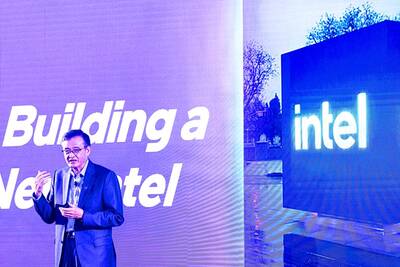
Intel Corp is joining Elon Musk’s long-shot effort to develop semiconductors for Tesla Inc, Space Exploration Technologies Corp and xAI, marking a surprising twist in the chipmaker’s comeback bid. Intel would help the Terafab project “refactor” the technology in a chip factory, the company said on Tuesday in a post on X, Musk’s social media platform. That is a stage in the development process that typically helps make chips more powerful or reliable. The chipmaker’s shares jumped 4.2 percent to US$52.91 in New York trading on Tuesday. The Terafab project is a grand plan by Musk to eventually manufacture his own chips for


 RSS
RSS