


When Syahril Japarin took over as director of the Pontianak city water company in West Kalimantan, Indonesia, in November 2004, the public utility was running at an annual loss of tens of thousands of dollars. In just over two months he had turned the deficit into a surplus of tens of thousands of dollars; a year later, that had more than tripled to £120,000 (US$224,000).
"The secret was simple," the diminutive, cheerful Japarin said. "We changed the company's rules and, with the workers' permission, set targets. Everyone now has a target as a breakdown from the company target."
Bonuses for the very best performers, including free trips to Mecca for Muslims and equivalent cash for people of other faiths, were introduced, along with compulsory early retirement for employees who failed their appraisals.
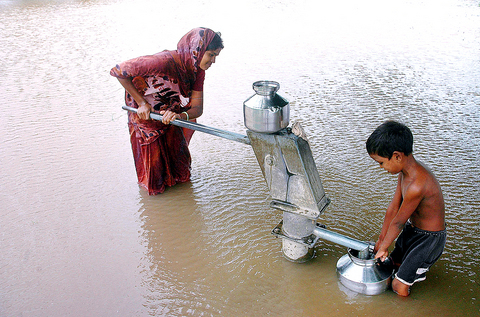
PHOTO: AP
Last week Japarin shared his experiences with other members of the world water community at a UN workshop in Bangkok, hoping to reinvigorate a global industry that has failed to deliver to the world's poorest people. UN data indicate almost 1.2 billion people have no sustainable water supply and twice that number have no access to a sanitation system.
In the past four months, policymakers have started to concur with activists who have argued for more than a decade that privatization is not the answer.
"The experience of privatization has been rather discredited, rather pathetic for the welfare of the poorest in the world," said Kwame Jomo, the UN assistant secretary-general for economic development.
But that does not automatically mean public services are the answer, said Antonio Miranda of the Brazilian Association of Municipal and Sanitation Public Operators, a member of the UN secretary-general's advisory board on water and sanitation.
"More than 90 percent of the world's water utilities are in public hands and 1.2 billion people don't have access to water," Miranda said. "It's clear the public sector has failed too."
The dilemma, Miranda believes, is simple.
"We need to provide water and sanitation to the poor, and the poor will never make you a profit. But public utilities cannot run at a loss. So if you will never recover your costs through tariffs, you have to do so through other means," he said.
At the World Water Forum in Mexico in March, two reports were published that turned conventional thinking on its head. One, the Gurria report, said financing had to be restructured from being supplier-driven to being demand-driven, particularly in the international financial institutions such as the World Bank, regional development banks and governments' international development departments.
The other, written by the UNsecretary-general's advisory board, said that if the world is to meet its Millennium Development Goal target (of halving the number of people without sustainable access to safe drinking water and basic sanitation by 2015), "radical change and swift, resolute action" would be needed.
Its primary recommendation was the creation of Water Operators Partnerships (WOPS), to bring together operators from around the world to share experiences for mutual benefit. The theory is that the less efficient can learn from the more competent on a not-for-profit basis on any issues of concern.
"Water provision is a natural monopoly since people don't usually have a choice about who supplies their water," Miranda said. "Therefore, there should not be competition issues."
Last week's workshop, aimed at Asian providers, was the first practical attempt to get the WOPS up and running.
"It's not even a work in progress yet, it's still embryonic," said Manuel Dengo, head of the water section at the UN's department for economic and social affairs. "But we have to start somewhere."
Crucial political players are starting to see the light, Miranda said, citing a meeting he had with Britain's development secretary, Hilary Benn, this month.
"Benn said: `Let's move from these incentives to privatization to look at other incentives.' That's very new. Let's hope it leads to something tangible." Miranda said.
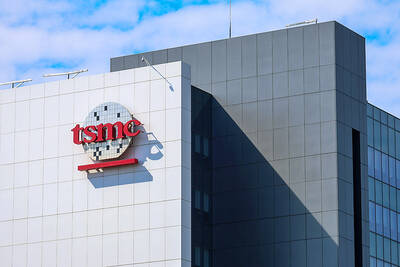
Taiwan Semiconductor Manufacturing Co (TSMC, 台積電), the world’s largest foundry service provider, yesterday said that global semiconductor revenue is projected to hit US$1.5 trillion in 2030, after the figure exceeds US$1 trillion this year, as artificial intelligence (AI) demand boosts consumption of token and compute power. “We are still at the beginning of the AI revolution, but we already see a significant impact across the whole semiconductor ecosystem,” TSMC deputy cochief operating officer Kevin Zhang (張曉強) said at the company’s annual technology symposium in Hsinchu City. “It is fair to say that in the past decade, smartphones and other mobile devices were
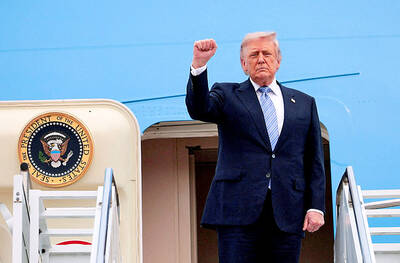
US-CHINA SUMMIT: MOFA welcomed US reassurance of no change in its Taiwan policy; Trump said he did not comment when Xi talked of opposing independence US President Donald Trump yesterday said he has not made a decision on whether to move forward with a major arms package for Taiwan after hearing concerns about it from Chinese President Xi Jinping (習近平). Trump’s comments on Taiwan came as he flew back to Washington after wrapping up critical talks in which both leaders said important progress was made in stabilizing US-China relations even as deep differences persist between the world’s two biggest powers on Iran and Taiwan. “I will make a determination,” Trump said, adding: “I’ll be making decisions. But, you know, I think the last thing we need right
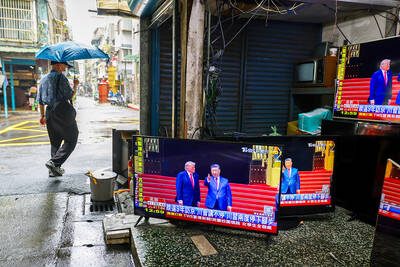
TAIWAN ISSUE: US treasury secretary Scott Bessent said on the first day of meetings that ‘it wouldn’t be a US-China summit without the Taiwan issue coming up’ There were no surprises on the first day of the summit between US President Donald Trump and Chinese President Xi Jinping (習近平), the Mainland Affairs Council (MAC) said yesterday, as the government reiterated that cross-strait stability is crucial to the Asia-Pacific region, as well as the world. As the two presidents met for a highly anticipated summit yesterday, Chinese state media reported that Xi warned Trump that missteps regarding Taiwan could push their two countries into “conflict.” Trump arrived in China with accolades for his host, calling Xi a “great leader” and “friend,” and extending an invitation to visit the White House
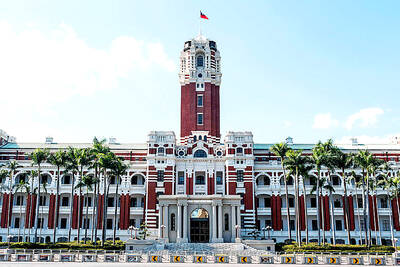
SECURITY: Taipei presses the US for arms supplies, saying the arms sales are not only a reflection of the US security commitment to Taiwan but also serve as a mutual deterrent against regional threats Taiwan is committed to preserving the cross-strait “status quo” and contributing to regional peace and stability, the Presidential Office said yesterday. “It is an undeniable fact that the Republic of China is a sovereign and independent democratic nation,” Presidential Office spokeswoman Karen Kuo (郭雅慧) reiterated, adding that Beijing has no right to claim sovereignty over Taiwan. The statements came after US President Donald Trump warned against Taiwanese independence. Trump wrapped up a state visit to Beijing on Friday, during which Chinese President Xi Jinping (習近平) had pressed him not to support Taiwan. Taiwan depends heavily on US security backing to deter China from carrying


 RSS
RSS