


Apple Inc on Wednesday said it planned to lay off 190 employees in its self-driving car program, Project Titan, changes that provide a rare window into the automotive technologies the company has been pursuing.
The tech firm said in a filing with state regulators that it planned to lay off people from eight Santa Clara County facilities near its Cupertino, California, headquarters, as of April 16.
A company spokesman confirmed that the reduction was from the self-driving car program.
While the iPhone maker has acknowledged its interest in self-driving cars in broad terms, it has never detailed precisely which technologies it is working on and whether it seeks to build a whole vehicle or the sensors, computer system and software to control one.
The public documents filed with regulators provide some previously undisclosed clues.
Among those laid off were at least two dozen software engineers, including a machine-learning engineer, and 40 hardware engineers, according to a letter sent by Apple to California employment regulators earlier this month.
Some of the positions hint at physical products for consumers: three product design engineers and an ergonomics engineer face layoffs. A machine shop supervisor was among the reductions, though it is unclear how many machinists reported to the supervisor and whether the shop fabricates automotive parts or smaller parts for electronics and sensors.
The layoffs appear to be the first major shake-up of Project Titan under Doug Field, who returned to Apple last year as vice president of special projects after a stint at electric car maker Tesla Inc.
Apple operates the car project on a “need-to-know” basis, with only about 5,000 of Apple’s 140,000 fulltime workers included, according to court documents in a theft of trade secrets criminal case filed this year against an ex-Apple employee.
About 1,200 of those are “core” employees that are “directly working on the development of the project,” according to the complaint, which was unsealed in January.
Despite the headcount changes, the company appears to have ramped up its testing on California roads. In a filing with regulators earlier this month, Apple said it had logged nearly 128,748km of testing in its home state last year, far surpassing the less than 1,600km it had logged the year before.
However, it was far fewer than Alphabet Inc’s Waymo unit, which logged 1.9 million kilometers in California last year.
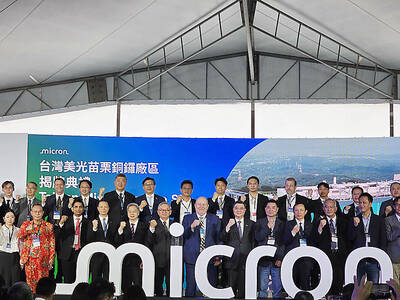
UNPRECEDENTED PACE: Micron Technology has announced plans to expand manufacturing capabilities with the acquisition of a new chip plant in Miaoli Micron Technology Inc unveiled a newly acquired chip plant in Miaoli County yesterday, as the company expands capacity to meet growing demand for advanced DRAM chips, including high-bandwidth memory chips amid the artificial intelligence boom. The plant in Miaoli County’s Tongluo Township (銅鑼), which Micron acquired from Powerchip Semiconductor Manufacturing Corp (力積電) for US$1.8 billion, is expected to make a sizeable capacity contribution to the company from fiscal 2028, the company said in a statement. It would be an extended production site of Micron’s large-scale manufacturing hub in Taichung, the company said. As the global semiconductor industry is racing to reach US$1 trillion

Singapore-based ride-hailing and delivery giant Grab Holdings Ltd has applied for regulatory approval to acquire the Taiwan operations of Germany-based Delivery Hero SE's Foodpanda in a deal valued at about US$600 million. Grab submitted the filing to the Fair Trade Commission on Friday last week, with the transaction subject to regulatory review and approval, the company said in a statement yesterday. Its independent governance structure would help foster a healthy and competitive market in Taiwan if the deal is approved, Grab said. Grab, which is listed on the NASDAQ, said in the filing that US-based Uber Technologies Inc holds about 13 percent of

Taiwan’s food delivery market could undergo a major shift if Singapore-based Grab Holdings Ltd completes its planned acquisition of Delivery Hero SE’s Foodpanda business in Taiwan, industry experts said. Grab on Monday last week announced it would acquire Foodpanda’s Taiwan operations for US$600 million. The deal is expected to be finalized in the second half of this year, with Grab aiming to complete user migration to its platform by the first half of next year. A duopoly between Uber Eats and Foodpanda dominates Taiwan’s delivery market, a structure that has remained intact since the Fair Trade Commission (FTC) blocked Uber Technologies Inc’s

Memory chip stocks extended their losses yesterday after Alphabet Inc’s Google publicized research that could allow more efficient use of the storage needed for artificial intelligence (AI) development. SK Hynix Inc and Samsung Electronics Co, South Korean leaders in the market, fell more than 6 percent and about 5 percent respectively in Seoul. In the US, Micron Technology Inc, Western Digital Corp and Sandisk Corp slid more than 2 percent in pre-market trading, after they all closed lower on Wednesday. Memory companies have been on a tear in recent months as the rapid development of AI infrastructure triggered a spike in chip


 RSS
RSS