


Tokyo businessman Randal Furudera is not about to swap his German-made BMW M5 for a “boring” Japanese car, although he will give them some grudging respect for their ho-hum dependability.
Deep-pocketed buyers like Furudera are driving sales in Japan of high-end foreign brands, which dominate the niche sector in a car market long seen as all but shuttered to overseas automakers.
“Most Japanese cars these days are sort of becoming moving appliances,” the 54-year-old said.

Photo: AFP
“They’re very reliable, they’re good quality, they never break and all that, but they’re not very interesting to drive,” he said.
Mid-range foreign vehicles are a rare sight on Japanese streets, but it is not hard to spot a Porsche zipping around the capital or a nouveau riche billionaire behind the wheel of a half-a-million-dollar Lamborghini.
Sales of the Italian sportscar in Japan doubled to about 300 vehicles in 2015 from a year earlier.
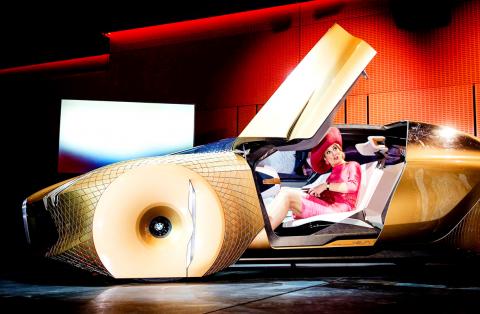
Photo: EPA
The jump comes as US car giant Ford announced in January it was quitting the country, blaming the “closed” market, after it sold fewer than 5,000 cars last year.
Less than 6 percent of the more than 5 million vehicles sold last year in Japan — the world’s No. 3 car market — were made by foreign automakers.
US auto unions have blasted what they say are non-tariff barriers that shut the door on a sector already dominated by eight domestic carmakers, including Toyota, Nissan and Honda.
In 2013, former Ford boss Alan Mulally accused Tokyo of manipulating the yen’s sharp decline to gain a trade advantage for domestic firms, which sell millions of vehicles overseas, including top markets China and the US.
The imbalance has not gone unnoticed by US Republican party frontrunner Donald Trump.
“When did we beat Japan at anything?” Trump said in a speech last summer to announce his run for the presidency.
“They send their cars over by the millions, and what do we do? When was the last time you saw a Chevrolet in Tokyo? It doesn’t exist, folks,” he said.
Trump is not far off — Chevrolet and Cadillac maker General Motors sold a puny 1,600 vehicles in Japan last year.
However, it is a different story for prestige foreign brands, whose success did not come without a fight.
They had to “overcome stereotypes like Western cars break down easily or they are expensive to repair,” said Miki Kurosu, communications director for BMW Japan, which sold about 46,000 vehicles last year, along with 21,000 Minis.
Japan’s luxury car market has remained frothy despite a years-long downturn in the economy, while a stock market rally in recent years has also helped buoy sales.
Nissan considered selling its high-end Infiniti brand at home, as Honda did with Acura. However, those plans were scrapped owing to foreign automakers’ dominance in the market.
Rival Toyota has also struggled to score big with its Lexus in Japan, although sales have been on an upswing lately.
“Lexus is a bit behind. They had great ambitions when they launched the brand [at home] in 2005, but have not achieved their goals,” said Yoshiaki Kawano, an auto analyst at IHS Automotive.
German brands have slick marketing campaigns and a top-notch image in Japan, and rich drivers rarely switch brands so domestic automakers were late to the party.
“There is quite a bit of prestige attached to certainly the three main German brands,” Furudera said.
Foreign brands tend to focus on the driving experience, rather than just passenger comfort, the car enthusiast added.
In Japanese cars, “[passengers] are probably enjoying it more than the drivers — watching DVDs, getting a massage from their chairs — but the driver is not enjoying it that much,” Furudera said.
“In a German car, the driver gains the most — that’s kind of the big difference,” he said.
While he may consider buying a Lexus down the road, it is not likely to happen any time soon.
“I wouldn’t say never, but for now I think BMW still has the edge in terms of driving experience,” he said.
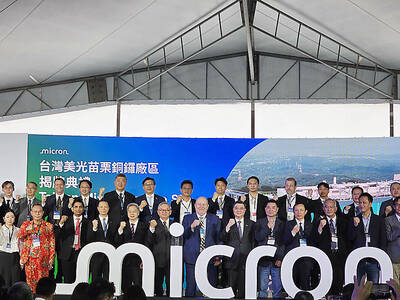
UNPRECEDENTED PACE: Micron Technology has announced plans to expand manufacturing capabilities with the acquisition of a new chip plant in Miaoli Micron Technology Inc unveiled a newly acquired chip plant in Miaoli County yesterday, as the company expands capacity to meet growing demand for advanced DRAM chips, including high-bandwidth memory chips amid the artificial intelligence boom. The plant in Miaoli County’s Tongluo Township (銅鑼), which Micron acquired from Powerchip Semiconductor Manufacturing Corp (力積電) for US$1.8 billion, is expected to make a sizeable capacity contribution to the company from fiscal 2028, the company said in a statement. It would be an extended production site of Micron’s large-scale manufacturing hub in Taichung, the company said. As the global semiconductor industry is racing to reach US$1 trillion

Singapore-based ride-hailing and delivery giant Grab Holdings Ltd has applied for regulatory approval to acquire the Taiwan operations of Germany-based Delivery Hero SE's Foodpanda in a deal valued at about US$600 million. Grab submitted the filing to the Fair Trade Commission on Friday last week, with the transaction subject to regulatory review and approval, the company said in a statement yesterday. Its independent governance structure would help foster a healthy and competitive market in Taiwan if the deal is approved, Grab said. Grab, which is listed on the NASDAQ, said in the filing that US-based Uber Technologies Inc holds about 13 percent of

Taiwan’s food delivery market could undergo a major shift if Singapore-based Grab Holdings Ltd completes its planned acquisition of Delivery Hero SE’s Foodpanda business in Taiwan, industry experts said. Grab on Monday last week announced it would acquire Foodpanda’s Taiwan operations for US$600 million. The deal is expected to be finalized in the second half of this year, with Grab aiming to complete user migration to its platform by the first half of next year. A duopoly between Uber Eats and Foodpanda dominates Taiwan’s delivery market, a structure that has remained intact since the Fair Trade Commission (FTC) blocked Uber Technologies Inc’s

Memory chip stocks extended their losses yesterday after Alphabet Inc’s Google publicized research that could allow more efficient use of the storage needed for artificial intelligence (AI) development. SK Hynix Inc and Samsung Electronics Co, South Korean leaders in the market, fell more than 6 percent and about 5 percent respectively in Seoul. In the US, Micron Technology Inc, Western Digital Corp and Sandisk Corp slid more than 2 percent in pre-market trading, after they all closed lower on Wednesday. Memory companies have been on a tear in recent months as the rapid development of AI infrastructure triggered a spike in chip


 RSS
RSS