


State-run Taiwan Business Bank (TBB, 台灣企銀) has gained approval from the US regulator to set up a branch office in New York, according to a statement issued on Thursday.
The regulatory green light granted by the US Federal Reserve Board took effect immediately, the statement said.
The approval is to allow TBB to expand its business in the US from the west coast to eastern regions. It is also to help increase the number of the lender’s overseas branches from six to seven.
TBB currently operates a US branch in Los Angeles; two Australian branches, in Sydney and Brisbane; a Hong Kong branch; and branches in Shanghai and Wuhan in China.
Small and medium-sized enterprises are the primary clientele of TBB, which has 125 branches in Taiwan.
The bank held consolidated assets of about US$45 billion as of June 30 last year, ranking it the 14th-largest bank in Taiwan.
State-run Bank of Taiwan (臺灣銀行) controls a 17.2 percent stake in TBB, the statement added.
Separately, Taiwan Cooperative Bank (TCB, 合作金庫銀行), the banking arm of Taiwan Cooperative Financial Holding Co (合庫金控), on Thursday opened a representative office in Yangon, Myanmar, the bank’s fifth foothold in the ASEAN market.
ASEAN FOOTHOLD
The bank’s four other units in the ASEAN market are one branch located in Phnom Penh; two sub-branches located in Tuek Thla and Pur Senchey, also in Cambodia; and another branch located in Manila.
The bank said that the representative office in Yangon is expected to help the bank extend its reach in the ASEAN market and take advantage of the market’s great growth potential.
TCB operates 15 overseas branches: five in ASEAN; two in the US; one in Belgium; one in Australia; five in China; and one in Hong Kong.
On Thursday, the bank gained regulatory approval from the Financial Supervisory Commission to open a branch in Changsha in China’s Hunan Province.
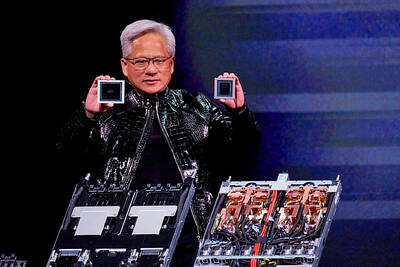
Nvidia Corp chief executive officer Jensen Huang (黃仁勳) on Monday introduced the company’s latest supercomputer platform, featuring six new chips made by Taiwan Semiconductor Manufacturing Co (TSMC, 台積電), saying that it is now “in full production.” “If Vera Rubin is going to be in time for this year, it must be in production by now, and so, today I can tell you that Vera Rubin is in full production,” Huang said during his keynote speech at CES in Las Vegas. The rollout of six concurrent chips for Vera Rubin — the company’s next-generation artificial intelligence (AI) computing platform — marks a strategic
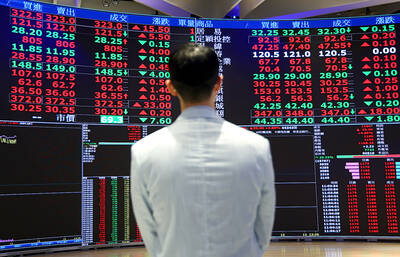
Shares in Taiwan closed at a new high yesterday, the first trading day of the new year, as contract chipmaker Taiwan Semiconductor Manufacturing Co (TSMC, 台積電) continued to break records amid an artificial intelligence (AI) boom, dealers said. The TAIEX closed up 386.21 points, or 1.33 percent, at 29,349.81, with turnover totaling NT$648.844 billion (US$20.65 billion). “Judging from a stronger Taiwan dollar against the US dollar, I think foreign institutional investors returned from the holidays and brought funds into the local market,” Concord Securities Co (康和證券) analyst Kerry Huang (黃志祺) said. “Foreign investors just rebuilt their positions with TSMC as their top target,
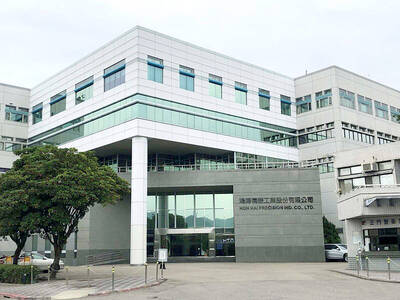
REVENUE PERFORMANCE: Cloud and network products, and electronic components saw strong increases, while smart consumer electronics and computing products fell Hon Hai Precision Industry Co (鴻海精密) yesterday posted 26.51 percent quarterly growth in revenue for last quarter to NT$2.6 trillion (US$82.44 billion), the strongest on record for the period and above expectations, but the company forecast a slight revenue dip this quarter due to seasonal factors. On an annual basis, revenue last quarter grew 22.07 percent, the company said. Analysts on average estimated about NT$2.4 trillion increase. Hon Hai, which assembles servers for Nvidia Corp and iPhones for Apple Inc, is expanding its capacity in the US, adding artificial intelligence (AI) server production in Wisconsin and Texas, where it operates established campuses. This
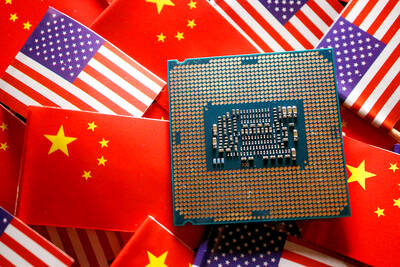
US President Donald Trump on Friday blocked US photonics firm HieFo Corp’s US$3 million acquisition of assets in New Jersey-based aerospace and defense specialist Emcore Corp, citing national security and China-related concerns. In an order released by the White House, Trump said HieFo was “controlled by a citizen of the People’s Republic of China” and that its 2024 acquisition of Emcore’s businesses led the US president to believe that it might “take action that threatens to impair the national security of the United States.” The order did not name the person or detail Trump’s concerns. “The Transaction is hereby prohibited,”


 RSS
RSS