


Dell Inc’s plan to take the computer giant private offers an opportunity to return to its start-up roots, but is unlikely to solve the fundamental problems facing the company and the PC sector, analysts said.
The Texas-based tech giant on Tuesday unveiled a US$24.4 billion buyout deal giving founder Michael Dell a chance to reshape the former No. 1 PC maker away from the spotlight of Wall Street.
Roger Kay, an analyst at Endpoint Technologies, said that Dell’s plan underscores the deep problems of an industry roiled by a rapid shift to mobile devices, such as tablets and smartphones, and away from traditional PCs.
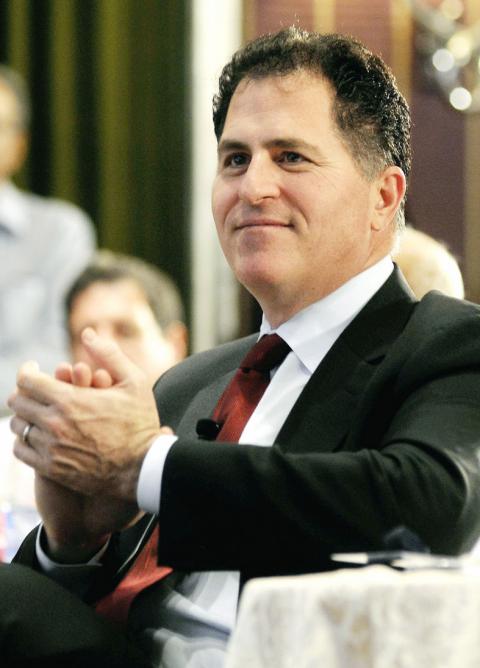
Photo: AFP
“It’s an illustration of how tough the PC business is, that Dell had to take this extreme step,” Kay said.
Kay said that without the pressure of meeting quarterly financial targets, Dell can focus on more profitable PC segments as it tries to reinvent itself as a services and software company.
“Michael has been trying to turn Dell into a supplier of enterprise solutions for a long time,” Kay said. “He has pleaded with Wall Street to give him time.”
Kay told reporters that going private would make a transition easier by avoiding the spotlight of “ugly results,” which could come from scaling back the PC business.
“The commodity PC business has been suffering,” Kay said. “Dell may probably keep the higher margin consumer lines, but maybe look at rest of the portfolio.”
Sterne Agee analyst Shaw Wu said Dell has a difficult task ahead.
“Despite the company’s strong efforts to transform itself ... we estimate that about 70 percent of its business is tied to PCs,” Wu said in a note to clients.
“On the positive, we believe going private takes the company out of the quarter-to-quarter grind of being a publicly traded company. But on the negative, not having publicly traded stock could make it more difficult to make larger, transformative acquisitions,” Wu said.
Wu said that as a private firm, Dell’s cash would be needed to pay equity investors and service debt.
“We are not sure going private improves the company’s fundamental position,” he said.
Darren Hayes, a Pace University computer science professor and former investment banker, said that by going private, “you’re not subject to a lot of regulation, you don’t have to answer to your shareholders, so maybe you can be more nimble in strategy.”
“Dell has struggled because of Apple [Inc] and Lenovo [Group (聯想)], so this might be a way to trim costs and regain some ground,” he added.
The computer maker once had a market capitalization of US$100 billion as the world’s biggest PC producer. It is now the No. 3 global PC maker, behind Hewlett-Packard Co (HP) and Lenovo, according to a recent report from market tracker IDC, showing Dell’s market share at 10.6 percent in the fourth quarter.
HP said in a statement that Dell “has a very tough road ahead” and “an extended period of uncertainty and transition that will not be good for its customers,” adding that HP “plans to take full advantage of that opportunity.”
China’s Lenovo said it would not comment on a competitor, but added that “we remain as always confident in our strategy, our ability to deliver compelling and innovative products and our overall position and performance.”
However, Rob Enderle, a tech analyst and consultant, said that the deal suggests “tighter coupling of Dell and Microsoft,” which is providing a US$2 billion loan toward the buyout.
“Surface [tablet computer] was created because Microsoft didn’t think the [PC makers] were listening. Dell will now be listening and Microsoft is likely to listen to Dell better as well,” Enderle said.
“But the goal is to put Dell back in start-up mode ... Both will target Apple and Google [Inc] as a team which is where their combined power is likely to be made visible,” he added.
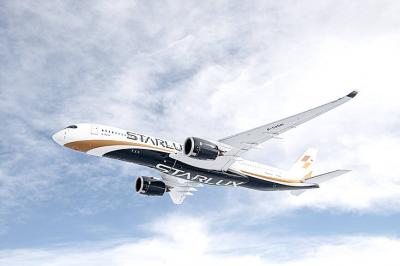
Starlux Airlines Co (星宇航空) today unveiled a long-haul network expansion plan at a shareholders’ meeting in Taipei, including direct flights to Barcelona, Spain, and Zurich, Switzerland, as well as a service connecting Taipei, Sydney and New Zealand. Starlux is to become the first Taiwanese carrier to offer non-stop services to the two European cities, while the inaugural oceanic route is expected to expand transit opportunities within the Australia-New Zealand market, Starlux said. Flight services to Chicago, Dallas, Washington and New York are under evaluation, the airline added. Prior to the shareholders’ meeting, the airline earlier this year announced that it would be

Netherlands-based semiconductor equipment supplier ASML Holding NV yesterday said that it is planning to hire an additional 1,000 people in Taiwan this year in response to growing demand from clients. ASML had previously planned to recruit 600 people this year, but that the plan has been adjusted upward, ASML vice president and ASML Taiwan general manager Grace Wang (汪佳慧) told reporters. ASML has a workforce of more than 4,500 in Taiwan, accounting for about 10 percent of its global total, Wang said. This year’s recruitment campaign would focus on adding people in the customer support, manufacturing and supply chain domains to assist ASML

UNDER MICROSCOPE: Taiwan detained three people who allegedly conspired to buy servers in Taiwan and export them using fraudulent documentation, prosecutors said Nvidia Corp chief executive officer Jensen Huang (黃仁勳) on Saturday urged Super Micro Computer Inc to tighten up on compliance after Taiwan detained three people this week for allegedly making fraudulent declarations about artificial intelligence (AI) servers made by its US partner. The development marked the nation’s first crackdown on semiconductor smuggling, which grew after the US slapped restrictions on exports of high-end chips such as Nvidia AI accelerators to China. Nvidia is “rigorous” in explaining regulations to all of its partners, Huang told reporters after arriving in Taipei. “Ultimately Super Micro has to run their own company,” he said in response to

Nvidia Corp yesterday announced that CEO Jensen Huang (黃仁勳) would attend an employee meeting in Taipei tomorrow to celebrate the launch of the company’s Taiwan headquarters project. Huang would attend a gathering at the site of Nvidia’s planned headquarters in Beitou Shilin Technology Park (北投士林科技園區), the company said in a statement. After arriving in Taiwan on Saturday last week, Huang told reporters that he plans to meet with Quanta Computer Inc (廣達) chairman Barry Lam (林百里) and Taiwan Semiconductor Manufacturing Co (TSMC, 台積電) chairman C.C. Wei (魏哲家), and would attend the groundbreaking ceremony for Nvidia’s Taiwan headquarters tomorrow. Nvidia has not yet applied


 RSS
RSS