


General Motors Co (GM) said on Tuesday it would stop advertising on Facebook, even as the social networking Web site prepares to go public, with a source familiar with the matter saying the automaker had decided Facebook’s ads had little impact on consumers.
The decision by GM, the third-largest advertiser in the US, marks the first highly visible crack in Facebook’s strategy and underscores doubts about whether advertising on Facebook works better than traditional media.
“This does highlight what we are arguing is the riskiness of the overall Facebook business model,” said Brian Wieser, Internet and media analyst at Pivotal Research Group. “It is not a sure thing. It sure looks likely that it will be one of the most important ad-supported media properties, but it’s not certain because there will be marketers who are challenged to prove the effectiveness of the marketing vehicle.”
For now, these worries do not appear to be impeding strong investor demand, with Facebook Inc increasing the size of its offering by 25 percent to raise about US$15 billion, a separate source said on Tuesday.
Facebook is expected to start trading on the NASDAQ on Friday.
GM said it would still have Facebook pages, which cost nothing to create and for which it pays no fees, to market its vehicles and added that it is not unusual for it to move spending around various media outlets.
“In terms of Facebook specifically, while we currently do not plan to continue with advertising, we remain committed to an aggressive content strategy through all of our products and brands, as it continues to be a very effective tool for engaging with our customers,” GM said.
Facebook declined to comment on GM’s move.
Concerns about advertising on Facebook are not confined to GM, with an executive at another large consumer products company saying it was hard to know if it is worth the money spent.
“Is it just a shiny new object, or is it a real value proposition?” said the executive, who asked not to be identified.
However, Ford Motor Co said it was committed to advertising on Facebook and is boosting its spending, including ad buys.
“You just can’t buy your way into Facebook,” Ford spokesman Scott Monty said. “You need to have a credible presence and be doing innovative things.”
More than 20 percent of Ford’s marketing budget is spent on digital and social media, he said. The company launched last year’s Explorer SUV on Facebook and other digital outlets for a fraction of the cost of a Super Bowl TV spot, which cost US$3.5 million on average per 30 seconds this year.
Another fan of Facebook is -Japanese automaker Subaru, which started using banner ads at the Web site in the past year in addition to its free content.
“Advertising plus content equals more clicks to our Web site, which we like,” Subaru spokesman Michael McHale said.
Facebook has ramped up its outreach to Madison Avenue in recent years. Last year, Facebook hired Carolyn Everson, an ad industry veteran who worked at Microsoft Corp, Viacom’s MTV Networks and Walt Disney Co, and the company hosted a splashy event in New York in March to showcase its newest ad offerings.
John Battelle, chairman of the Internet advertising network Federated Media, said Facebook may need to invest more heavily in building relationships with major advertisers.
It may also need to develop richer, more customized advertising offerings, even though such efforts would likely be less profitable than traditional display or pay-per-click advertising.
“GM is a warning shot across the bow,” Battelle said.
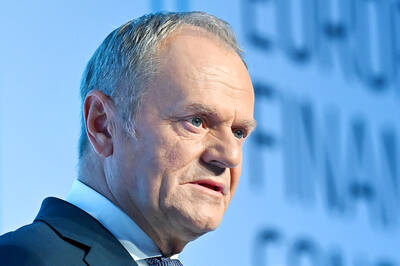
Poland is betting on a flood of investments and technology transfers from Taiwanese companies to reengineer its US$1 trillion economy. Polish Prime Minister Donald Tusk said yesterday that Poland will no longer be “just an assembly hub” as it pursues further investments from the likes of Foxconn Technology Group (富士康). The firm, whose full name is Hon Hai Precision Industry Co (鴻海精密), last month agreed to build electric vehicles (EVs) in the European Union nation and now could be a partner in a semiconductor venture, he said. The government’s aim is to boost manufacturing and the country’s high-tech chops in an era

Taiwan remained the sixth-largest net creditor nation in the world last year, despite a fall of more than 10 percent in its net international investment position (NIIP) over the year, the central bank said yesterday. The NIIP is the difference between a country’s external financial assets and its external financial liabilities. Taiwan’s external financial assets hit US$3.27 trillion at the end of last year, up US$275.75 billion or 9.2 percent from a year earlier, the central bank said in its annual NIIP report. The growth largely reflected an increase in holdings of overseas marketable securities by residents in Taiwan, as well as a

RESTRICTION BREACH: ASML said that it denies ‘unfounded rumors regarding non-compliance with export controls concerning China,’ and enforces controls strictly US Secretary of Commerce Howard Lutnick in a series of recent meetings outlined concerns to Dutch chip-equipment giant ASML Holding NV’s senior leaders that one of its top-of-the-line machines might have made its way into China, in violation of US-led export restrictions. In the meetings, Lutnick expressed concern to ASML executives over the company’s extreme ultraviolet lithography (EUV) machines, people familiar with the talks said. EUV systems are used by firms such as Taiwan Semiconductor Manufacturing Co (台積電) to manufacture processors for the likes of Nvidia Corp and Apple Inc. ASML has never been allowed to ship them to China because of curbs

BAD FAITH LITIGATION? The two companies, owned by a California-based private equity firm, could be seeking licensing fees or a settlement payout with the suit Taiwan Intellectual Property Office (TIPO) Director-General Liao Cheng-wei (廖承威) said yesterday he suspected that two firms suing contract chipmaker Taiwan Semiconductor Manufacturing Co (TSMC, 台積電) for patent infringement are “patent trolls.” A patent troll refers to a company that buys patents not for manufacturing products, but to sue other companies for compensation, accusing them of using its patents. Patent trolls, formally called Non-Practicing Entities or Patent Assertion Entities, were responsible for more than 50 percent of lawsuits in the US last year, costing targeted businesses tens of billions of US dollars a year, according to the US-based LegalCharity Web site. Asked whether


 RSS
RSS