


The National Communications Commission (NCC) will soon launch an investigation targeting Asia Pacific Telecom Co (亞太電信) and Chunghwa International Communication Network (中華國際通訊網路) for allegedly overcharging customers.
NCC spokesperson Chen Jeng-chang (陳正倉) called for the investigation after news reports that a 16-year-old student received a NT$110,000 phone bill after spending hours on the phone with a woman he had met online.
The woman asked the student to call her mobile phone, whose number began with 0985, which is allocated to Asia Pacific Telecom. She then asked him to put that line on hold and dial another mobile phone number on the Chunghwa International Communication Network. The woman assured the student that this was a way to save money, when in fact the student was being charged for calling two mobile phone numbers simultaneously.
The student called the woman several times a week and held both lines without hanging up for four straight days.
The student called from a regular Chunghwa Telecom Co (中華電信) land line.
Chunghwa International Communication Network is also one of Asia Pacific Telecom’s corporate accounts.
After negotiating with the student’s parents, Chunghwa Telecom cut the charge from NT$110,000 to NT$30,000.
The NCC said firms offering paid voice services over the phone are categorized as second-tier telecom operators. They normally deliver the service through platforms set up by first-tier telecom operators including Chunghwa Telecom, Taiwan Mobile Co (台灣大哥大) and Asia Pacific Telecom.
The numbers for paid voice services usually have the prefix 0204, 0208 and 0209. By law, callers to these numbers must be charged no more than NT$100 per minute. The calls must also be automatically disconnected after five minutes. If a call lasts more than five minutes, the caller will be charged NT$500.
The focus of the NCC investigation will be whether the operators have been using mobile phone numbers while charging customers the paid voice service rate.
“Technically, callers do not have to pay anything if both caller and receiver belong to the same network. Callers should also be charged fixed rates for calling outside the network,” said Chen Kuo-lung (陳國龍), chief of the NCC business management department.
“Our job is to make sure the companies stick to the rate plan that they submitted to us,” Chen said.
If Chunghwa International Communication Network is contracted by Asia Pacific Telecom to offer additional services, the services must also be approved by the NCC before they can be offered to customers.
Article 67 in the Telecommunication Act (電信法) states that operators can be fined between NT$30,000 and NT$300,000 if the operational plan is not approved by the administrative authority.
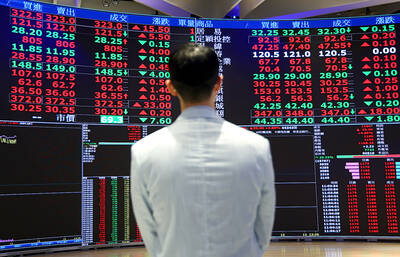
Shares in Taiwan closed at a new high yesterday, the first trading day of the new year, as contract chipmaker Taiwan Semiconductor Manufacturing Co (TSMC, 台積電) continued to break records amid an artificial intelligence (AI) boom, dealers said. The TAIEX closed up 386.21 points, or 1.33 percent, at 29,349.81, with turnover totaling NT$648.844 billion (US$20.65 billion). “Judging from a stronger Taiwan dollar against the US dollar, I think foreign institutional investors returned from the holidays and brought funds into the local market,” Concord Securities Co (康和證券) analyst Kerry Huang (黃志祺) said. “Foreign investors just rebuilt their positions with TSMC as their top target,
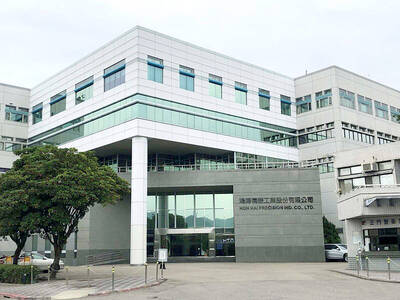
REVENUE PERFORMANCE: Cloud and network products, and electronic components saw strong increases, while smart consumer electronics and computing products fell Hon Hai Precision Industry Co (鴻海精密) yesterday posted 26.51 percent quarterly growth in revenue for last quarter to NT$2.6 trillion (US$82.44 billion), the strongest on record for the period and above expectations, but the company forecast a slight revenue dip this quarter due to seasonal factors. On an annual basis, revenue last quarter grew 22.07 percent, the company said. Analysts on average estimated about NT$2.4 trillion increase. Hon Hai, which assembles servers for Nvidia Corp and iPhones for Apple Inc, is expanding its capacity in the US, adding artificial intelligence (AI) server production in Wisconsin and Texas, where it operates established campuses. This

Nvidia Corp chief executive officer Jensen Huang (黃仁勳) on Monday introduced the company’s latest supercomputer platform, featuring six new chips made by Taiwan Semiconductor Manufacturing Co (TSMC, 台積電), saying that it is now “in full production.” “If Vera Rubin is going to be in time for this year, it must be in production by now, and so, today I can tell you that Vera Rubin is in full production,” Huang said during his keynote speech at CES in Las Vegas. The rollout of six concurrent chips for Vera Rubin — the company’s next-generation artificial intelligence (AI) computing platform — marks a strategic
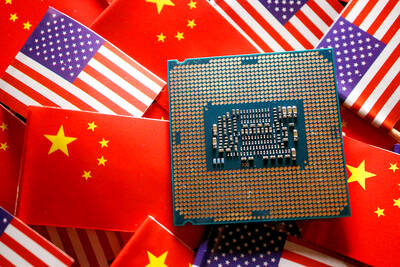
US President Donald Trump on Friday blocked US photonics firm HieFo Corp’s US$3 million acquisition of assets in New Jersey-based aerospace and defense specialist Emcore Corp, citing national security and China-related concerns. In an order released by the White House, Trump said HieFo was “controlled by a citizen of the People’s Republic of China” and that its 2024 acquisition of Emcore’s businesses led the US president to believe that it might “take action that threatens to impair the national security of the United States.” The order did not name the person or detail Trump’s concerns. “The Transaction is hereby prohibited,”


 RSS
RSS