


Shares close lower
Taiwanese shares closed down 0.30 percent yesterday, led by large cap electronic firms amid concerns over earnings, dealers said.
The weighted index fell 21.00 points to 7,056.71 on turnover of NT$128.77 billion (US$3.93 billion).
The market opened down 0.58 percent as investors expressed dissatisfaction with smartphone maker HTC’s (宏達電) cautious guidance on its outlook, dragging the index down to 6,986.29 at one point, dealers said.
However, interest rotated to old economy firms, in particular property and steel stocks, helping the broader market back above 7,000.
Investors were worried that stiff global competition would undermine the company’s profitability, Concord Securities (康和證券) analyst Allen Lin said.
“While HTC remains profitable, investors expected it would have earned more,” Lin said.
Firms packed with large property assets outperformed the broader market on hopes that domestic property prices would rise further, dealers said.
No Nan Shan sale favorite: FSC
The Financial Supervisory Commission (FSC) yesterday denied media speculation that it was firming on Cathay Financial Holding Co (國泰金控) as the recipient of a planned sale of Nan Shan Life Insurance Co (南山人壽) by its US parent, the financially troubled American International Group Inc (AIG).
“The commission fully respects the market mechanism,” an FSC press statement said yesterday.
The Chinese-language Commercial Times yesterday reported that Cathay Financial was the most hopeful of the bidders and the first to conduct a diligence check on the life insurer last week.
The report added that the commission preferred Cathay Financial because of its greater experience in insurance than bidders Fubon Financial Holding Co (富邦金) and Chinatrust Financial Holding Co (中信金).
Citibank in business transfer
Citibank Taiwan Ltd (台灣花旗) and Citibank NA Taiwan yesterday completed a transfer of business to provide a full range of financial services to customers through 65 branches and 5,000 employees nationwide, a statement said.
Business transferred to subsidiary Citibank Taiwan included consumer banking, wealth management and corporate banking, while Citibank NA Taiwan will continue to provide large loan extensions to corporate clients as well as making foreign exchange/derivatives transactions with financial institutions, the statement added.
Macroblock falls by day limit
Macroblock Inc (聚積科技), a light-emitting diode driver maker, fell by its 7 percent daily limit after Fubon Securities Co (富邦證券) cut its rating to “underweight” from “overweight” on “weaker than expected” second-quarter results.
The stock retreated NT$10.50 to NT$139.50, the most since Aug. 16, 2007, at the Taipei close, while the benchmark TAIEX lost 0.3 percent.
“It is facing intensive competition, especially in the China market,” said Shen Hua-jian (沈華堅), an analyst at Fubon Securities in Taipei, by telephone. “This will threaten its margin, which is already not doing that well.”
Hsinchu-based Macroblock reported that net income dropped by 50 percent to NT$31.9 million (US$973,674) in the three months ended June 30, compared with NT$64.24 million a year earlier, according to Bloomberg data.
SinoPac Securities Corp (永豐金證券) rated the company “sell” on July 21.
NT dollar slightly stronger
The New Taiwan dollar yesterday rose slightly by NT$0.05 to close at NT$32.768 against the greenback on turnover of US$656 million.
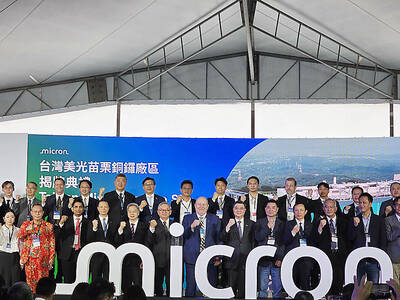
UNPRECEDENTED PACE: Micron Technology has announced plans to expand manufacturing capabilities with the acquisition of a new chip plant in Miaoli Micron Technology Inc unveiled a newly acquired chip plant in Miaoli County yesterday, as the company expands capacity to meet growing demand for advanced DRAM chips, including high-bandwidth memory chips amid the artificial intelligence boom. The plant in Miaoli County’s Tongluo Township (銅鑼), which Micron acquired from Powerchip Semiconductor Manufacturing Corp (力積電) for US$1.8 billion, is expected to make a sizeable capacity contribution to the company from fiscal 2028, the company said in a statement. It would be an extended production site of Micron’s large-scale manufacturing hub in Taichung, the company said. As the global semiconductor industry is racing to reach US$1 trillion

Singapore-based ride-hailing and delivery giant Grab Holdings Ltd has applied for regulatory approval to acquire the Taiwan operations of Germany-based Delivery Hero SE's Foodpanda in a deal valued at about US$600 million. Grab submitted the filing to the Fair Trade Commission on Friday last week, with the transaction subject to regulatory review and approval, the company said in a statement yesterday. Its independent governance structure would help foster a healthy and competitive market in Taiwan if the deal is approved, Grab said. Grab, which is listed on the NASDAQ, said in the filing that US-based Uber Technologies Inc holds about 13 percent of

Taiwan’s food delivery market could undergo a major shift if Singapore-based Grab Holdings Ltd completes its planned acquisition of Delivery Hero SE’s Foodpanda business in Taiwan, industry experts said. Grab on Monday last week announced it would acquire Foodpanda’s Taiwan operations for US$600 million. The deal is expected to be finalized in the second half of this year, with Grab aiming to complete user migration to its platform by the first half of next year. A duopoly between Uber Eats and Foodpanda dominates Taiwan’s delivery market, a structure that has remained intact since the Fair Trade Commission (FTC) blocked Uber Technologies Inc’s

Memory chip stocks extended their losses yesterday after Alphabet Inc’s Google publicized research that could allow more efficient use of the storage needed for artificial intelligence (AI) development. SK Hynix Inc and Samsung Electronics Co, South Korean leaders in the market, fell more than 6 percent and about 5 percent respectively in Seoul. In the US, Micron Technology Inc, Western Digital Corp and Sandisk Corp slid more than 2 percent in pre-market trading, after they all closed lower on Wednesday. Memory companies have been on a tear in recent months as the rapid development of AI infrastructure triggered a spike in chip


 RSS
RSS