


Governments across Asia have pledged a combined US$700 billion in stimulus spending and central banks have slashed interest rates to spur growth and cushion the blow of plunging export demand from the West.
But worries remain whether the moves will stave off a lengthy regional recession.
Much depends on how Asian consumers and businesses respond to the stimulus measures - which range from construction projects in China to create jobs to cash handouts and loan guarantees in Singapore.
Some analysts say Asia could be the first region to recover from the global crisis later this year because its financial systems are on sounder footing than those in the West, allowing consumers and companies to better take advantage of the public spending and lower rates. Banks haven’t needed massive bailouts, and consumer and bank debt levels are lower than in the US, meaning people and businesses may be more willing to borrow, lend and spend.
“Asia faces fewer structural problems than elsewhere in the world, and the policy easing has a better chance of working here than in the US,” said Richard Urwin, who helps manage more than US$10 billion of stocks, bonds and other investments, including Asian assets, for BlackRock Inc in London.
“It’s sensible to expect some gap opening up this year between what’s happening in the US and what’s happening in this region,” he said.
Still, stimulating domestic demand can only go so far for much of Asia, and a sustainable recovery ultimately hinges on exports. News last week of sharply slowing growth in China, a contraction in South Korea’s economy and a record 35 percent drop in Japanese exports last month only served to emphasize the region’s dependence on the rest of the world.
“The infrastructure spending does help to provide a short-term boost to the Chinese economy,” said Tai Hui (�?�), head of Southeast Asia economic research for Standard Chartered Bank in Singapore. “But it’s taking a big knock in its export sector right now.”
The outlook is overwhelmingly bleak. This year’s slowdown will likely rival the 1997-1998 debt crisis as Asia’s worst downturn in more than 50 years. Already, economies in Japan, South Korea, Singapore and New Zealand are shrinking.
Asian exports are in a free-fall. Vietnam’s exports plunged 24 percent and Singapore’s slid 21 percent. China’s exports dropped in November and December for the first time in seven years.
China has led the policy response, announcing in November it would spend US$585 billion, mostly on infrastructure development. It’s also reducing sales and property taxes. It has lowered its benchmark one-year lending rate five times since September.
But getting Chinese consumers to spend more is a challenge. Many families still feel compelled to save up to 50 percent of their incomes to pay for health care, education and other necessities.
In Singapore, the government is taking steps to dissuade companies from laying off workers. The government will also assume 80 percent of the risk on private bank loans of up to US$3.34 million to help spark lending and investment.
In South Korea, the government is spending US$10.2 billion to build and repair roads, railways and ports, tax cuts and other measures to aid ailing business. In a package that still needs parliamentary approval, Japan plans to boost payments to parents who give birth, reduce the unemployment insurance premium and lower taxes.
Taiwan, Malaysia, Australia and India have also announced plans for extra spending. And a collapse in oil prices has eased inflation, giving central bankers room to slash rates.
“We’re seeing the most powerful, most synchronized fiscal easing Asia has ever seen, and in time, it should generate strong domestic demand and a recovery,” said Robert Prior-Wandesforde, co-head of Asian economic research at HSBC in Singapore.
“In contrast to the West, money isn’t going toward bailing out financial institutions, it’s being pumped directly into the economy,” he said.
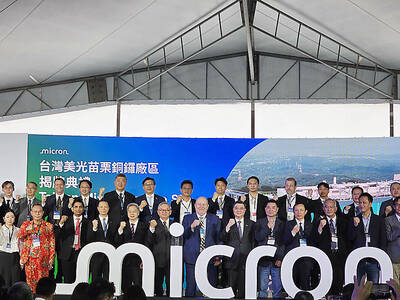
UNPRECEDENTED PACE: Micron Technology has announced plans to expand manufacturing capabilities with the acquisition of a new chip plant in Miaoli Micron Technology Inc unveiled a newly acquired chip plant in Miaoli County yesterday, as the company expands capacity to meet growing demand for advanced DRAM chips, including high-bandwidth memory chips amid the artificial intelligence boom. The plant in Miaoli County’s Tongluo Township (銅鑼), which Micron acquired from Powerchip Semiconductor Manufacturing Corp (力積電) for US$1.8 billion, is expected to make a sizeable capacity contribution to the company from fiscal 2028, the company said in a statement. It would be an extended production site of Micron’s large-scale manufacturing hub in Taichung, the company said. As the global semiconductor industry is racing to reach US$1 trillion

Singapore-based ride-hailing and delivery giant Grab Holdings Ltd has applied for regulatory approval to acquire the Taiwan operations of Germany-based Delivery Hero SE's Foodpanda in a deal valued at about US$600 million. Grab submitted the filing to the Fair Trade Commission on Friday last week, with the transaction subject to regulatory review and approval, the company said in a statement yesterday. Its independent governance structure would help foster a healthy and competitive market in Taiwan if the deal is approved, Grab said. Grab, which is listed on the NASDAQ, said in the filing that US-based Uber Technologies Inc holds about 13 percent of

Taiwan’s food delivery market could undergo a major shift if Singapore-based Grab Holdings Ltd completes its planned acquisition of Delivery Hero SE’s Foodpanda business in Taiwan, industry experts said. Grab on Monday last week announced it would acquire Foodpanda’s Taiwan operations for US$600 million. The deal is expected to be finalized in the second half of this year, with Grab aiming to complete user migration to its platform by the first half of next year. A duopoly between Uber Eats and Foodpanda dominates Taiwan’s delivery market, a structure that has remained intact since the Fair Trade Commission (FTC) blocked Uber Technologies Inc’s

Memory chip stocks extended their losses yesterday after Alphabet Inc’s Google publicized research that could allow more efficient use of the storage needed for artificial intelligence (AI) development. SK Hynix Inc and Samsung Electronics Co, South Korean leaders in the market, fell more than 6 percent and about 5 percent respectively in Seoul. In the US, Micron Technology Inc, Western Digital Corp and Sandisk Corp slid more than 2 percent in pre-market trading, after they all closed lower on Wednesday. Memory companies have been on a tear in recent months as the rapid development of AI infrastructure triggered a spike in chip


 RSS
RSS