


The Executive Yuan passed a resolution yesterday to carry out 10 major infrastructure projects that it had selected for immediate implementation under the direct supervision of the four ministers without portfolio.
Premier Liu Chao-shiuan (劉兆玄) said after hearing a briefing on the plan that the 10 infrastructure projects, including a mass rapid transit system connecting Taipei and Taiwan Taoyuan International Airport in Taoyuan County, would be carried out as scheduled.
“It is also anticipated that the development of these infrastructure projects will help rev up the slumping domestic economy and boost employment,” Liu said.
The MRT system connecting Taipei Railway Station and Taoyuan airport is expected to reduce travel time between the two places by some 35 minutes from the current hour or so.
The plans call for providing convenient transit services for 200,000 travelers to and from the airport as well as commuters who work at the airport.
Another project — an expansion of Kaohsiung Harbor, the largest seaport in Taiwan — is expected to create 27,000 jobs and generate business worth NT$39.4 billion (US$1.2 billion) when it is complete.
The project will be a joint venture between the government and the private sector, said Chu Yun-peng (朱雲鵬), one of the four ministers without portfolio who will be in charge of the projects.
The other three ministers without portfolio are Tsai Hsung-hsiung (蔡勳雄), Chang Jin-fu (張進福) and Ovid Tzeng (曾志朗).
Other infrastructure projects approved in the resolution include the development of new highways, renovation of cities and industrial zones, rebuilding of old bridges, flood prevention projects, revamping old school buildings, streamlining sewage systems and improving rural villages, the plan states.
The budget for the 10 projects will require legislative approval, although the Executive Yuan didn’t specify yesterday how much these projects would cost the government.
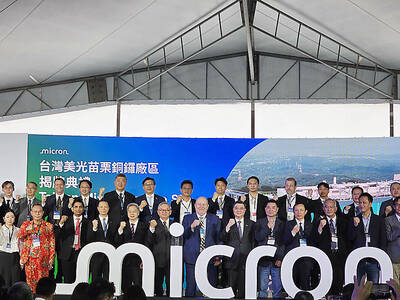
UNPRECEDENTED PACE: Micron Technology has announced plans to expand manufacturing capabilities with the acquisition of a new chip plant in Miaoli Micron Technology Inc unveiled a newly acquired chip plant in Miaoli County yesterday, as the company expands capacity to meet growing demand for advanced DRAM chips, including high-bandwidth memory chips amid the artificial intelligence boom. The plant in Miaoli County’s Tongluo Township (銅鑼), which Micron acquired from Powerchip Semiconductor Manufacturing Corp (力積電) for US$1.8 billion, is expected to make a sizeable capacity contribution to the company from fiscal 2028, the company said in a statement. It would be an extended production site of Micron’s large-scale manufacturing hub in Taichung, the company said. As the global semiconductor industry is racing to reach US$1 trillion
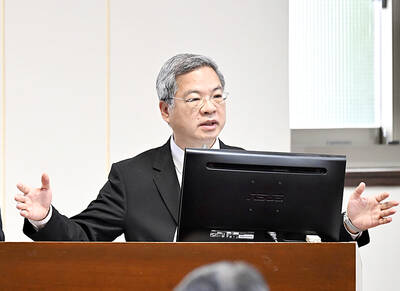
ABOVE LEGAL REQUIREMENT: The Ministry of Economic Affairs is prepared if LNG supply is disrupted, with more than the legal requirement of 11 days of inventory Taiwan has largely secured liquefied natural gas (LNG) supplies through May and arranged about half of June’s supply, Minister of Economic Affairs Kung Ming-hsin (龔明鑫) said yesterday. Since the Middle East conflict began on Feb. 28, Taiwan’s LNG inventories have remained more than 12 days, exceeding the legal requirement of 11 days, indicating no major supply concerns for domestic gas and electricity, Kung said at a meeting of the legislature’s Economics Committee in Taipei. The ministry aims to increase the figure to 14 days by the end of next year, he said. While one or two LNG or crude oil shipments for May

Taiwan’s food delivery market could undergo a major shift if Singapore-based Grab Holdings Ltd completes its planned acquisition of Delivery Hero SE’s Foodpanda business in Taiwan, industry experts said. Grab on Monday last week announced it would acquire Foodpanda’s Taiwan operations for US$600 million. The deal is expected to be finalized in the second half of this year, with Grab aiming to complete user migration to its platform by the first half of next year. A duopoly between Uber Eats and Foodpanda dominates Taiwan’s delivery market, a structure that has remained intact since the Fair Trade Commission (FTC) blocked Uber Technologies Inc’s

Memory chip stocks extended their losses yesterday after Alphabet Inc’s Google publicized research that could allow more efficient use of the storage needed for artificial intelligence (AI) development. SK Hynix Inc and Samsung Electronics Co, South Korean leaders in the market, fell more than 6 percent and about 5 percent respectively in Seoul. In the US, Micron Technology Inc, Western Digital Corp and Sandisk Corp slid more than 2 percent in pre-market trading, after they all closed lower on Wednesday. Memory companies have been on a tear in recent months as the rapid development of AI infrastructure triggered a spike in chip


 RSS
RSS