


A new Airbus A380, the biggest aircraft in the world, touched down at Taiwan Taoyuan International Airport yesterday, impressing passengers and airport workers who craned their necks to see the gigantic airliner.
The aircraft has also visited Tokyo and Sydney in the A380 World Tour this year and will fly back to Toulouse, France, on Sunday after carrying local airline and government officials on a compatibility trial today.
The A380 stopped in Taiwan to introduce the aircraft to local carriers including China Airlines Ltd (
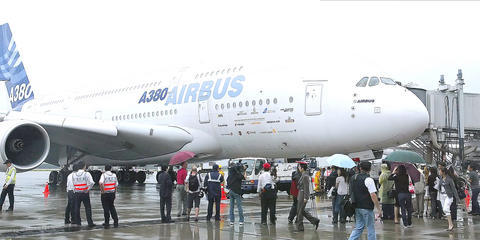
PHOTO: YAO CHIEH-HSIU, TAIPEI TIMES
"It's up to the passengers to decide what aircraft to buy," Airbus chief operating officer John Leahy said at a press conference after the A380's arrival.
Passengers who have boarded the new jet during the demonstration tour have given it high marks, Leahy said.
"They said this is the future of flight and they don't want to go back to the past," Leahy said.
The airliner can accommodate 525 passengers in a typical three-class configuration, or 40 percent more passengers than Boeing Co's B747-400 passenger jet -- the largest aircraft in service -- can carry.
For Taiwanese carriers, the A380 could serve on the Taipei-Los Angeles route, the second-busiest route in the Asia-Pacific region, Leahy said.
The only complaint that customers have had about the A380 is its delayed delivery schedule, Leahy said.
Manufacturing problems have delayed the introduction of the aircraft for two years, he said.
Airbus has received 160 orders for the A380 from 14 airlines. The first will be delivered to Singapore Airlines in October.
If buyers place orders for A380 now, they will have to wait until 2012 for delivery, Leahy said.
The A380's passenger comfort improvements include wider seats and more floor space in the cabin for all passengers, Leahy said.
The airliner is also the quietest commercial aircraft in the world, he said.
"The loudest noise during my flight was a man who snored in front of me," Leahy said.
Despite its size, the A380 is the world's most environmentally friendly airplane, consuming 17 percent less fuel per seat than the largest aircraft today, he said, adding that the jet had earned the nickname "green giant."
The A380's fuel efficiency will reduce airlines' operating costs by 15 percent to 20 percent over other aircraft, he said.
The airliner also has 15 percent greater range, which can help to bring down ticket prices, he said.
The double decker A380 is the first long-haul aircraft to consume less than three liters of fuel per passenger over 100km, a rate comparable to an average economical car, an Airbus statement said.
Airbus said in a statement that it estimates that air passenger traffic is expected to increase by 5 percent per year over the next 20 years.
The company is looking for more business from emerging markets such as China and India, where an increasing number of people can afford international air travel, the statement said.

Elon Musk’s lieutenants have reached out to chip industry suppliers, including Applied Materials Inc, Tokyo Electron Ltd and Lam Research Corp, for his envisioned Terafab, early steps in an audacious and likely arduous attempt to break into the production of cutting-edge chips. Staff working for the joint venture between Tesla Inc and Space Exploration Technologies Corp (SpaceX) have sought price quotes and delivery times for an array of chipmaking gear, people familiar with the matter said. In past weeks, they’ve contacted makers of photomasks, substrates, etchers, depositors, cleaning devices, testers and other tools, according to the people, who asked not to
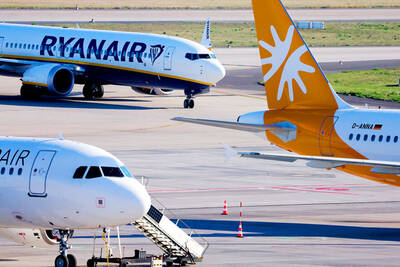
JET JUICE: The war on Iran’s secondary effects have seen fuel prices skyrocket, knocking flight schedules down to earth in return as airlines struggle with costs Airline passengers should brace for more irritation in the next few months as carriers worldwide cancel flights and ground planes to cope with stratospheric increases in jet-fuel prices. Dutch flag carrier KLM is the latest company to cut its schedule, saying on Thursday that it would scrap 80 return flights at Amsterdam’s Schiphol Airport in the coming month. That puts it in the same league as United Airlines Holdings Inc, Deutsche Lufthansa AG and Cathay Pacific Airways Ltd, which have all pruned itineraries to mitigate costs. Global capacity for next month has been reduced by about 3 percentage points, with all
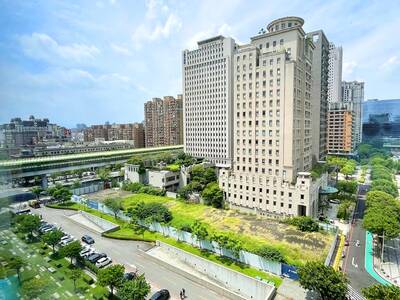
Taichung reported the steepest fall in completed home prices among the six special municipalities in the first quarter of this year, data compiled by Taiwan Realty Co (台灣房屋) showed yesterday. From January through last month, the average transaction price for completed homes in Taichung fell 8 percent from a year earlier to NT$299,000 (US$9,483) per ping (3.3m²), said Taiwan Realty, which compiled the data based on the government’s price registration platform. The decline could be attributed to many home buyers choosing relatively affordable used homes to live in themselves, instead of newly built homes in the city’s prime property market, Taiwan Realty

Taiwan is attracting a growing number of foreign jobseekers as companies increasingly recruit overseas talent to ease labor shortages and expand global reach, recruitment platform 104 Job Bank (104人力銀行) said yesterday. More than 40,000 foreign nationals searched for jobs in Taiwan through the platform last year, a 28 percent increase from a year earlier, the company said. Malaysians accounted for the largest share of overseas jobseekers at 12.2 percent, followed by Indonesians at 11.9 percent and Vietnamese at 10.8 percent. Indonesian applicants surged more than 50 percent year-on-year, while Vietnamese jobseekers rose by more than 30 percent. Applicants from the


 RSS
RSS