


The global airline industry will take at least three years to recover from a travel slump caused by the worst recession in six decades, said Giovanni Bisignani, chief executive of the International Air Transport Association (IATA).
The airline industry globally lost US$50 billion in the past 10 years, including US$11 billion last year alone. Revenues declined by US$80 billion last year, Bisignani said.
“These numbers are really shocking,” Bisignani said in an interview in Singapore on Sunday. “We’ve had a terrible 10 years. It would take at least three years to recover the level of growth we have lost.”
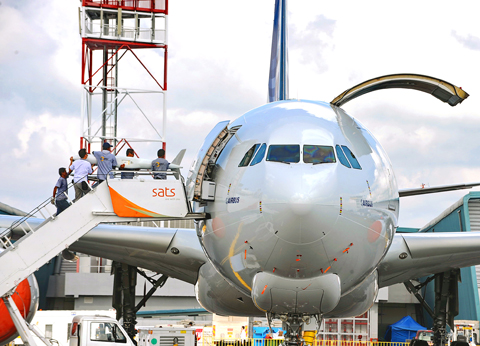
PHOTO: AFP
Airlines worldwide suffered the worst drop in passenger demand since World War II last year, IATA said last Wednesday. The global travel slump has pushed carriers —including Singapore Airlines Ltd and British Airways PLC —into losses and forced Japan Airlines Corp to file for bankruptcy.
“It’s going to be a bumpy road,” said Chris Tarry, an independent analyst in London, who has followed the industry for more than two decades. “A lot of capacity is going to come into the industry. Capacity will mean that prices and fares go down, so it will make it even more difficult for a recovery in profit.”
Globally, airlines will probably post losses totaling US$5.6 billion this year, the trade group estimated. That’s about half of last year’s estimated US$11 billion deficit.
Traffic, a measure of passengers flown multiplied by the distance traveled, dropped 3.5 percent last year, with declines exceeding 5 percent in Europe, North America and the Asia-Pacific region, said IATA, which represents 230 carriers.
The economic slump and credit crisis have cost carriers two-and-a-half years of growth in passenger markets and three-and-a-half years in freight, so that this year will be “another spartan year” of cost controls and capacity caps, Bisignani had said earlier.
British Airways, Europe’s No. 3 carrier, expects a “bigger loss” in the 12 months ending on March 31 than it had in the last fiscal year, chairman Martin Broughton said on Jan. 25.
Singapore Airlines, the world’s second-largest carrier by market value, may have its first annual loss as a publicly traded company, the carrier said in July.
Japan Airlines last month became Asia’s first major flag carrier to seek bankruptcy protection after four government bailouts failed to revive the region’s most indebted carrier.
Passenger yield, or the average price a traveler pays to fly one kilometer, would remain “flat” this year and increase only next year, Bisignani forecast.
While the industry’s worst loss to date was almost US$13 billion in 2001 following the Sept. 11 terror attacks, an US$80 billion revenue decline last year was “vastly bigger” than anything previously experienced, IATA chief economist Brian Pearce said.
More airlines will go bankrupt, Bisignani said.
About 34 carriers have gone out of business since 2008, IATA said.
“I don’t think bankruptcies are over for airlines anywhere across the world,” Tarry said. “Although 2009 has been difficult for airlines, for some airlines, 2010 may be more difficult still.”
Taiwan Semiconductor Manufacturing Co (TSMC, 台積電), the world’s largest foundry service provider, yesterday said that global semiconductor revenue is projected to hit US$1.5 trillion in 2030, after the figure exceeds US$1 trillion this year, as artificial intelligence (AI) demand boosts consumption of token and compute power. “We are still at the beginning of the AI revolution, but we already see a significant impact across the whole semiconductor ecosystem,” TSMC deputy cochief operating officer Kevin Zhang (張曉強) said at the company’s annual technology symposium in Hsinchu City. “It is fair to say that in the past decade, smartphones and other mobile devices were
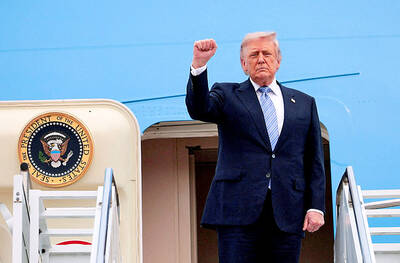
US-CHINA SUMMIT: MOFA welcomed US reassurance of no change in its Taiwan policy; Trump said he did not comment when Xi talked of opposing independence US President Donald Trump yesterday said he has not made a decision on whether to move forward with a major arms package for Taiwan after hearing concerns about it from Chinese President Xi Jinping (習近平). Trump’s comments on Taiwan came as he flew back to Washington after wrapping up critical talks in which both leaders said important progress was made in stabilizing US-China relations even as deep differences persist between the world’s two biggest powers on Iran and Taiwan. “I will make a determination,” Trump said, adding: “I’ll be making decisions. But, you know, I think the last thing we need right
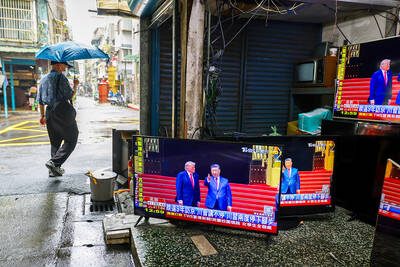
TAIWAN ISSUE: US treasury secretary Scott Bessent said on the first day of meetings that ‘it wouldn’t be a US-China summit without the Taiwan issue coming up’ There were no surprises on the first day of the summit between US President Donald Trump and Chinese President Xi Jinping (習近平), the Mainland Affairs Council (MAC) said yesterday, as the government reiterated that cross-strait stability is crucial to the Asia-Pacific region, as well as the world. As the two presidents met for a highly anticipated summit yesterday, Chinese state media reported that Xi warned Trump that missteps regarding Taiwan could push their two countries into “conflict.” Trump arrived in China with accolades for his host, calling Xi a “great leader” and “friend,” and extending an invitation to visit the White House
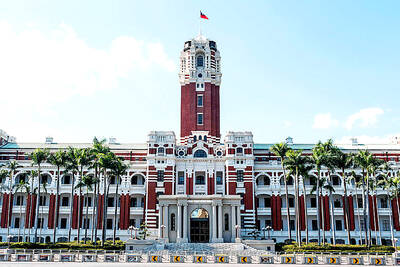
SECURITY: Taipei presses the US for arms supplies, saying the arms sales are not only a reflection of the US security commitment to Taiwan but also serve as a mutual deterrent against regional threats Taiwan is committed to preserving the cross-strait “status quo” and contributing to regional peace and stability, the Presidential Office said yesterday. “It is an undeniable fact that the Republic of China is a sovereign and independent democratic nation,” Presidential Office spokeswoman Karen Kuo (郭雅慧) reiterated, adding that Beijing has no right to claim sovereignty over Taiwan. The statements came after US President Donald Trump warned against Taiwanese independence. Trump wrapped up a state visit to Beijing on Friday, during which Chinese President Xi Jinping (習近平) had pressed him not to support Taiwan. Taiwan depends heavily on US security backing to deter China from carrying


 RSS
RSS