


Microsoft Corp, which bought 22 companies for about US$750 million in the past year, is planning more purchases and “long-term” investments to fuel growth, chief executive officer Steve Ballmer said.
“You ought to expect us to continue to do more acquisitions, but still primarily, small-and mid-sized companies,” Ballmer, 50, said during a press conference in Seoul. “Our pace of acquisitions continues to rise.”
Ballmer, who also announced plans to spend US$60 million in South Korea in the next three years, declined to comment on Microsoft’s budget for buying companies and didn’t name any purchase targets.
Ballmer is counting on investments to help Microsoft fend off rivals such as Google Inc even as some investors have asked the company to instead return more profit directly to shareholders.
Microsoft shares plunged 11 percent, their biggest drop in more than five years, on April 28, a day after the company said it would increase spending on its Internet unit to stem customer defections to Google. The plan called for spending US$2 billion more than some expected, prompting at least five analysts to cut their ratings on the stock.
“We are going to continue to make the kind of long-term investments that drive long-term innovation and growth,” Ballmer said yesterday. “Shareholders, I think, have appreciated the fact that we are able to grow our profits. We’ll continue to do so.”
Ballmer’s comments may not sooth investors who want the company to spend more of its money on buying back shares. Joseph Rosenberg, chief investment strategist at New York-based Loews Corp, has criticized Ballmer for not buying back enough shares to bolster the stock price and earnings per share.
Rosenberg said he told Microsoft officials the company should buy back US$60 billion in shares, half with cash and half with debt.
Richard Pzena of Pzena Investment Management LLC, which holds 14.3 million Microsoft shares, said he is seeking a meeting with Chief Financial Officer Chris Liddell to persuade him to buy back between US$30 billion and US$60 billion in stock.
Microsoft is nearing the end of a US$30 billion share buyback announced in 2004 and Ballmer is spending in areas to help compete against Google, owner of the world’s most-used search engine.
In 2004, Ballmer agreed to return a record amount to investors, buying US$30 billion of shares over four years and paying a US$32.6 billion dividend. While he accelerated the timetable, Ballmer is focusing on new projects.
Separately, Ballmer said Microsoft is “on track” for the scheduled general release of Windows Vista in January.
The company will look at customer feedback on test versions of the software, he said yesterday.
“The most important thing is to get quality right,” Ballmer said.
The release date could be moved by “a few weeks,” Ballmer said at a press conference in Tokyo on Wednesday.
Just weeks after Microsoft’s March announcement that it would need to delay the retail availability that had been planned for this year, analysts such as market research firm Gartner Inc and Rick Sherlund at Goldman, Sachs & Co expressed concern Vista will slip further into next year.
Windows is Microsoft’s biggest and most profitable product and the two-year delay in Vista has eroded sales growth.
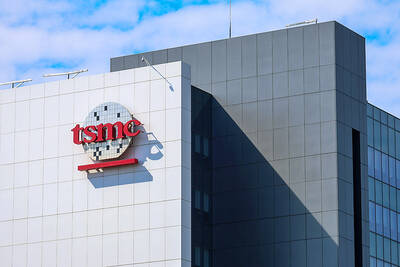
Taiwan Semiconductor Manufacturing Co (TSMC, 台積電), the world’s largest foundry service provider, yesterday said that global semiconductor revenue is projected to hit US$1.5 trillion in 2030, after the figure exceeds US$1 trillion this year, as artificial intelligence (AI) demand boosts consumption of token and compute power. “We are still at the beginning of the AI revolution, but we already see a significant impact across the whole semiconductor ecosystem,” TSMC deputy cochief operating officer Kevin Zhang (張曉強) said at the company’s annual technology symposium in Hsinchu City. “It is fair to say that in the past decade, smartphones and other mobile devices were
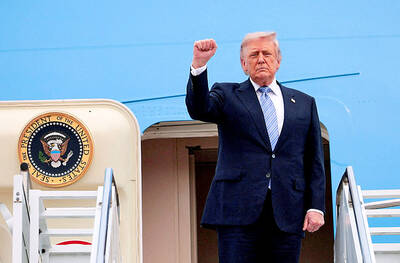
US-CHINA SUMMIT: MOFA welcomed US reassurance of no change in its Taiwan policy; Trump said he did not comment when Xi talked of opposing independence US President Donald Trump yesterday said he has not made a decision on whether to move forward with a major arms package for Taiwan after hearing concerns about it from Chinese President Xi Jinping (習近平). Trump’s comments on Taiwan came as he flew back to Washington after wrapping up critical talks in which both leaders said important progress was made in stabilizing US-China relations even as deep differences persist between the world’s two biggest powers on Iran and Taiwan. “I will make a determination,” Trump said, adding: “I’ll be making decisions. But, you know, I think the last thing we need right
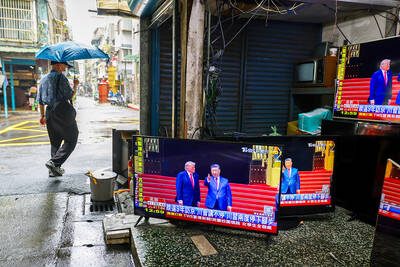
TAIWAN ISSUE: US treasury secretary Scott Bessent said on the first day of meetings that ‘it wouldn’t be a US-China summit without the Taiwan issue coming up’ There were no surprises on the first day of the summit between US President Donald Trump and Chinese President Xi Jinping (習近平), the Mainland Affairs Council (MAC) said yesterday, as the government reiterated that cross-strait stability is crucial to the Asia-Pacific region, as well as the world. As the two presidents met for a highly anticipated summit yesterday, Chinese state media reported that Xi warned Trump that missteps regarding Taiwan could push their two countries into “conflict.” Trump arrived in China with accolades for his host, calling Xi a “great leader” and “friend,” and extending an invitation to visit the White House
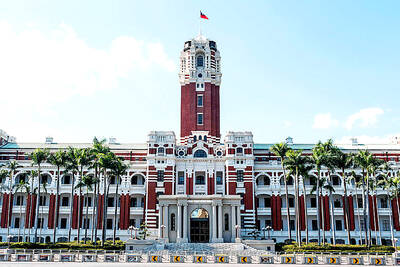
SECURITY: Taipei presses the US for arms supplies, saying the arms sales are not only a reflection of the US security commitment to Taiwan but also serve as a mutual deterrent against regional threats Taiwan is committed to preserving the cross-strait “status quo” and contributing to regional peace and stability, the Presidential Office said yesterday. “It is an undeniable fact that the Republic of China is a sovereign and independent democratic nation,” Presidential Office spokeswoman Karen Kuo (郭雅慧) reiterated, adding that Beijing has no right to claim sovereignty over Taiwan. The statements came after US President Donald Trump warned against Taiwanese independence. Trump wrapped up a state visit to Beijing on Friday, during which Chinese President Xi Jinping (習近平) had pressed him not to support Taiwan. Taiwan depends heavily on US security backing to deter China from carrying


 RSS
RSS