


Tokyo's skyline has been regularly menaced by the skyscraper-munching Godzilla, but now it has another foe -- Robosapien, one of the hottest toys in the run-up to Christmas.
A homemade movie casting the robot in the role usually reserved for a man in a rubber monster suit is one of thousands of Internet videos, pictures and hacking guides that have sprung up around the toy.
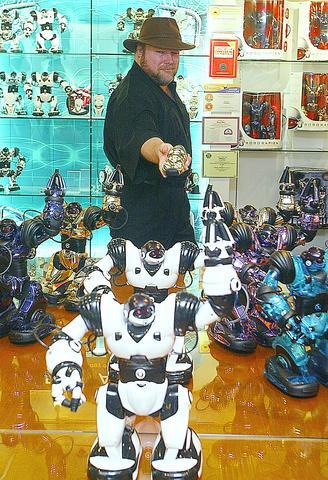
PHOTO: AFP
As Robosapien's maker, Hong Kong-based toy company WowWee, prepared to roll the millionth unit off the production line at its Chinese factory yesterday, inventor Mark Tilden said he was astounded at the geek cottage industry that has sprung up around the robot.
"These guys are nuts," Tilden, a huge bear of a man, roars in laughter at the mention of the Robosapien Destroys Tokyo video posted on one of many fan Web sites.
"You'd be amazed what people are doing with these things. It's hilarious. But it's fantastic. It shows it has wide appeal."
Robosapien has exploded onto the world toy market since its launch in February.
Boasting the scientific knowledge of former NASA robotics engineer Tilden -- who part-built a probe sent to gather climate data from Mars -- it claims to be the first mass-produced robot.
Already it has won some 20 awards -- including two from famed London toy store Hamley's -- and has sold some 600,000 units.
Radio-controlled and powered by seven tiny motors that enable the toy to emulate the movements of humans, users can program it to do an almost infinite number of manoeuvres, from picking up and throwing objects to break dancing.
Toy experts and consumers alike have been drawn not only to the high-tech gadgetry that has gone into it, but also Robosapien's more unusual human features: as well as dancing and walking, moving not unlike a toddler, it also belches and breaks wind.
"It's me inside this thing," says Tilden, a British-born naturalized Canadian who won his spurs working for the US military at the Los Alamos National Laboratories. "I have recreated my personality inside this little guy."
Tilden designed the toy as a vehicle for a new breakthrough in robotics he'd discovered.
NASA refused to help him develop the science as did many other scientific institutes. A toy buff, he decided to take it to the toy industry instead.
"The science community was not willing to run with it, but the toy industry said `hell yeah,'" Tilden boasts.
He's keeping the actual science secret -- "there is more industrial espionage in the toy industry than the military intelligence industry" -- but believes it could revolutionize robotics.
"It is light, small and requires very little power, that's the holy grail of robotics."
Like all the best toys, Robosapien appeals to adults as well as children.
The robot has also attracted the attention of amateur robotics enthusiasts who have pulled it apart to create new, and often disturbing, "hacks" of the toy.
One Web site has transplanted a Swiss army knife onto Robosapiens head, while another has replaced its arms with other utilities, such as a cork-screw. Many fans have also converted their robots into mobile radio controlled video cameras.
On the lunatic fringe, one man in New York has filmed himself being pulled on a sleigh by 20 of the robots, which he whips as he is hauled along a pavement, and another bought a dozen which he has programmed to salute his Darth Vader doll.
Among the more humorous, one fan has provided details on how the ordinarily peace-loving robots can be transplanted with plastic heads of US President George W. Bush and former opponent John Kerry and programmed to fight a bout of fisticuffs.
And a Web-based music video stars a Robosapien decked out in full zebra-skin and velvet street pimp regalia topped with a broad-brimmed fedora, posing with a clutch of scantily clad bathing beauties around a swimming pool.
Tilden is delighted with the wacky response to his invention and hopes fans will take their obsession further.
"I want people to take the thing apart and come up with some other variants on the toy -- I want them to hack into it as people do to computer games and programs," he says.
To aid hackers, Tilden has even labelled every component inside the toy. The reason, he claims, is to help advance robotics.
"Kids these days want to a toy that gives instant gratification -- they want something that they can just pick up and play; just look at toy stores for proof -- how many Meccano or Lego kits do you see these days?" he asks.
"What that has done is reduced the talent pool that can be drawn on for the next generation of robotic engineers. By allowing people to hack in, we feel like we are doing our bit for the future of robotics."

‘NO SECURITY RISK’: The Railway Bureau reassured the public that the technicians’ activities were limited to technical guidance and did not involve sensitive systems The Railway Bureau yesterday said it had invited eight Chinese technicians to assist with an airport MRT construction project. The bureau issued the confirmation after an Internet user said Chinese nationals had entered the construction zone of Taiwan Taoyuan International Airport’s Terminal 3 project. They asked why “individuals from an enemy state” were allowed access to such a major national infrastructure project, which raised serious concerns over Taiwan’s industrial safety, sensitive systems and information security. The bureau’s Northern Region Engineering Branch Office said subcontractor Taiwan Handle Industrial Co (台灣手把工業) of the Taoyuan airport MRT’s “Contract No. CU05 Project A14 Station Civil, MEP &

The National Chungshan Institute of Science and Technology yesterday showcased its locally developed variants of the Vision 60 robotic patrol dog, which it plans to deploy on the nation’s outlying territories in the South China Sea. The variants were produced under the Joint Lab project — created by the institute and domestic companies — and assembled with domestically produced motors, lenses and artificial intelligence (AI) systems alongside licensed tech from the US, Missile and Rocket Systems Research Division deputy director Jen Kuo-kang (任國光) told the media event at a military base in Taipei’s Dazhi (大直) area. Taiwan has built up its strengths

TIT-FOR-TAT: The US allegedly revoked the visa of a Chinese national working at Xinhua News Agency in the US in response to Beijing’s expulsion of Vivian Wang The Presidential Office yesterday condemned China for expelling a New York Times correspondent from Beijing following the newspaper’s interview with President William Lai (賴清德), saying the move highlighted Beijing’s suppression of press freedom and its threat to international news media. Taiwan has noted a series of recent incidents in which Beijing used similar tactics to “threaten and pressure international media outlets and journalists,” Presidential Office spokeswoman Karen Kuo (郭雅慧) said in a statement. “This concerns not only press freedom and freedom of expression, but also the safety of journalists, and Taiwan and relevant partners are paying close attention to the situation,” she

NOT IMMEDIATE: Taiwan has a chance to appeal the proposed 10 percent tariff before it starts, while other countries face a 12.5 percent tariff from the trade office Taiwan is among 60 economies determined by the US to have failed to impose or enforce a ban on the importation of goods produced with forced labor, according to a notice released on Tuesday by the Office of the US Trade Representative (USTR), which proposed imposing an additional 10 percent or more tariff on them. The USTR in a statement said that following an investigation, it had determined under Section 301 of the Trade Act of 1974 that the failure of the 60 economies to impose and effectively enforce a prohibition on the importation of goods produced with forced labor is


 RSS
RSS