


Portenos, as the residents of Buenos Aires call themselves, are in a foul mood these days. Nearly one in five is out of work, crime is on the rise and the only thing to joke about is the bumbling of the government.
But there is a lot to grumble about. The three-year-old recession has gotten so bad that even this cosmopolitan city's most entrenched institution -- the cafe -- is in distress.
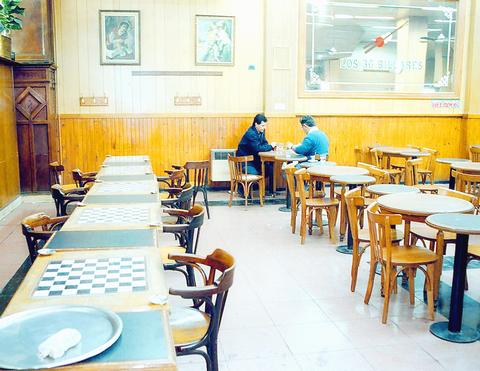
PHOTO: NY TIMES
The free flow of Malbec wine over a game of chess has just about become a thing of the past, cafe managers report. There is not enough money around anymore to gamble more than a few pesos over a deck of cards. And everyone has become so grumpy that customers argue and insult each over even the smallest infractions at Scrabble.
Assessments of the crisis have become almost apocalyptic, with cafe managers like Ricardo Paquali, who runs the venerable Plaza Dorrego Bar, casting back a hundred years or more for just the right disaster to compare it to.
"The yellow fever epidemic really hit this bar hard," he said, referring to the plague that struck the San Telmo neighborhood in the mid-19th century just after his cafe was founded on the Plaza Dorrego. "But this crisis is pretty tough too."
While the dark corner of a neighborhood cafe is still the preferred place to hide out with a mistress, the 54-year-old bar manager said, more and more Argentine men with wandering eyes are staying home, to save money.
So the Plaza Dorrego Bar, which used to stay open till 4am, now shuts at 2:30am.
It is just one more sign that Buenos Aires is no longer the carefree town that dines and drinks all night long as it did just a few years ago.
Cafes here take the form of bistros, taverns and tango clubs, reflecting the character of their neighborhoods. But cheese cubes, garlicky lima beans and spicy sausages are universal, and the cigarette smoke tends to be thick all around.
Waiters typically wear black bow ties and vests over bleached white shirts. Cheap wine flows in the traditionally Italian neighborhoods, while champagne is the beverage of choice in upscale establishments.
But even many of the cafes frequented by the upper classes are feeling the pinch.
"A table that once ordered two bottles of champagne now orders one," grumbled Bartolome Llo-rens, 35, the bartender at Clasica y Moderna, a downtown cafe that draws the literary crowd. Sales are down 40 percent, he said.
It is hard to overestimate the importance of the cafe in the social and cultural life of Buenos Aires. It is a place to read about the latest financial crisis in the morning newspaper over a cup of espresso, dance the tango in midafternoon or watch a soccer match on television after work.
People frequently go to the same cafes every night, becoming such fixtures that they can amble into the kitchen by themselves to fix a bowl of spaghetti.
Tributes to cafe life are almost as frequent in tango songs as heartfelt considerations of unrequited love.
Enrique Santos Discepolo, the great tango composer of the 1940s, once wrote an ode to the cafe in a classic ballad called Cafetin de Buenos Aires, about a lonely man reminiscing about how as a child he once looked dreamily through the windows of a cafe seeking wonder. "You are the only one who reminds me of my mother," the song goes. It is the cafe, he writes, that gave him his "first cigarette, the faith in dreams and a hope of love."
All that can still be found today in the Buenos Aires cafes, just in smaller doses.
"The country is just destroyed," said Ricardo Nakab, 44, as he read a horse racing form between throws of the dice at 36 Billares, a cafe and billiard hall that has been a working-class institution on Avenida de Mayo since 1894.
"Look around you," said Nakab, who has not had a steady job in several years, as he pointed to groups of men playing tute cabrero, a complicated Argentine card game. "People used to play for five or 10 pesos a game. Now they play for three pesos or for a cup of coffee."
Pesos, which are worth a dollar, have become so tight that the 70 regulars who come every night have just about given up playing chinchon, a card game akin to gin rummy, because the stakes rise too quickly.
"Business is really down," said Ernesto Vidal, 45, the manager of 36 Billares. "We used to stay open all night. Now we turn the lights out at 3 a.m. and only unlock the doors for people we know. We used to have lines waiting for tables. No more. We used to sell a round of coffee after every domino game; now it's after every other round."
Taiwan Semiconductor Manufacturing Co (TSMC, 台積電), the world’s largest foundry service provider, yesterday said that global semiconductor revenue is projected to hit US$1.5 trillion in 2030, after the figure exceeds US$1 trillion this year, as artificial intelligence (AI) demand boosts consumption of token and compute power. “We are still at the beginning of the AI revolution, but we already see a significant impact across the whole semiconductor ecosystem,” TSMC deputy cochief operating officer Kevin Zhang (張曉強) said at the company’s annual technology symposium in Hsinchu City. “It is fair to say that in the past decade, smartphones and other mobile devices were
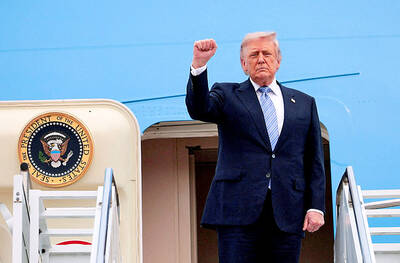
US-CHINA SUMMIT: MOFA welcomed US reassurance of no change in its Taiwan policy; Trump said he did not comment when Xi talked of opposing independence US President Donald Trump yesterday said he has not made a decision on whether to move forward with a major arms package for Taiwan after hearing concerns about it from Chinese President Xi Jinping (習近平). Trump’s comments on Taiwan came as he flew back to Washington after wrapping up critical talks in which both leaders said important progress was made in stabilizing US-China relations even as deep differences persist between the world’s two biggest powers on Iran and Taiwan. “I will make a determination,” Trump said, adding: “I’ll be making decisions. But, you know, I think the last thing we need right
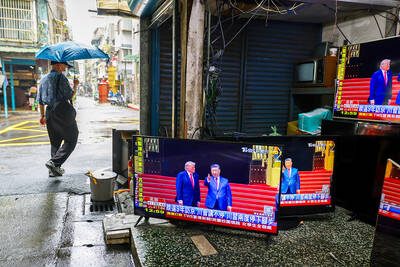
TAIWAN ISSUE: US treasury secretary Scott Bessent said on the first day of meetings that ‘it wouldn’t be a US-China summit without the Taiwan issue coming up’ There were no surprises on the first day of the summit between US President Donald Trump and Chinese President Xi Jinping (習近平), the Mainland Affairs Council (MAC) said yesterday, as the government reiterated that cross-strait stability is crucial to the Asia-Pacific region, as well as the world. As the two presidents met for a highly anticipated summit yesterday, Chinese state media reported that Xi warned Trump that missteps regarding Taiwan could push their two countries into “conflict.” Trump arrived in China with accolades for his host, calling Xi a “great leader” and “friend,” and extending an invitation to visit the White House
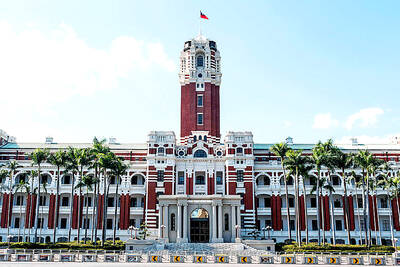
SECURITY: Taipei presses the US for arms supplies, saying the arms sales are not only a reflection of the US security commitment to Taiwan but also serve as a mutual deterrent against regional threats Taiwan is committed to preserving the cross-strait “status quo” and contributing to regional peace and stability, the Presidential Office said yesterday. “It is an undeniable fact that the Republic of China is a sovereign and independent democratic nation,” Presidential Office spokeswoman Karen Kuo (郭雅慧) reiterated, adding that Beijing has no right to claim sovereignty over Taiwan. The statements came after US President Donald Trump warned against Taiwanese independence. Trump wrapped up a state visit to Beijing on Friday, during which Chinese President Xi Jinping (習近平) had pressed him not to support Taiwan. Taiwan depends heavily on US security backing to deter China from carrying


 RSS
RSS