


China’s armed forces secretly trained about 200 Russian military personnel in China late last year, and some have since returned to fight in Ukraine, according to three European intelligence agencies and documents seen by Reuters.
While China and Russia have held a number of joint military exercises since Moscow’s full-scale invasion of Ukraine in 2022, Beijing has repeatedly said that it is neutral in the conflict and presents itself as a peace mediator.
The covert training sessions, which predominantly focused on the use of drones, were outlined in a dual-language Russian-Chinese agreement signed by senior Russian and Chinese officers in Beijing on July 2 last year.
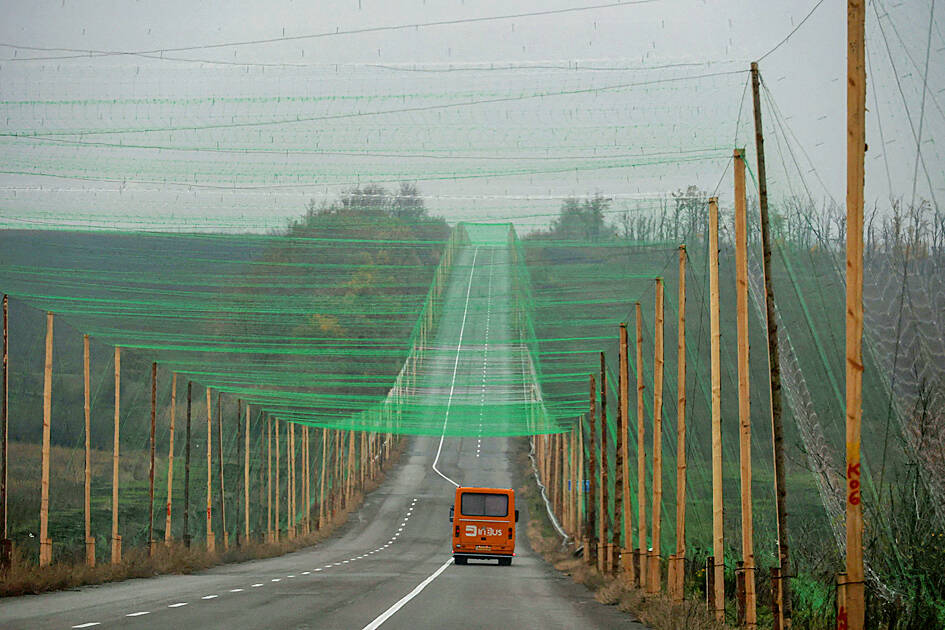
Photo: Reuters
The agreement, reviewed by Reuters, said that about 200 Russian troops would be trained at military facilities in locations including Beijing and the eastern city of Nanjing.
About that number of soldiers subsequently trained in China, the sources said.
The agreement also said that hundreds of Chinese troops would undergo training at military facilities in Russia.
By training Russian military personnel at an operational and tactical level who then participate in Ukraine, China is far more directly involved in the war on the European continent than previously known, one intelligence official said.
The Russian and Chinese defense ministries did not respond to requests for comment.
“On the Ukraine crisis, China has consistently maintained an objective and impartial stance and worked to promote peace talks, this is consistent and clear and is witnessed by the international community,” the Chinese Ministry of Foreign Affairs said in a statement. “Relevant parties should not deliberately stoke confrontation or shift blame.”
The intelligence agencies spoke on condition they not be identified in order to discuss sensitive information.
European powers, which see Russia as a major security threat, have watched warily at increasingly close relations between Russia and China, the world’s second-largest economy and an important EU trade partner.
The two nations announced a “no limits” strategic partnership days before Russia’s invasion of Ukraine in 2022 and pledged to conduct military exercises to rehearse coordination between their armed forces. As the West tried to isolate Russia, China provided a lifeline by buying its oil, gas and coal.
Chinese President Xi Jinping (習近平) on Tuesday and yesterday hosted Russian President Vladimir Putin, less than a week after US President Donald Trump’s high-profile visit.
China and Russia have cast Putin’s trip — his 25th visit to China — as further evidence of their “all-weather” partnership, even as the West urges Beijing to pressure Moscow into ending its war in Ukraine.
Both sides use long-range models to attack targets hundreds of miles away, while on the battlefield, smaller drones that are remotely controlled by pilots using first-person view equipment and armed with explosives dominate the sky, making it hazardous for armored vehicles or infantry to move.
In September last year, Reuters reported that experts from private Chinese companies had conducted technical development work on military drones for a Russian attack drone manufacturer, according to European officials.
China’s foreign ministry said then it was unaware of the collaboration.
The EU last month sanctioned the two companies identified in the article.
According to the training agreement, the Russians would be schooled in disciplines such as drones, electronic warfare, army aviation and armored infantry. The agreement prohibited any media coverage of the visits in either country and said no third parties should be informed.
Visits by Chinese troops to Russia for training have been taking place since at least 2024, but Russian personnel training in China is new, two of the intelligence agencies said.
While Russia has extensive combat experience in Ukraine, China’s vast drone industry offers technological know-how and advanced training methods such as flight simulators, they said.
The Chinese People’s Liberation Army (PLA) has not fought a major war for decades, but it has expanded quickly in the past 20 years and rivals US military might in some areas.
A significant number of Russian personnel who received training in China were ranking military instructors in a position to pass knowledge down the chain of command, the two intelligence agencies said.
One of the agencies said they had confirmed the identities of a handful of Russian military personnel who trained in China and had since been directly involved in combat operations with drones in Ukraine’s occupied Crimea and Zaporizhzhia regions.
The rank of those people ranged from junior sergeant to lieutenant colonel, the agency said.
The names of the individuals appeared in a Russian military document seen by Reuters that listed the service members going to China. Reuters was unable to independently confirm the subsequent involvement of those individuals in the Ukraine war.
The same intelligence agency said it was highly probable that many of those who trained in China had gone to Ukraine.
Internal Russian military reports described four of the training sessions for Russian troops in China after they had taken place.
One report dated December last year described a training course on combined-arms warfare for about 50 Russian military personnel at the Army Infantry College of the PLA branch in Shijiazhuang.
The report said the course involved training soldiers to fire 82mm mortars while using uncrewed aerial vehicles to identify their targets.
A second report described air defense training at a military facility, including the use of electronic warfare rifles, net-throwing devices and drones to counter incoming drones. Two officials said the facility was located in Zhengzhou.
All of those types of equipment are relevant to the war in Ukraine. Electronic warfare rifles are aimed at incoming drones to interfere with and disrupt their signals, while nets can be thrown around drones to ensnare them as they approach.
Both sides use fiber-optic aerial drones connected to their pilots by fine thread that cannot be jammed electronically. Fiber-optic drones typically operate with a range of 10km to 20km, but some can go as far as 40km.
A third report, dated December last year and written by a Russian major, described drone training for Russian personnel at Yibin’s PLA Training Center for Military Aviation, First Brigade.
The course centered around multimedia presentations and involved the use of flight simulators, training to use several types of first-person view drone and two other types of drones, it said.
A fourth report described a course in November last year at the Army Engineering University of the PLA Infantry. The training covered explosives technology, mine construction, demining, and the removal of unexploded ordnance and improvised explosive devices.
The report included photographs of Russian soldiers in uniform being taught by Chinese instructors in military uniform. The images also showed Russian soldiers being shown engineering equipment and how to sweep for mines.

Kouri Richins, a Utah mother who published a children’s book about grief after the death of her husband is to serve a life sentence for his murder without the possibility of parole, a judge ruled on Wednesday. Richins was convicted in March of aggravated murder for lacing a cocktail given to her husband, Eric Richins, with five times the lethal dose of fentanyl at their home near Park City in 2022. A jury also found her guilty of four other felonies, including insurance fraud, forgery and attempted murder for trying to poison her husband weeks earlier on Feb. 14, 2022, with a
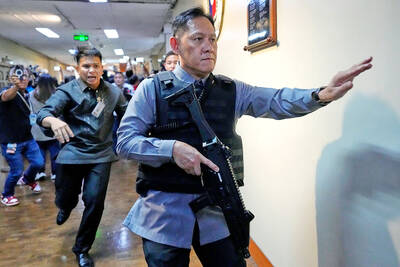
DELA ROSA CASE: The whereabouts of the senator, who is wanted by the ICC, was unclear, while President Marcos faces a political test over the senate situation Philippine authorities yesterday were seeking confirmation of reports that a top politician wanted by the International Criminal Court (ICC) had fled, a day after gunfire rang out at the Philippine Senate where he had taken refuge fearing his arrest. Senator Ronald “Bato” dela Rosa, the former national police chief and top enforcer of former Philippine president Rodrigo Duterte’s “war on drugs,” has been under Senate protection and is wanted for crimes against humanity, the same charges Duterte is accused of. “Several sources confirmed that the senator, Senator Bato, is no longer in the Senate premises, but we are still getting confirmation,” Presidential

HELP DENIED? The US Department of State said that the Cuban leadership refuses to allow the US to provide aid to Cubans, ‘who are in desperate need of assistance’ US Secretary of State Marco Rubio on Wednesday said that Cuba’s leadership must change, as Washington renewed an offer of US$100 million in aid if the communist nation agrees to cooperate. Cuba has been suffering severe economic tumult led by an energy shortage that plunged 65 percent of the country into darkness on Tuesday. Cuba’s leaders have blamed US sanctions, but Rubio, a Cuban American and critic of the government established by Fidel Castro, said the system was to blame, including corruption by the military. “It’s a broken, nonfunctional economy, and it’s impossible to change it. I wish it were different,” he told

Myanmar yesterday published a parliamentary bill proposing the death sentence for those who detain or violently coerce people into working in online scam centers. Internet fraud factories have flourished in Myanmar, part of Southeast Asia’s scam economy, targeting Internet users worldwide with romance and cryptocurrency investment cons. The multibillion-dollar black market attracts many willing employees, but repatriated foreigners have also reported being trafficked to sites in Myanmar and tortured by scam center operators. The draft legislation would allow capital punishment for “violence, torture, unlawful arrest and detention, or cruel treatment against another person for the purpose of forcing them to commit online scams.” The


 RSS
RSS