


A joint European-Chinese spacecraft is set to blast off tomorrow to investigate what happens when extreme winds and giant explosions of plasma shot out from the sun slam into Earth’s magnetic shield.
Particularly fierce solar storms can knock out satellites, threaten astronauts — and create colorful auroras in the skies of northern and southern latitudes.
To find out more about this little-understood space weather, the van-sized SMILE spacecraft is tasked with making the first-ever X-ray observations of Earth’s magnetic field.
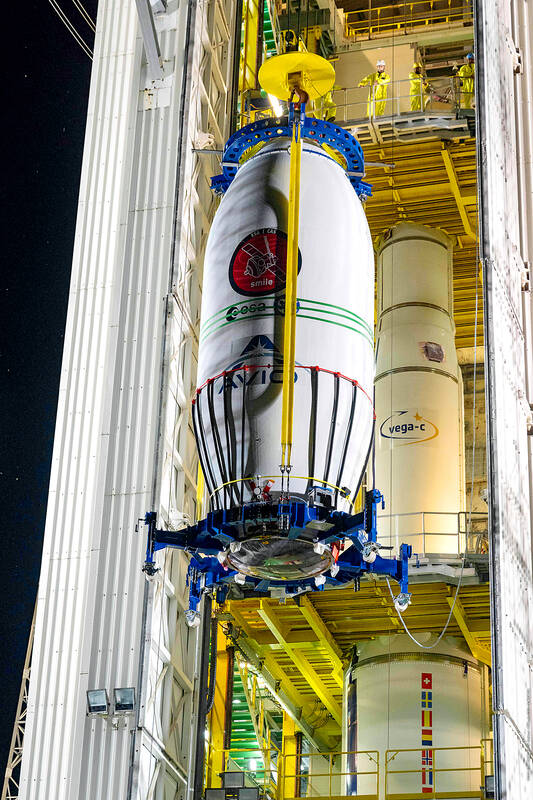
Photo: S. Martin, AFP/ESA/CNES/Avio/Optique Video du CSG
The spacecraft is scheduled to launch on a Vega-C rocket from Europe’s spaceport in Kourou, French Guiana, on the northeastern coast of South America.
Lift-off was originally planned for April 9, but was postponed due to a technical issue.
SMILE — or the Solar Wind Magnetosphere Ionosphere Link Explorer — is a joint mission between the European Space Agency (ESA) and the Chinese Academy of Sciences.
“What we want to study with SMILE is the relationship between the Earth and the sun,” ESA scientist Philippe Escoubet said.
Solar wind is a stream of charged particles shot out from the sun. Sometimes, this wind is kicked up into a huge storm by massive eruptions of plasma called coronal mass ejections.
Hurtling at about 2 million kilometers per hour, these powerful blasts take a day or two to reach Earth. When they arrive, Earth’s magnetic field acts as a shield, deflecting most of the charged particles.
However, during particularly intense events, some particles can penetrate our atmosphere, where they have the potential to take out power grids or communication networks. They also create dazzling auroras known as the northern or southern lights.
During the worst geomagnetic storm on record in 1859, bright auroras were seen as far south as Panama — and telegraph operators around the world were given electric shocks.
Solar winds also pose a danger to satellites orbiting Earth, as well as astronauts sheltering inside space stations.
Given these threats, scientists want to learn more about space weather, so the world can better forecast and prepare for big blasts in the future.
To help with this endeavor, the SMILE mission plans to detect the X-rays emitted when charged particles from the sun interact with the neutral particles of Earth’s upper atmosphere.
The spacecraft would observe this phenomenon from several important locations, including the magnetopause — where the magnetic shield deflects solar particles.
It would also soar above the Earth’s poles, where X-ray photons are visible, French National Centre for Scientific Research researcher Dimitra Koutroumpa said.
The spacecraft has four scientific instruments, including a UK-built X-ray imager, as well as a UV imager, ion analyzer and magnetometer all made by the Chinese Academy of Sciences.
SMILE is expected to start collecting data just an hour after it is put into orbit. The mission is designed to run for three years, but could be extended if all goes well.


Through the noise of rushing papers and whirring belts at a print factory in Kyoto, two creators watch their photo essay come to life in broadsheet form — part of an effort to win new audiences in the age of artificial intelligence (AI). Despite the decline of the publishing industry, self-publication and handmade “zine” magazines are growing in popularity in Japan, reflecting the nation’s enduring love of paper in the digital era. While speaking to Agence France-Presse at the plant, his hands black with ink, one of the creators, Kazuma Obara, said: “I think [paper] is a medium that engages all five
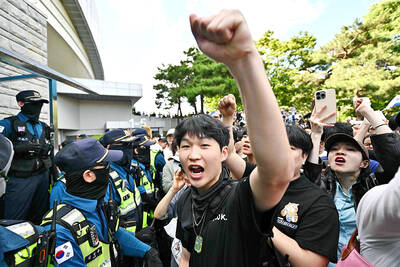
‘ABSURD MISTAKE’: The election commission said that there had been a failure to anticipate turnout after 14 polling stations ran short of ballot papers South Korean riot police yesterday cleared protesters from a Seoul polling station after a 35-hour blockade sparked by a shortage of ballot papers during local elections earlier this week. Wednesday’s election was the first nationwide vote since South Korean President Lee Jae-myung took office following the ouster of Yoon Suk-yeol over his short-lived martial law declaration. Lee’s ruling Democratic Party swept most races, but failed to flip the crucial Seoul mayoral seat. The South Korean National Election Commission apologized, blaming a failure to anticipate turnout after 14 polling stations in Seoul ran short of ballot papers. Some polling stations stayed open until 10pm to

France experienced its hottest spring on record, the French weather service said on Tuesday, after an exceptional early heat wave that also broke highs for the season in England and Wales. Meteo-France said the average nationwide temperature over March to May was 13.8°C — about 1.7°C above the norm, and surpassing records set in 2011 and 2020. “The warmest spring since records began in 1900,” it said in a bulletin. All three months were warmer than average, but the onset of an “unprecedented heatwave” late last month pushed the mercury to highs typically seen at the height of the summer. “Our country had never
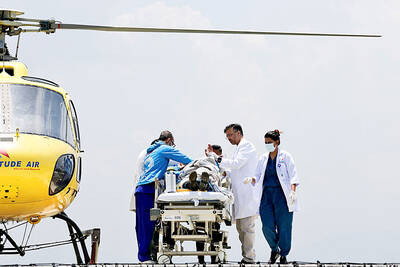
A Sherpa guide was found crawling to base camp on Mount Everest a week after he went missing and was reunited with his family, who had given up hope he would return. Dawa Sherpa was last seen on Friday last week descending the mountain, but he did not reach base camp even though his client did. The pair were among the last climbers on the mountain as the climbing season came to an end and the route was dismantled. Dawa was located by a cleaning crew on Thursday morning as he was crawling down the snowy slopes around the Khumbu Icefall, just above


 RSS
RSS