


Indonesia’s president yesterday ordered an investigation after a long-distance train smashed into a stationary commuter train overnight, killing 14 people and injuring dozens.
Officials ended a nearly 12-hour rescue effort near Bekasi Timur Station, east of the capital, Jakarta, which saw crews prying open mangled carriages following the Monday night collision.
“And this morning ... it is all finished,” Mohammad Syafii, head of the National Search and Rescue Agency told a news conference yesterday. “I am certain there are no more victims to be found.”
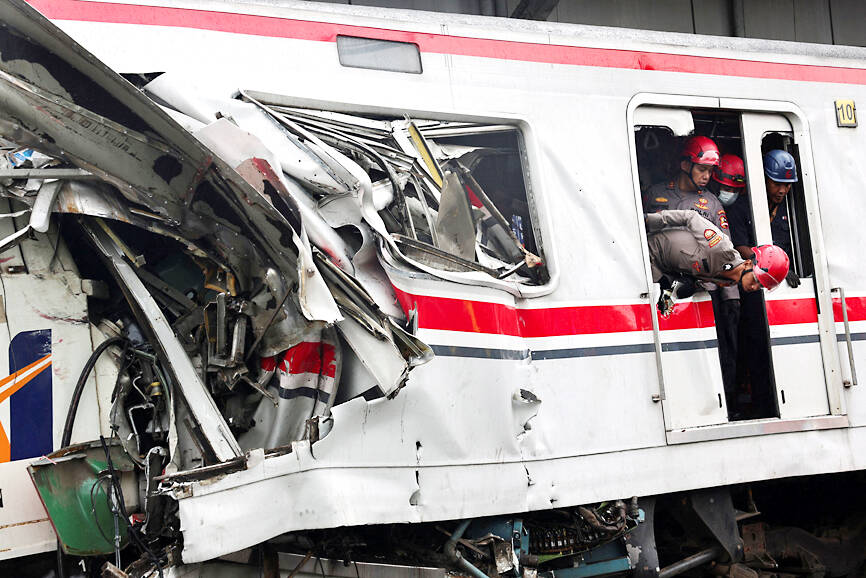
Photo: Reuters
One survivor described the terror of being trapped inside a crushed carriage.
“I thought I was going to die,” Sausan Sarifah, 29, said from her bed at RSUD Bekasi hospital where she was admitted with a broken arm and a deep cut to one thigh.
She was on her way home from work on Monday night when her train stopped at Bekasi Timur Station, she said.
“It all happened so fast, in a split second,” Sausan said. “There were two announcements from the commuter train. Everyone was ready to get off, and then suddenly there was the sound of the locomotive, really loud. There was no time to get out, and everyone ended up piled up inside the train, crushed on top of one another. I don’t know how the person underneath me is doing.”
She said she had feared suffocating to death in the human pileup, and worried that some pinned underneath did not make it.
“Thank God I was on top, so I could be evacuated quickly,” she said.
State-owned rail operator KAI yesterday said that the death toll had risen to 14.
Another 84 people required medical treatment, it said, without specifying how many remained hospitalized.
KAI spokesman Franoto Wibowo said that a taxi appears to have clipped the commuter train on a level crossing, causing it to come to a standstill on the tracks, where it was hit.
At the station, chaotic scenes unfolded in the aftermath of the crash, with rescue workers shouting for oxygen tanks as ambulances stood by, lights flashing.
A reporter at the scene witnessed people being carried out of the wreckage on gurneys and loaded into waiting ambulances as hundreds of bystanders looked on, some seemingly in shock.
The military, fire brigade, the national search and rescue agency and the Red Cross aided in the massive evacuation effort that followed.
Indonesian President Prabowo Subianto yesterday visited hospital patients in Bekasi, offered his condolences to relatives of the deceased, and said he had ordered an “immediate investigation.”
He also ordered the construction of an overpass in Bekasi.
“In general, we do see that many railway crossings are not guarded,” the president said. “I have ordered that we immediately repair all these crossings, either by guard posts or by flyovers.”
Jakarta Police Chief Asep Edi Suheri said the long-distance train had crashed into the last, women-only, carriage of the commuter train.
All the victims were in the commuter train and all 240-odd passengers on the other train had been evacuated safely, KAI spokeswoman Anne Purba said.
The agency said it would cover all medical expenses for the injured and funeral costs for the deceased.
The collision had caused “significant damage to several train carriages,” the Jakarta search and rescue agency said in a statement.
Several people were trapped in the carriages “due to the force of the impact,” it added.
The rescue agency would not say whether all had been freed.
Eva Chairista, 39, said that she had rushed to RSUD Bekasi hospital after hearing that her sister-in-law, who she named only as 27-year-old Fira, had been injured in the crash.
She arrived to a frenetic scene of medical triage.
“The doctor told us to be patient, there are many whose condition is worse than my sister-in-law’s,” she said.

Kouri Richins, a Utah mother who published a children’s book about grief after the death of her husband is to serve a life sentence for his murder without the possibility of parole, a judge ruled on Wednesday. Richins was convicted in March of aggravated murder for lacing a cocktail given to her husband, Eric Richins, with five times the lethal dose of fentanyl at their home near Park City in 2022. A jury also found her guilty of four other felonies, including insurance fraud, forgery and attempted murder for trying to poison her husband weeks earlier on Feb. 14, 2022, with a

DELA ROSA CASE: The whereabouts of the senator, who is wanted by the ICC, was unclear, while President Marcos faces a political test over the senate situation Philippine authorities yesterday were seeking confirmation of reports that a top politician wanted by the International Criminal Court (ICC) had fled, a day after gunfire rang out at the Philippine Senate where he had taken refuge fearing his arrest. Senator Ronald “Bato” dela Rosa, the former national police chief and top enforcer of former Philippine president Rodrigo Duterte’s “war on drugs,” has been under Senate protection and is wanted for crimes against humanity, the same charges Duterte is accused of. “Several sources confirmed that the senator, Senator Bato, is no longer in the Senate premises, but we are still getting confirmation,” Presidential

Nauru said it would hold a referendum to change its official name, described as a colonial relic from a time when “foreign tongues” mangled the native language. Nauru would change its name to Naoero to “more faithfully honor our nation’s heritage, our language and our identity,” Nauruan President David Adeang said in a statement on Tuesday. The Pacific island nation’s native language is Dorerin Naoero, which is spoken by the vast majority of its approximately 10,000 inhabitants. “Nauru emerged because Naoero could not be properly pronounced by foreign tongues, and was changed not by our choice, but for convenience,” the government said in

HELP DENIED? The US Department of State said that the Cuban leadership refuses to allow the US to provide aid to Cubans, ‘who are in desperate need of assistance’ US Secretary of State Marco Rubio on Wednesday said that Cuba’s leadership must change, as Washington renewed an offer of US$100 million in aid if the communist nation agrees to cooperate. Cuba has been suffering severe economic tumult led by an energy shortage that plunged 65 percent of the country into darkness on Tuesday. Cuba’s leaders have blamed US sanctions, but Rubio, a Cuban American and critic of the government established by Fidel Castro, said the system was to blame, including corruption by the military. “It’s a broken, nonfunctional economy, and it’s impossible to change it. I wish it were different,” he told


 RSS
RSS