


North Korean leader Kim Jong-un showcased his tighter ties with old allies and battlefield lessons from Ukraine, as he positions North Korea as a strong nuclear power before US President Donald Trump’s trip to China.
After three days of back-to-back missile tests, including purported cluster munitions plus a bomb for targeting enemy electric grids, North Korea is hosting China’s top diplomat for the first time in six years. That comes months after Kim stood beside Chinese President Xi Jinping (習近平) and Russian President Vladimir Putin at a military parade in Beijing, for what Chinese Minister of Foreign Affairs Wang Yi (王毅) called a “historic meeting.”
Kim and Wang on Friday reaffirmed close bilateral ties in their discussions in Pyongyang, the state-run Korean Central News Agency (KCNA) reported.
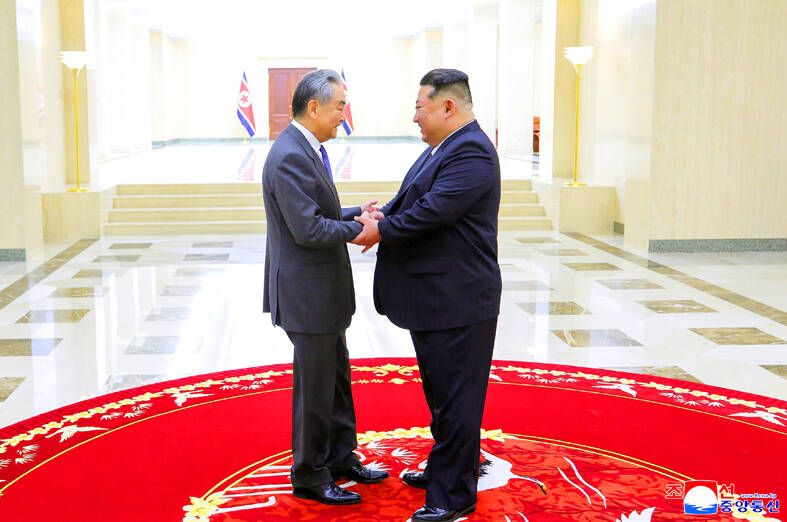
Photo: EPA/KCNA
Kim stressed the need for broader contact to protect the two countries’ shared strategic interests, while Wang highlighted Beijing’s commitment to advancing relations under last year’s agreement, the KCNA said.
Rail links and Air China flights between Beijing and Pyongyang resumed this year, with analysts speculating this could pave the way for a future return of Chinese tourists to North Korea, which would give Kim another source of hard currency.
Kim’s flurry of diplomacy — and weapons tests — come as Trump gears up to travel to China in the first visit of a sitting US president in nearly a decade. South Korea has been trying to encourage a meeting between the US and North Korean leaders around that trip, but it is unclear whether either side is open to the idea.
“North Korea now has a battle-forged alliance with Russia, and China continues to stand behind the regime,” Korea Research Institute for National Strategy researcher Doo Jin-ho said. “It’s no longer the country it once was — and is much harder for the US to deal with.”
Trump and Kim met three times during the US president’s first term, as the Republican leader worked to convince the North Korean leader to scale back his nuclear program — an effort that ultimately failed.
Despite that, Trump has said he gets along with Kim “very well” and would be available for another meeting.
Bolstered by growing military ties with Russia — and now closer relations with Beijing — Kim has asked Washington to recognize it as a nuclear power for any dialogue to begin.
Wang’s trip marks the latest in North Korea’s broader efforts to bolster overseas ties after years of isolation and sanctions. Kim has also hosted Belarusian President Alexander Lukashenko in Pyongyang, and signed a treaty of friendship and cooperation.
Lukashenko and Kim are allies in Putin’s war against Ukraine. North Korea provided artillery ammunition, missiles and soldiers, while Belarus served as a launchpad for Russia’s full-scale invasion in the neighboring nation four years ago.
Although diplomatically solid, the Russia relationship appears to have cooled off a bit in recent months, Leiden University professor and Crisis Group analyst Christopher Green said.
It is “natural Kim would rebalance, seeking to maintain as diversified a range of partners and income sources as he can within the limits of North Korea’s capabilities,” he added.
The experience gained by North Korea in the Russian conflict with Ukraine is helping it modernize its military, including by incorporating drone intelligence directly into artillery firing systems and creating smaller, more nimble infantry units instead of large scale battalions, Henry Jackson Society National Security Centre Director John Hemmings said.
Pyongyang is also now attaching growing importance to artificial intelligence, anti-satellite weapons and electronic warfare.
The upshot is that the Korean People’s Army “is significantly more dangerous than the one that existed just two years ago,” Hemmings said.


Showcasing phallus-shaped portable shrines and pink penis candies, Japan’s annual fertility festival yesterday teemed with tourists, couples and families elated by its open display of sex. The spring Kanamara Matsuri near Tokyo features colorfully dressed worshipers carrying a trio of giant phallic-shaped objects as they parade through the street with glee. The festival, as legend has it, honors a local blacksmith in the Edo Period (1603-1868) who forged an iron dildo to break the teeth of a sharp-toothed demon inhabiting a woman’s vagina that had been castrating young men on their wedding nights. A 1m black steel phallus sits in the courtyard of
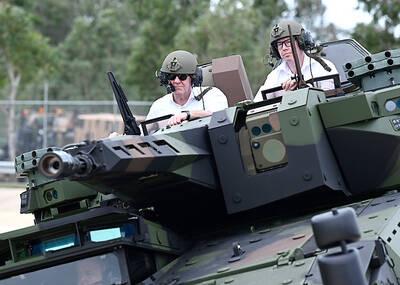
JAN. 1 CLAUSE: As military service is voluntary, applications for permission to stay abroad for over three months for men up to age 45 must, in principle, be granted A little-noticed clause in sweeping changes to Germany’s military service policy has triggered an uproar after it emerged that the law requires men aged up to 45 to get permission from the armed forces before any significant stay abroad, even in peacetime. The legislation, which went into effect on Jan. 1 aims to bolster the military and demands all 18-year-old men fill out a questionnaire to gauge their suitability to serve in the armed forces, but stops short of conscription. If the “modernized” model fails to pull in enough recruits, parliament will be compelled to discuss the reintroduction of compulsory service, German
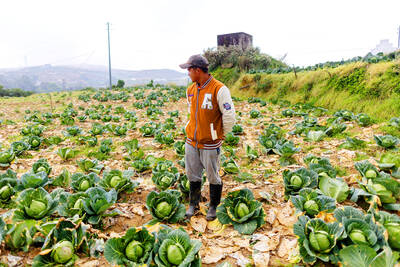
Filipino farmers like Romeo Wagayan have been left with little choice but to let their vegetables rot in the field rather than sell them at a loss, as rising oil prices linked to the Iran war drive up the cost of harvesting, labor and transport. “There’s nothing we can do,” said Wagayan, a 57-year old vegetable farmer in the northern Philippine province of Benguet. “If we harvest it, our losses only increase because of labor, transportation and packing costs. We don’t earn anything from it. That’s why we decided not to harvest at all,” he said. Soaring costs caused by the Middle East
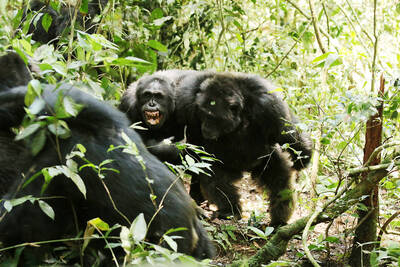
For two decades, researchers observed members of the Ngogo chimpanzee group of Kibale National Park in Uganda spend their days eating fruits and leaves, resting, traveling and grooming in their tropical rainforest abode, but this stable community then fractured and descended into years of deadly violence. The researchers are now describing the first clearly documented example of a group of wild chimpanzees splitting into two separate factions, with one launching a series of coordinated attacks against the other. Adult males and infants were targeted, with 28 deaths. “Biting, pounding the victim with their hands, dragging them, kicking them — mostly adult males,


 RSS
RSS