


Thousands of people across Greece yesterday demonstrated in solidarity with victims of the country’s worst train tragedy, which claimed 57 lives in 2023 and rattled the government of Greek Prime Minister Kyriakos Mitsotakis.
With a long-awaited trial into the disaster looming next month, unanswered questions remain about the accident and the ensuing investigation, which victims’ relatives said was deficient and left state officials largely untouched.
Most of those killed in the crash on Feb. 28, 2023, were young students aboard a passenger locomotive carrying about 350 people from Athens to Thessaloniki that hit a freight train in the dead of the night.
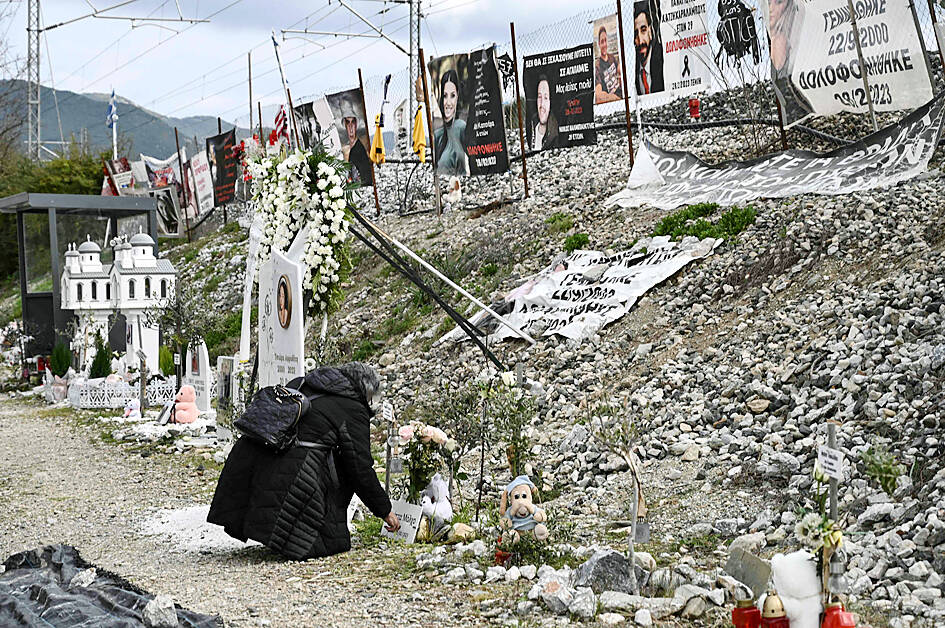
Photo: AFP
The crash was “not a stroke of bad luck,” an association of victims’ relatives said. “It was an expression of an inhuman policy that, in the face of profitability and profit, does not even take human life into account, a policy that breeds and covers up crimes.”
More than 300,000 people rallied to mark last year’s anniversary, one of the biggest demonstrations the country has seen since the decade-long financial crisis, which began in late 2009.
This year was to see demonstrations in more than 70 towns and cities across Greece.
Unions went on strikes, while stores in Athens were urged to close.
The two trains had run on the same track for more than 10 minutes without triggering any alarm, laying bare the parlous state of the Greek railway network’s security fail-safes — despite EU grants for their modernization.
European Chief Prosecutor Laura Kovesi said the accident could have been avoided if an EU-funded railway signaling project had been completed on time.
The victims’ families have protested that valuable clues were lost when the crash site was bulldozed soon after the accident, sparking allegations the government was literally trying to bury the evidence.
Several parents have also demanded tests to determine whether their children were killed by the collision, or by a fire that broke out afterwards, with one going on a hunger strike last year.
Earlier this month, experts appointed by the families said the passenger train had poorly-insulated seating that enabled the fire to spread.
Despite the disaster, Mitsotakis comfortably won re-election just months later, and went on to defeat two votes of no confidence on the issue.
However, anger continues to simmer, increasing support for smaller opposition parties, including one headed by a leading lawyer for the accident victims.
The mother of another victim, Maria Karystianou, has announced plans for a new party.
“We don’t just want to remain a protest movement. We really want to see some things change in the country,” Karystianou said.
Nearly 40 people are to go on trial on March 23, including railway executives and the station master on duty that night. They risk prison sentences of up to 20 years.
Two former Greek ministers, including the former minister of infrastructure and transport, were also referred to justice by parliament, but face only misdemeanor charges at present.
The European prosecutor has separately charged more than 30 people with various offenses, including subsidy fraud.

Kouri Richins, a Utah mother who published a children’s book about grief after the death of her husband is to serve a life sentence for his murder without the possibility of parole, a judge ruled on Wednesday. Richins was convicted in March of aggravated murder for lacing a cocktail given to her husband, Eric Richins, with five times the lethal dose of fentanyl at their home near Park City in 2022. A jury also found her guilty of four other felonies, including insurance fraud, forgery and attempted murder for trying to poison her husband weeks earlier on Feb. 14, 2022, with a

‘PERSONAL MISTAKES’: Eileen Wang has agreed to plead guilty to the felony, which comes with a maximum sentence of 10 years in federal prison A southern California mayor has agreed to plead guilty to acting as an illegal agent for the Chinese government and has resigned from her city position, officials said on Monday. Eileen Wang (王愛琳), mayor of Arcadia, was charged last month with one count of acting in the US as an illegal agent of a foreign government. She was accused of doing the bidding of Chinese officials, such as sharing articles favorable to Beijing, without prior notification to the US government as required by law. The 58-year-old was elected in November 2022 to a five-person city council, from which the mayor is selected

DELA ROSA CASE: The whereabouts of the senator, who is wanted by the ICC, was unclear, while President Marcos faces a political test over the senate situation Philippine authorities yesterday were seeking confirmation of reports that a top politician wanted by the International Criminal Court (ICC) had fled, a day after gunfire rang out at the Philippine Senate where he had taken refuge fearing his arrest. Senator Ronald “Bato” dela Rosa, the former national police chief and top enforcer of former Philippine president Rodrigo Duterte’s “war on drugs,” has been under Senate protection and is wanted for crimes against humanity, the same charges Duterte is accused of. “Several sources confirmed that the senator, Senator Bato, is no longer in the Senate premises, but we are still getting confirmation,” Presidential

HELP DENIED? The US Department of State said that the Cuban leadership refuses to allow the US to provide aid to Cubans, ‘who are in desperate need of assistance’ US Secretary of State Marco Rubio on Wednesday said that Cuba’s leadership must change, as Washington renewed an offer of US$100 million in aid if the communist nation agrees to cooperate. Cuba has been suffering severe economic tumult led by an energy shortage that plunged 65 percent of the country into darkness on Tuesday. Cuba’s leaders have blamed US sanctions, but Rubio, a Cuban American and critic of the government established by Fidel Castro, said the system was to blame, including corruption by the military. “It’s a broken, nonfunctional economy, and it’s impossible to change it. I wish it were different,” he told


 RSS
RSS