


Chimpanzees consume the equivalent of at least one alcoholic drink per day as they eat ripe, fermenting fruit, a study published on Wednesday said.
The study was carried out in the wilds of Africa, where the animals live.
The researchers collected fruits that chimps eat and measured their ethanol content, which is produced as sugar ferments.
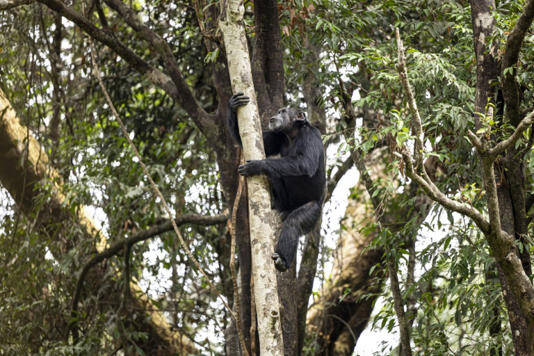
Photo: AFP
They concluded that the animals consume alcohol on a daily basis — and not just a little.
Through the large amount of fruit that chimps eat, the researchers said that they take in about 14g of alcohol per day.
Correcting for body size, it is like the chimps are drinking a pint of beer per day, said Aleksey Maro, lead author of the study published in the journal Science Advances.
“It’s not an insubstantial amount of alcohol, but very diluted and more associated with food,” said Maro, who is a doctoral candidate at the University of California, Berkeley.
“We’ve seen for the first time that, indeed, our closest living relatives are consuming physiologically relevant doses of alcohol routinely daily,” Maro said.
This is in line with the “drunken monkey theory” espoused more than a decade ago by US biologist Robert Dudley, who coauthored the new study.
The theory is that humans liking alcohol and being able to metabolize it stems from primate ancestors ingesting it daily through the fruit they eat.
“The drunken monkey hypothesis is becoming more and more a reality,” Maro said. “Its name is unfortunate. A better name would be the evolutionary hangover.”
Nathaniel Dominy, a professor of anthropology and evolutionary biology at Dartmouth College who did not take part in this study, welcomed it.
“The paper is a tour de force,” Dominy told reporters.
He said it “puts to rest the debate over the prevalence of ethanol in tropical fruits.”
However, the study raises new questions on the biological and behavioral consequences of chronic low-level ethanol exposure for primates, he said.
Another unanswered question is whether chimps search out boozy fruit or just eat it when they find it.
The researchers in this study said they did not know.
The issue of chimps ingesting alcohol will remain under study to learn more about the origins of human alcohol consumption, and assess its risks and possible benefits, Maro said.
“We can learn about ourselves through the chimpanzees,” he said.

An American scientist convicted of lying to US authorities about payments from China while he was at Harvard University has rebuilt his research lab in Shenzhen, China, to pursue technology the Chinese government has identified as a national priority: embedding electronics into the human brain. Charles Lieber, 67, is among the world’s leading researchers in brain-computer interfaces. The technology has shown promise in treating conditions such as amyotrophic lateral sclerosis and restoring movement in paralyzed people. It also has potential military applications: Scientists at the Chinese People’s Liberation Army have investigated brain interfaces as a way to engineer super soldiers by boosting

Jailed media entrepreneur Jimmy Lai (黎智英) has been awarded Deutsche Welle’s (DW) freedom of speech award for his contribution to Hong Kong’s pro-democracy movement. The German public broadcaster on Thursday said Lai would be presented in absentia with the 12th iteration of the award on June 23 at the DW Global Media Forum in Bonn. Deutsche Welle director-general Barbara Massing praised the 78-year-old founder of the now-shuttered news outlet Apple Daily for standing “unwaveringly for press freedom in Hong Kong at great personal risk.” “With Apple Daily, he gave journalists a platform for free reporting and a voice to the democracy movement in
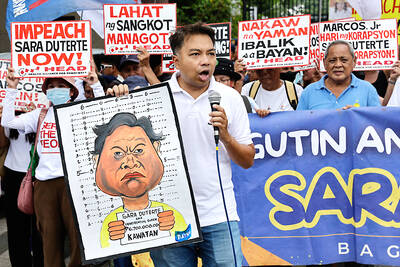
PHILIPPINE COMMITTEE: The head of the committee that made the decision said: ‘If there is nothing to hide, there is no reason to hide, there is no reason to obstruct’ A Philippine congressional committee on Wednesday ruled that there was “probable cause” to impeach Philippine Vice President Sara Duterte after hearing allegations of unexplained wealth, misuse of state funds and threats to have the president assassinated. The unanimous decision of the 53-member committee in the Philippine House of Representatives sends the two impeachment complaints to deliberations and voting by the entire lower chamber, which has more than 300 lawmakers. The complaints centered on Duterte’s alleged illegal use and mishandling of intelligence funds from the vice president’s office, and from her time as education secretary under Philippine President Ferdinand Marcos Jr. Duterte and the

Burmese President Min Aung Hlaing yesterday cut all prisoners’ sentences by one-sixth, a blanket measure that a source close to deposed leader Aung San Suu Kyi said would further shorten her detention. Aung San Suu Kyi has been sequestered since a 2021 military coup, but the senior member of her dissolved National League for Democracy (NLD) party said that while her term had been reduced, her remaining sentence is still unclear. “We also don’t know exactly how many years she has left,” the source told reporters, speaking on condition of anonymity for security reasons. The military toppled Aung San Suu Kyi’s elected government


 RSS
RSS