

Leftist candidate Jeannette Jara and far-right leader Jose Antonio Kast are to go head-to-head in Chile’s presidential runoff after topping Sunday’s first round of voting in an election dominated by fears of violent crime.
With 99 percent of the results counted, Jara, a 51-year-old communist running on behalf of an eight-party coalition, won 26.85 percent, compared with 23.93 percent for Kast, the Servel electoral service said.
The election was dominated by deep concern over a surge in murders, kidnappings and extortion widely blamed on foreign crime gangs.

Photo: EPA
Kast, 59, has vowed to build walls, fences and trenches along Chile’s border with Bolivia to keep out migrants from poorer countries to the north, such as Venezuela.
After Sunday’s results came in, he vowed to “rebuild” Chile after four years of center-left rule, which he termed “maybe the worst government in Chile’s democratic history.”
“Chile woke up tonight,” the straight-laced, ultraconservative father of nine said, adding that while he was perhaps “not the most likeable,” he felt he had a mandate from 1 million Chilean voters.

Photo: Bloomberg
The right also secured a majority in simultaneous elections to the Chamber of Deputies and the Senate, partial results showed.
Jara, who served in the administration of outgoing left-wing Chilean President Gabriel Boric, struggled to overcome strong anticommunist sentiment in one of Latin America’s most open economies.
Her win, by a far shorter margin than polls had predicted, was seen as an ominous sign for the second round and gave little cause for cheer at her election party.
Rodrigo Arellano, an analyst at Chile’s University for Development, said it seemed “unlikely” she could win the Dec. 14 runoff.
“Not only is her vote count low, but the combined total of the opposition candidates is almost more than double hers,” he said out, linking her score to strong anti-incumbent and anticommunist sentiment.
“Don’t let fear harden your hearts,” Jara appealed to voters, insisting that the answer to crime was not to “come up with ideas, each more radical than the next.”
The vote is seen as a bellwether of support for South America’s left, which has lost power in Argentina and Bolivia in the past two years, and faces a stiff challenge in Colombian and Brazilian elections next year.
Maverick economist Franco Parisi caused surprise by finishing third, ahead of ultra-right lawmaker Johannes Kaiser, and former conservative mayor Evelyn Matthei, the establishment choice, in fifth.
Parisi refrained from backing either Jara or Kast in the presidential runoff, saying that they both needed to go look for new voters “on the street.”
Chile is one of Latin America’s safest countries, but the murder rate has doubled in a decade to exceed that of the US.
The crime surge has happened in tandem with a doubling of the immigrant population since 2017, now comprising 8.8 percent of the population. Wall-to-wall news coverage of crime has led to a clamor for a “mano dura” (iron fist).
“I hope that some day we’ll go back to the way we were before,” said Mario Faundez, an 87-year-old retired salesman, who voted in the wealthy Santiago district of Providencia. “If we have to kill [criminals], so be it.”
A combative Kast told cheering supporters that while the opposition had won Sunday’s vote, “the only real victory will be when we defeat crime and drug trafficking, and close our borders.”
If elected, the ultraconservative father of nine would be the first far-right leader since the 1973-1990 military dictatorship of Augusto Pinochet.
He has defended Pinochet, whose regime killed thousands of dissidents under the pretext of fighting communism during the Cold War.
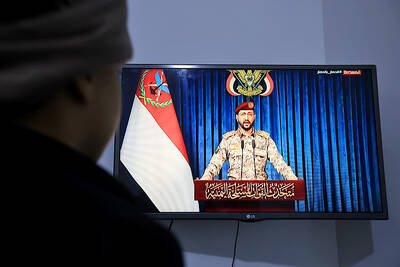
ON THE MOVE: Trump unexpectedly cut short a trip to return to the White House, while the State Department warned Americans to avoid travel to the Middle East The US on Saturday warned that hostilities between Saudi Arabia and Iran-backed Houthis could “escalate rapidly” after a missile attack targeted Riyadh for the first time since the Yemen conflict resumed. US President Donald Trump on Saturday cut short a weekend at Camp David, a secluded presidential complex in rural Maryland, to return unexpectedly to the White House. The White House gave no explanation for the early return, which comes as a new threshold was crossed in the conflict between Saudi Arabia and the Houthis, who control a large part of Yemen and are fighting government forces backed by a coalition led
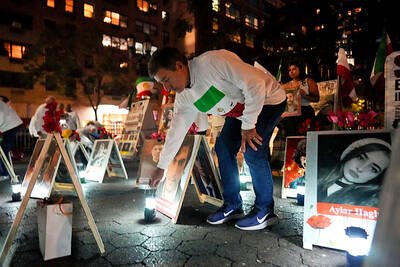
World leaders gather in New York this week for the UN General Assembly, bracing for US President Donald Trump’s return to the rostrum for a second year running, with talks centering on the widening conflicts in the Middle East and Ukraine and the risks of artificial intelligence (AI). Nearly 130 heads of state meet with the post-World War II order under strain and with the UN itself struggling to remain relevant and weathering attacks from Trump, who has slashed the US’ contributions and withdrawn from dozens of UN bodies. Chinese President Xi Jinping (習近平), who last addressed the diplomatic jamboree via video
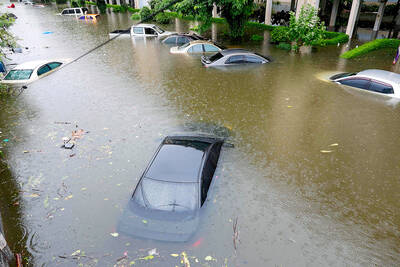
Several areas of Thailand’s capital city Bangkok were inundated by continuous rain from Thursday afternoon to yesterday morning that has disrupted traffic and forced some residents to evacuate. Major canals in Bangkok filled with accumulated rainfall exceeding 20cm, officials said yesterday. Floodwaters spread across the city, particularly in the central and eastern parts, blocking roads and stopping traffic. The Thai Meteorological Department warned that the heavy rain would continue in most parts of the country through today, citing a strong low-pressure system over the central region and strengthening southwest monsoon conditions. More than 84,000 people in 21 provinces nationwide were
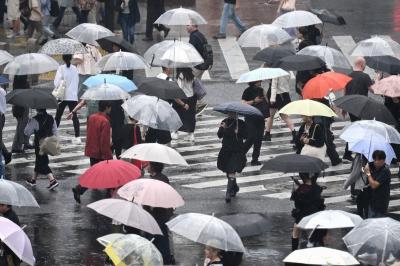
Typhoon Dujuan forced the cancellation of at least 275 flights in Japan today and prompted warnings of potentially record-breaking rainfall as the storm nears Tokyo. The typhoon, which is accompanied by high winds, has also led to the early closure in Tokyo of one the world’s biggest video game trade fairs and knocked out power for thousands. The Japan Meteorological Agency (JMA) warned yesterday that rain and winds were expected to intensify even before the typhoon’s arrival. “The total rainfall through Tuesday could exceed the average monthly rainfall for September, resulting in record-breaking heavy rain,” the agency said. The typhoon’s wind speeds were at


 RSS
RSS