


Former Philippine president Rodrigo Duterte earned global infamy for the deadly drug crackdown that led to his arrest over crimes against humanity charges, despite his huge popularity at home.
A profane-lipped populist and self-professed killer, Duterte’s anti-crime campaign resulted in the deaths of thousands of alleged dealers and addicts.
Rights groups said many of those killed were poor men, often without any proof they were linked to drugs.
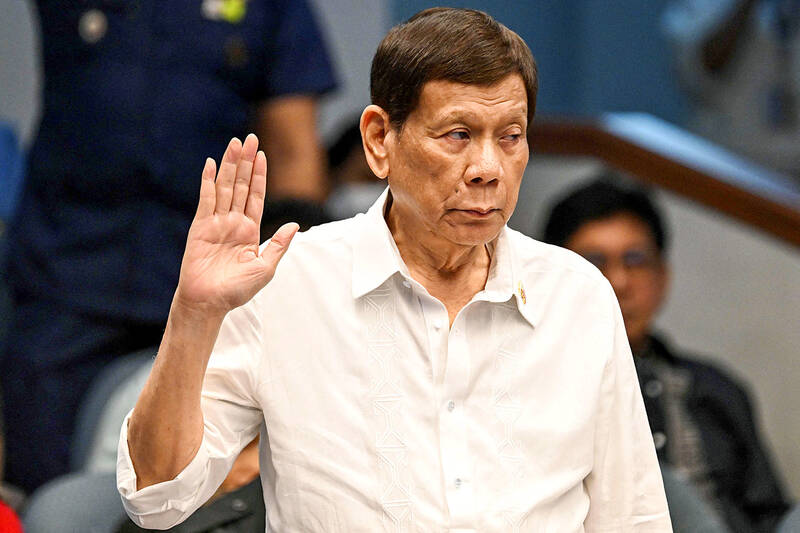
Photo: AFP
Yet, while drawing condemnation abroad, tens of millions of Filipinos backed his swift brand of justice — even as he joked about rape in his rambling speeches, locked up his critics and failed to root out entrenched corruption.
That trust was dented by the COVID-19 pandemic, which plunged the country into its worst economic crisis in decades, leaving tens of thousands dead and millions jobless with a slow-paced vaccine rollout.
Duterte’s woes deepened in 2021, when the chief prosecutor at the International Criminal Court (ICC) sought an investigation into crimes against humanity during his crackdown between 2013 and 2018.
He served out his six-year term, leaving office in 2022.
On March 11 last year, Duterte was arrested and flown to the Netherlands, seat of the ICC, where he has been in detention since.
Duterte has repeatedly said there was no official campaign to kill addicts and dealers, but his speeches included calls for violence, and he did tell police to use lethal force if their lives were in danger.
“If you know of any addicts, go ahead and kill them yourself, as getting their parents to do it would be too painful,” Duterte said hours after being sworn in as president in June 2016.
Months later, he would liken the deadly crackdown to the Nazis’ mass murder of Jews, while vastly underestimating the number of people killed in the Holocaust.
“Hitler massacred 3 million Jews. Now there are 3 million drug addicts [in the Philippines]. I’d be happy to slaughter them.”
His unfiltered comments are part of his self-styled image as a “maverick,” which found traction in a nation where corruption, red tape and institutional dysfunction impact people’s lives at every level.
Duterte was elected to his old job as mayor of his southern stronghold of Davao in midterm elections held in May last year, although jail stopped him serving.
During his long tenure as Davao mayor, Duterte was accused of links to vigilante death squads that rights groups said killed more than 1,000 people — accusations he has accepted and denied, and which form part of the ICC charges.
Duterte now faces his second court date on Monday, when judges would decide whether the prosecution’s allegations are strong enough to proceed to trial.
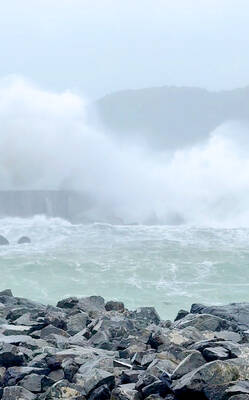
Heavy rain and strong winds yesterday disrupted flights, trains and ferries, forcing the closure of roads across large parts of New Zealand’s North Island, while snapping power links to tens of thousands. Domestic media reported a few flights had resumed operating by afternoon from the airport in Wellington, the capital, although cancelations were still widespread after airport authorities said most morning flights were disrupted. Air New Zealand said it hoped to resume services when conditions ease later yesterday, after it paused operations at Wellington, Napier and Palmerston North airports. Online images showed flooded semi-rural neighborhoods, inundated homes, trees fallen on vehicles and collapsed
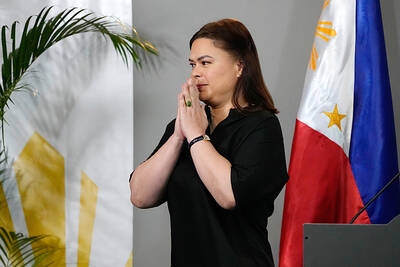
‘COST OF DEFECTION’: Duterte’s announcement could be an effort to keep allies in line with the promise of a return to power amid political uncertainty, an analyst said Philippine Vice President Sara Duterte yesterday announced she would run for president of the Southeast Asian nation of 116 million in 2028. Duterte, who is embroiled in a bitter feud with Philippine President Ferdinand Marcos Jr, was impeached last year only to see the country’s Supreme Court throw the case out over procedural issues. Her announcement comes just days before her father, former Philippine president Rodrigo Duterte, begins a pretrial hearing at the International Criminal Court (ICC) in the Netherlands over crimes against humanity allegedly committed as part of a brutal crackdown on drugs. “I offer my life, my strength and my future
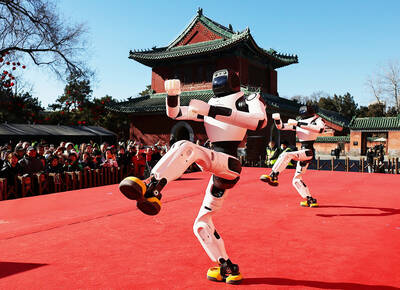
NOT YET THERE: While the show was impressive, it failed to demonstrate their ability to move in unstructured environments, such as a factory floor, an expert said Dancing humanoid robots on Monday took center stage during the annual China Media Group’s Spring Festival Gala, China’s most-watched official television broadcast. They lunged and backflipped (landing on their knees), they spun around and jumped. Not one fell over. The display was impressive, but if robots can now dance and perform martial arts, what else can they do? Experts have mixed opinions, with some saying the robots had limitations and that the display should be viewed through a lens of state propaganda. Developed by several Chinese robotics firms, the robots performed a range of intricate stunts, including martial arts, comedy sketches and choreographed
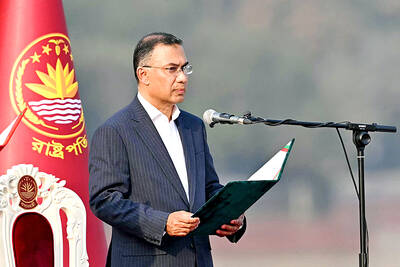
POST-UPRISING: Bangladesh Nationalist Party lawmakers were yesterday expected to formally elect Tarique Rahman as their leader and new head of government Bangladesh’s prime minister-to-be Tarique Rahman and lawmakers were yesterday sworn into parliament, becoming the first elected representatives since a deadly 2024 uprising. Rahman is set to take over from an interim government that has steered the country of 170 million people for 18 months since the autocratic government of Sheikh Hasina was overthrown. The lawmakers, who promised loyalty to Bangladesh, were sworn in by Chief Election Commissioner AMM Nasir Uddin. Bangladesh Nationalist Party (BNP) lawmakers are expected to formally elect Rahman as their leader, with President Mohammed Shahabuddin then to administer the oath of office to the prime minister and his ministers


 RSS
RSS