


Dancing humanoid robots on Monday took center stage during the annual China Media Group’s Spring Festival Gala, China’s most-watched official television broadcast. They lunged and backflipped (landing on their knees), they spun around and jumped. Not one fell over.
The display was impressive, but if robots can now dance and perform martial arts, what else can they do?
Experts have mixed opinions, with some saying the robots had limitations and that the display should be viewed through a lens of state propaganda.
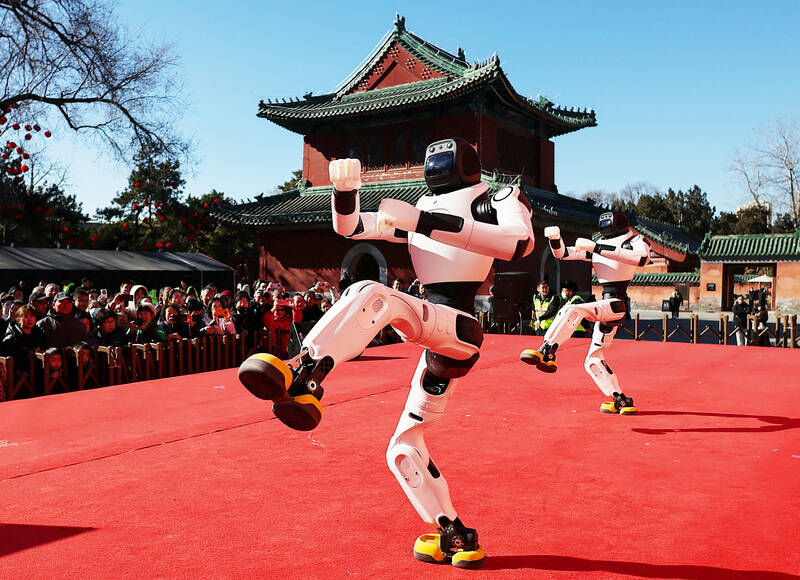
Photo: Reuters
Developed by several Chinese robotics firms, the robots performed a range of intricate stunts, including martial arts, comedy sketches and choreographed dance moves alongside human performers.
Clips circulating online quickly drew comparisons with last year’s Lunar New Year broadcast, which also featured dancing robots, but with noticeably simpler movements.
Kyle Chan — an expert in China’s technology development at Brookings Institution, a Washington-based policy organization — said that Beijing uses public robot performances to “dazzle domestic and international audiences with China’s technological prowess.”
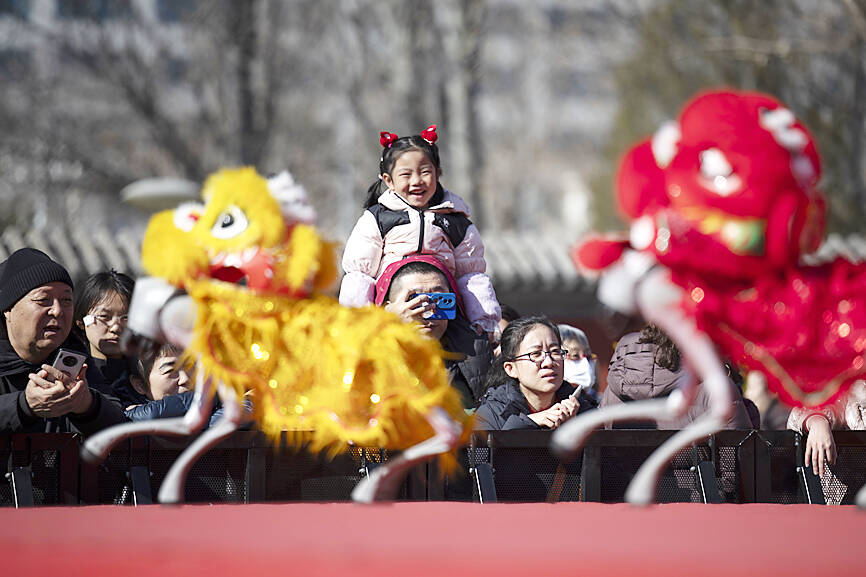
Photo: EPA
“Unlike AI [artificial intelligence] models or industrial equipment, humanoid robots are highly visible examples of China’s technological leadership that general audiences can see on their phones or televisions,” he said.
Pointing to intensifying competition in the tech space between China and the US, Chan added: “While China and the US are neck-and-neck on AI, humanoid robots are an area where China can claim to be ahead of the US, particularly in terms of scaling up production.”
Georg Stieler, the head of robotics and automation at the global technology consulting firm Stieler Technology and Marketing, also emphasized the symbolism of China’s prime time broadcast.
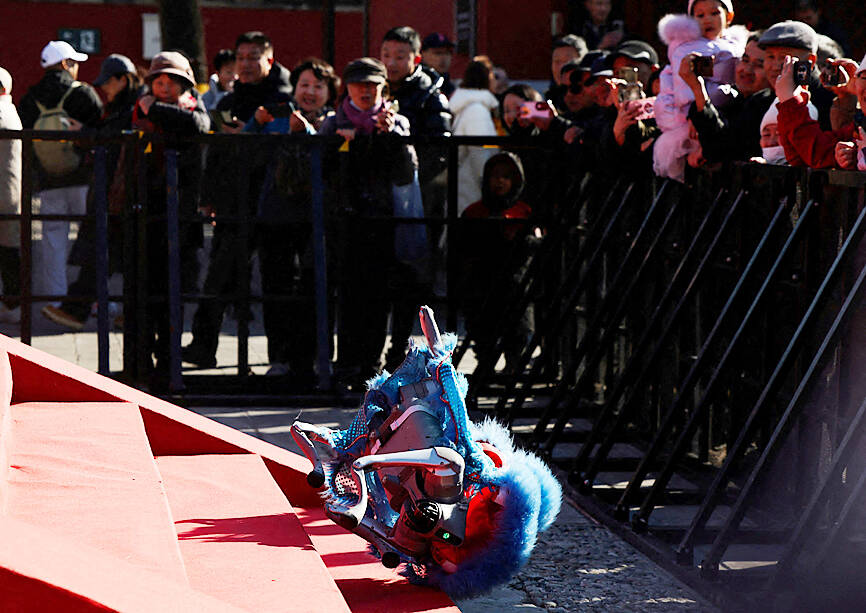
Photo: Reuters
“What distinguishes the gala from comparable events elsewhere is the directness of the pipeline from industrial policy to prime-time spectacle,” Stieler said in a statement.
Comparing this year’s performances with last year’s — when viewers saw “fundamentally a single choreographic mode” with limited motions including walking, twisting and kicking — Stieler said that one key signal of China’s robot progress is “the ability to run large numbers of near-identical humanoids in synchronized motion with stable gaits and consistent joint behavior.”
However, “stage performance does not equate to industrial robustness, yet,” he added.
What the robots did was the result of being trained for a routine “hundreds or thousands of times — you could not just tell them to change direction or do something completely different.”
“These dance motions involve very little environmental perception and are essentially imitation learning plus a balance-keeping controller. That has little bearing on reliability in unstructured environments, a prerequisite for factory-grade deployment. Also the progress in dexterity is not as fast as in locomotion,” he added.
The unveiling of China’s latest generation of robots underscores the country’s broader technological ambitions.
By the end of 2024, China had registered 451,700 smart robotics companies, with a total capital of 6.44 trillion yuan (US$932.15 billion), according to state data.
Major government projects such as “Made in China 2025” and the 14th Five-Year Plan, have made robotics and AI key Beijing priorities.
Morgan Stanley projects that China’s humanoid sales will more than double to 28,000 units this year; and Elon Musk has said he expects his biggest competitor to be Chinese companies as he pivots Tesla toward a focus on embodied AI and its flagship humanoid Optimus.
“People outside China underestimate China, but China is an ass-kicker next level,” Musk said last month.
Marina Zhang (張越), a technology professor at the University of Technology Sydney, said that such a visible showcase likely hints at a new phase in China’s manufacturing masterplan, “where robotics becomes a linchpin in the shift from low-cost assembly to high-end, smart manufacturing.”
Additional reporting by Reuters

Crowds in Bangladesh are flocking to snap photographs with an unlikely social media star — an albino buffalo with flowing blond hair nicknamed “Donald Trump” that is due to be sacrificed within days. Owner Zia Uddin Mridha, 38, said his brother named the 700kg bull over its flowing helmet of hair resembling the signature look of the US president. “My younger brother picked this name because of the buffalo’s extraordinary hair,” he said at his farm in Narayanganj, just outside the capital, Dhaka. Mridha said that a constant stream of curious visitors — social media fans, onlookers and children — have come throughout

It began as a satirical online project. Now millions of young people in India are flocking to it as an outlet for their frustration. A parody political party called the Cockroach Janta Party, with the insect as its symbol, has exploded across India’s social media by turning absurdist humor into protest. Memes and short videos mocking corruption, joblessness and political dysfunction have flooded social media sites, where millions of users are embracing the cockroach — known for its ability to survive harsh conditions — as a tongue-in-cheek symbol of endurance. The online movement’s rise has been unusually rapid. The Cockroach Janta Party (CJP)

HOTTER: While Indians are accustomed to summer heat, climate change has caused northwestern India to warm faster than other parts of the country, an academic said Roads and markets have emptied during afternoons and some farmers have switched to nighttime work to avoid scorching temperatures as a heat wave grips large parts of India. The India Meteorological Department forecast maximum temperatures for yesterday of about 45°C in the capital, New Delhi, where authorities have opened temporary “cooling zones” to help people cope. The weather department warned that conditions would likely persist across several northern regions in the coming days, with temperatures staying well above seasonal averages. Authorities urged people to stay indoors during the hottest hours and take precautions against heat-related illnesses. India declares a heat wave whenever maximum temperatures

A Hong Kong astronaut is to join a Chinese space mission for the first time as part of a three-person crew launching today, as Beijing edges closer to its goal of landing people on the moon. The Tiangong space station — crewed by teams of three astronauts that are typically rotated every six months — is the crown jewel of China’s space program, boosted by billions in state investment in a bid to catch up with the US and Russia. The Shenzhou-23 mission is to blast off at 11:08pm from the Jiuquan Satellite Launch Center in northwestern China, carrying three astronauts to


 RSS
RSS