


Heavy rain and strong winds yesterday disrupted flights, trains and ferries, forcing the closure of roads across large parts of New Zealand’s North Island, while snapping power links to tens of thousands.
Domestic media reported a few flights had resumed operating by afternoon from the airport in Wellington, the capital, although cancelations were still widespread after airport authorities said most morning flights were disrupted.
Air New Zealand said it hoped to resume services when conditions ease later yesterday, after it paused operations at Wellington, Napier and Palmerston North airports.
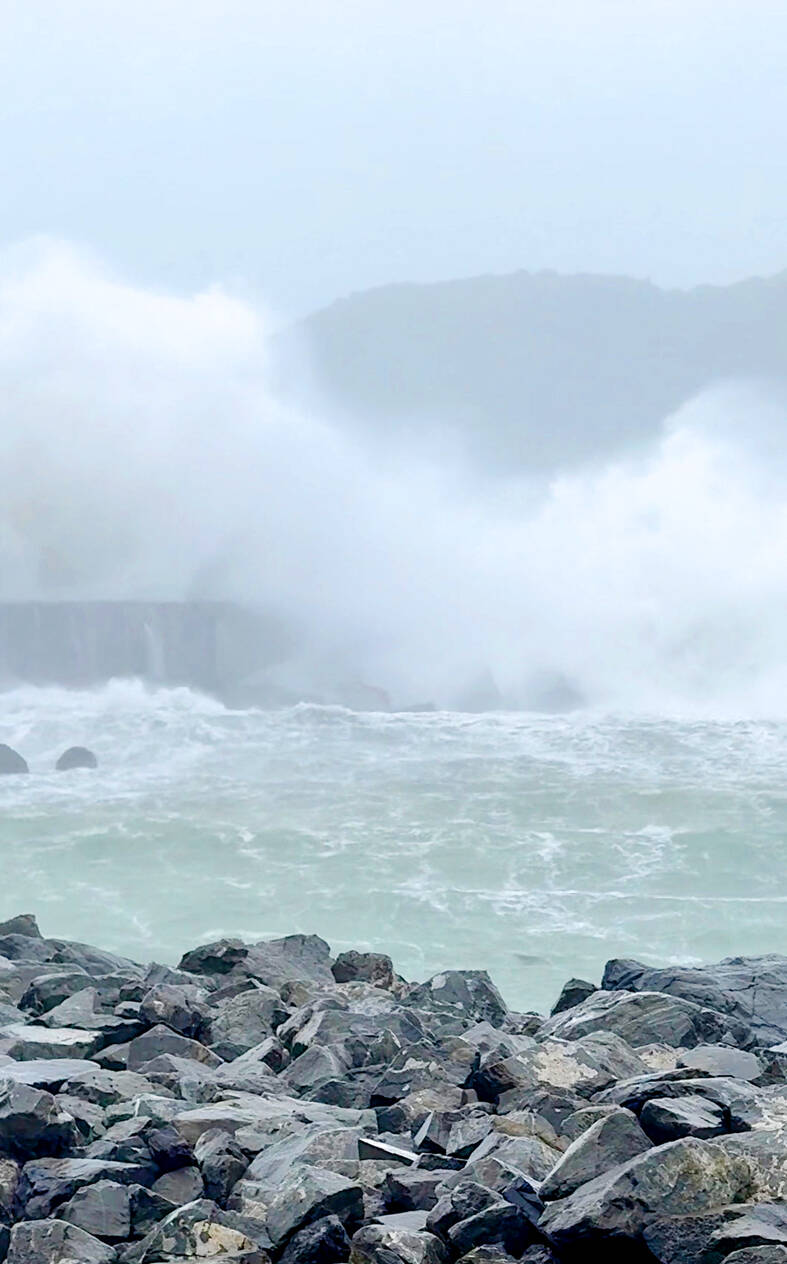
Photo: Kathy Hague @ Love Wellington / Reuters
Online images showed flooded semi-rural neighborhoods, inundated homes, trees fallen on vehicles and collapsed sections of road after waters receded.
The weather had been “absolutely terrifying,” Marilyn Bulford, who lives in the rural town of Bunnythorpe, about 160km north of Wellington, told the New Zealand Herald newspaper.
“I’ve never seen huge trees blowing around this much,” she added. “It’s so bad. I haven’t seen anything like it.”
The Wellington region accounted for more than half the 852 emergency calls received overnight, said Ken Cooper, assistant national commander of the emergency services.
“We had a very busy night, and our firefighters are continuing to respond to calls,” he added.
More than 30,000 properties were without power, including about 10,000 customers in Wellington, said authorities, who have urged motorists to stay off roads, while several schools were closed as emergency crews tackled widespread damage.
The storm is forecast to bring heavy rains as it heads for the east coast of the South Island today, the weather bureau said, with authorities warning of further disruption.
Raw sewage discharged after this month’s failure of Wellington’s main wastewater treatment plant in a storm was washed back onto the south coast by the weekend storm, in an incident some residents called a “poonami” on social media.
A low-pressure system east of the North Island has battered several regions since the weekend, bringing heavy rain and severe gales. A man was found dead on Saturday in a submerged vehicle on a highway.
The storm follows six deaths last month in a landslide triggered by heavy rains at Mount Maunganui on the North Island’s east coast, bringing down soil and rubble on a site crowded with families on summer holidays.

Four contenders are squaring up to succeed Antonio Guterres as secretary-general of the UN, which faces unprecedented global instability, wars and its own crushing budget crisis. Chile’s Michelle Bachelet, Argentina’s Rafael Grossi, Costa Rica’s Rebeca Grynspan and Senegal’s Macky Sall are each to face grillings by 193 member states and non-governmental organizations for three hours today and tomorrow. It is only the second time the UN has held a public question-and-answer, a format created in 2016 to boost transparency. Ultimately the five permanent members of the UN’s top body, the Security Council, hold the power, wielding vetoes over who leads the

South Korea’s air force yesterday apologized for a 2021 midair collision involving two fighter jets, a day after auditors said the pilots were taking selfies and filming during the flight and held them responsible for the accident. “We sincerely apologize to the public for the concern caused by the accident that occurred in 2021,” an air force spokesman told a news conference, adding that one of the pilots involved had been suspended from flying duties, received severe disciplinary action and has since left the military. The apology followed a report released on Wednesday by the South Korean Board of Audit and Inspection,

Young Chinese, many who fear age discrimination in their workplace after turning 35, are increasingly starting “one-person companies” that have artificial intelligence (AI) do most of the work. Smaller start-ups are already in vogue in Silicon Valley and elsewhere, with rapidly advancing AI tools seen as a welcome teammate even as they threaten layoffs at existing firms. More young people in China are subscribing to the model, as cities pledge millions of dollars in funding and rent subsidies for such ventures, in alignment with Beijing’s political goal of “technological self-reliance.” “The one-person company is a product of the AI era,” said Karen Dai

About 240 Indians claiming descent from a Biblical tribe landed at Tel Aviv airport on Thursday as part of a government operation to relocate them to Israel. The newcomers passed under a balloon arch in blue and white, the colors of the Israeli flag, as dozens of well-wishers welcomed them with a traditional Jewish song. They were the first “bnei Menashe” (“sons of Manasseh”) to arrive in Israel since the government in November last year announced funding for the immigration of about 6,000 members of the community from the states of Manipur and Mizoram in northeast India. The community claims to descend from


 RSS
RSS