


At a remote Sahara desert site in Niger, scientists have unearthed fossils of a new species of Spinosaurus, among the biggest of the meat-eating dinosaurs, notable for its large blade-shaped head crest and jaws bearing interlocking teeth for snaring fish.
It prowled a forested inland environment and strode into rivers to catch sizable fish like a modern-day wading bird — a “hell heron,” as one of the researchers put it, considering it was about 12 meters long and weighed 5-7 tons.
The dinosaur presented a striking profile on the Cretaceous Period landscape of Africa some 95 million years ago as it hunted large fish like coelacanths in the region’s waterways. Its bony cranial crest, about 50cm tall, resembled a curved sword called a scimitar, and it had a large sail-like structure on its back and an elongated crocodile-like snout.
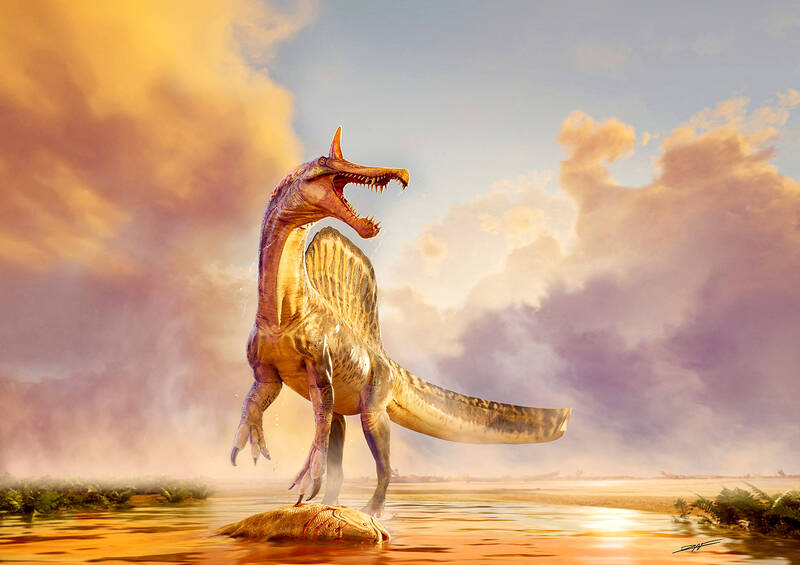
Photo: Reuters
Along with the existing genus name Spinosaurus, meaning “spine lizard,” the researchers gave it the species name mirabilis, meaning “astonishing,” referring to its crest. A genus is a group of closely related species bearing similar traits. For example, lions and tigers are the same genus but different species.
It is only the second known species of Spinosaurus, a dinosaur that has gained fame in popular culture for its depiction in the “Jurassic Park” movies. The other one, Spinosaurus aegyptiacus, was named in 1915 based on fossils from Egypt.
Spinosaurus, the only known semiaquatic dinosaur predator, joins Tyrannosaurus, Giganotosaurus and Carcharodontosaurus among the largest meat-eating dinosaurs.
The two Spinosaurus species, which were contemporaneous, shared the same general body plan including long dorsal spines forming the sail-like structure and a skull adapted for hunting fish. The crest of Spinosaurus mirabilis is much larger compared to Spinosaurus aegyptiacus, and it has a more elongated snout, teeth more spread out from each other and longer hind limbs.
The scientists said its crest likely was for display, since it appears too fragile to have been used as a weapon, even though it was solid bone without the air sacs present in some other dinosaur crests. The crest, probably sheathed in keratin like a bull’s horns, might have been vividly colored and instrumental in sexual or territorial competition or recognition between individuals.
“It’s about love and life — attracting a mate, defending your hot feeding shallows,” said University of Chicago paleontologist Paul Sereno, lead author of the research published on Thursday in the journal Science. “What else could be more important?”
The retracted location of its nostrils, farther back than usual, let it submerge most of its snout under water to stalk swimming prey for as long as necessary while breathing normally.
In addition, its upper and lower rows of teeth fit neatly together during a bite, called interdigitation.
“Their large conical teeth without serrations that interdigitate form a ‘fish trap’ that is very good at piercing and trapping slippery fish in the jaws, preventing them from sliding,” said paleontologist and study co-author Daniel Vidal of the University of Chicago and Universidad Nacional de Educacion a Distancia in Spain.
“Spinosaurus mirabilis has some of the most extreme piscivorous adaptations of any dinosaur, so we know it was better at preying upon fish than it would have been at preying upon other dinosaurs,” Vidal said.
Fossils of Spinosaurus aegyptiacus come from sites in Egypt and Morocco near the Cretaceous coastline of the Tethys Sea, predecessor to today’s Mediterranean Sea and Indian Ocean. That fact, plus certain skeletal traits, led some scientists to hypothesize Spinosaurus was fully aquatic, an open-water swimmer and diving pursuit predator in a marine setting.
But the Spinosaurus mirabilis fossils were found far inland, roughly 500-1,000km from the nearest ocean shoreline. This, coupled with aspects of the animal’s anatomy, instead point to Spinosaurus as a shallow-water predator and not fully aquatic, the scientists said.
Sereno called the Spinosaurus mirabilis discovery “the coup de grace for the aquatic hypothesis.”
Jenguebi, where the fossils were discovered, is a remote Sahara locality, with fossil-rich sandstone outcrops surrounded by sand dunes. For their 2022 expedition, the researchers set out from the city of Agadez in a convoy and drove off-road through desert terrain for almost three days, often getting stuck in the sand.
The journey paid off, as they discovered parts of three Spinosaurus mirabilis skulls and other bones, along with fossils of other creatures.
Long overshadowed in the public imagination by the Tyrannosaurus rex, Spinosaurus is now having its time in the spotlight.
“It’s a dino-happening,” Sereno said.

School bullies in Singapore are to face caning under new guidelines, but the education minister on Tuesday said it would be meted out only as a last resort with strict safeguards. Human rights groups regularly criticize Singapore for the use of corporal punishment, which remains part of the school and criminal justice systems, but authorities have defended it as a deterrent to crime and serious misconduct. Caning was discussed in the parliament after legislators asked how it would be used in relation to bullying in schools. The debate followed stricter guidelines on serious student misconduct, including bullying, unveiled by the Singaporean Ministry of

A MESSAGE: Japan’s participation in the Balikatan drills is a clear deterrence signal to China not to attack Taiwan while the US is busy in the Middle East, an analyst said The Japan Self-Defense Forces yesterday fired a Type 88 anti-ship missile during a joint maritime exercise with US, Australian and Philippine forces, hitting a decommissioned Philippine Navy ship in waters facing the disputed South China Sea, in drills that underscore Tokyo’s rising willingness to project military power on China’s doorstep. The drill took place as Manila and Tokyo began talks on a potential defense equipment transfer, made possible by Japan’s decision to scrap restrictions on military exports. The discussions include the possible early transfer of Abukuma-class destroyers and TC-90 aircraft to the Philippines, Japanese Minister of Defense Shinjiro Koizumi said. Philippine Secretary of
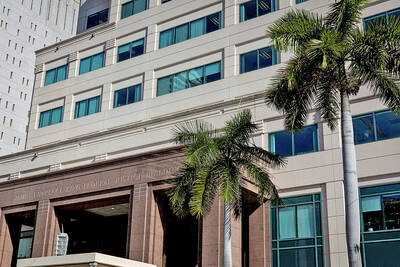
‘GROSS NEGLIGENCE?’ Despite a spleen typically being significantly smaller than a liver, the surgeon said he believed Bryan’s spleen was ‘double the size of what is normal’ A Florida surgeon who is facing criminal charges after allegedly removing a patient’s liver instead of his spleen has said he is “forever traumatized” by that person’s death. In a deposition from November last year that was recently obtained by NBC, 44-year-old Thomas Shaknovsky described the death of 70-year-old William Bryan as an “incredibly unfortunate event that I regret deeply.” Bryan died after the botched surgery; and last month, a grand jury in Tallahassee indicted Shaknovsky on a charge of manslaughter. “I’m forever traumatized by it and hurt by it,” Shaknovsky added, also saying that wrong-site surgeries can happen “during

A South Korean judge who last week more than doubled former South Korean first lady Kim Keon-hee’s prison sentence was found dead yesterday, police said. Shin Jong-o was found unconscious at about 1am at the Seoul High Court building, an investigator at the Seocho District Police Station in Seoul said. Shin was taken to a hospital and pronounced dead, he said. “There is no sign of foul play in the death,” the investigator added. Local media reported that Shin had left a suicide note, but the investigator said there was none. On Tuesday last week, Shin presided over 53-year-old Kim’s appeal trial, finding her guilty


 RSS
RSS