


The Japan Self-Defense Forces yesterday fired a Type 88 anti-ship missile during a joint maritime exercise with US, Australian and Philippine forces, hitting a decommissioned Philippine Navy ship in waters facing the disputed South China Sea, in drills that underscore Tokyo’s rising willingness to project military power on China’s doorstep.
The drill took place as Manila and Tokyo began talks on a potential defense equipment transfer, made possible by Japan’s decision to scrap restrictions on military exports.
The discussions include the possible early transfer of Abukuma-class destroyers and TC-90 aircraft to the Philippines, Japanese Minister of Defense Shinjiro Koizumi said.
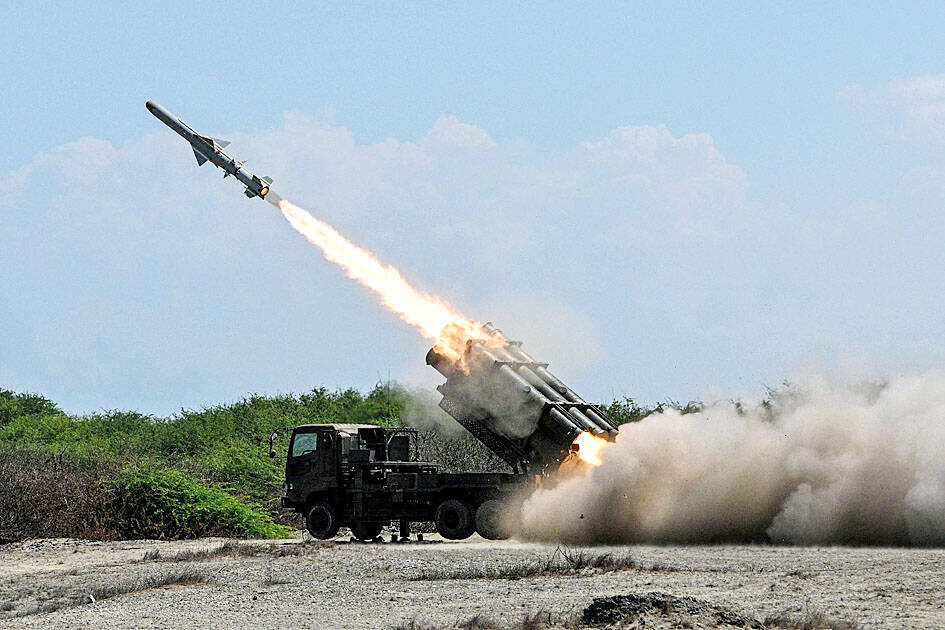
Photo: Reuters
Philippine Secretary of National Defense Gilberto Teodoro and Koizumi witnessed the live missile firing on the ground, while Philippine President Ferdinand Marcos Jr watched the exercise from military headquarters in Manila via a live video feed, the president’s office said.
The Philippine military said two Type 88 volleys were fired, hitting the former BRP Quezon within six minutes of their launch. The strikes took place about 75km off Paoay in the northern Philippines, which faces the South China Sea.
The Philippine Department of National Defense said Japan’s Type 88 missile system was “designed to defend coastal areas and deter maritime threats.”
“I’m very, very proud and happy that we were able to pull this off for the first time and it will only get larger in scope with more partners,” Teodoro said.
The live-fire drill was part of the annual war games held by Manila and Washington, known as “Balikatan,” or “shoulder-to-shoulder,” with Tokyo participating in a combat role for the first time.
This year’s Balikatan, which ends tomorrow, was joined by a record of more than 17,000 troops from seven nations. Japan is deploying 1,400 troops, making it the war games’ third-largest contingent.
For decades, Japan has restricted most of its military training to its own territory or to far-flung locations such as the US and Australia. The Type 88 missiles Japan used were first tested on its northern island of Hokkaido last year.
However, since coming to power last year, Japanese Prime Minister Sanae Takaichi has shown a greater willingness than her predecessors not to be intimidated by Beijing. Her suggestion in November last year that a Chinese attack on Taiwan would represent an existential threat to Japan that could trigger a military response infuriated Beijing, which has accused her administration of pursuing “neomilitarism.”
Many of the parts of Balikatan that Japan has been involved in — from maritime strikes to amphibious operations to missile defense — would be important in a potential conflict over Taiwan, said Naoko Aoki, an East Asian security specialist at the RAND Corp.
“To China, it is a demonstration of stronger cooperation between Japan and its defense partners as well as Japan’s increased combat readiness,” she said.
Takaichi is also keen to show the US that Japan is a more valuable military partner amid criticism from US President Donald Trump’s administration about allies’ overreliance on the US. Some security experts see a direct link from Balikatan to support for US forces deployed to the Middle East, including warships and troops sent from bases in Japan.
“Japan’s participation in Balikatan is a clear deterrence signal to Beijing not to attempt a takeover of Taiwan while the US is busy in the Middle East,” said John Hemmings, director of the National Security Centre at The Henry Jackson Society.
Tokyo’s dispatch of two amphibious ships and a destroyer for Balikatan, alongside aircraft, anti-ship missiles and air-and-missile defense systems, shows how much more capable the Japan Self-Defense Forces have become.
As Takaichi aims to build acceptance within Japan for its defense forces playing a greater regional role, Balikatan has offered a showcase of how they can contribute to shared security with other Asian nations, Aoki said.
It helps shape the view that Japan fields “a competent force that regularly exercises with non-US defense partners,” she said.

Crowds in Bangladesh are flocking to snap photographs with an unlikely social media star — an albino buffalo with flowing blond hair nicknamed “Donald Trump” that is due to be sacrificed within days. Owner Zia Uddin Mridha, 38, said his brother named the 700kg bull over its flowing helmet of hair resembling the signature look of the US president. “My younger brother picked this name because of the buffalo’s extraordinary hair,” he said at his farm in Narayanganj, just outside the capital, Dhaka. Mridha said that a constant stream of curious visitors — social media fans, onlookers and children — have come throughout

It began as a satirical online project. Now millions of young people in India are flocking to it as an outlet for their frustration. A parody political party called the Cockroach Janta Party, with the insect as its symbol, has exploded across India’s social media by turning absurdist humor into protest. Memes and short videos mocking corruption, joblessness and political dysfunction have flooded social media sites, where millions of users are embracing the cockroach — known for its ability to survive harsh conditions — as a tongue-in-cheek symbol of endurance. The online movement’s rise has been unusually rapid. The Cockroach Janta Party (CJP)

HOTTER: While Indians are accustomed to summer heat, climate change has caused northwestern India to warm faster than other parts of the country, an academic said Roads and markets have emptied during afternoons and some farmers have switched to nighttime work to avoid scorching temperatures as a heat wave grips large parts of India. The India Meteorological Department forecast maximum temperatures for yesterday of about 45°C in the capital, New Delhi, where authorities have opened temporary “cooling zones” to help people cope. The weather department warned that conditions would likely persist across several northern regions in the coming days, with temperatures staying well above seasonal averages. Authorities urged people to stay indoors during the hottest hours and take precautions against heat-related illnesses. India declares a heat wave whenever maximum temperatures

A Hong Kong astronaut is to join a Chinese space mission for the first time as part of a three-person crew launching today, as Beijing edges closer to its goal of landing people on the moon. The Tiangong space station — crewed by teams of three astronauts that are typically rotated every six months — is the crown jewel of China’s space program, boosted by billions in state investment in a bid to catch up with the US and Russia. The Shenzhou-23 mission is to blast off at 11:08pm from the Jiuquan Satellite Launch Center in northwestern China, carrying three astronauts to


 RSS
RSS