


A year after it was inaugurated, Indonesia’s would-be new capital Nusantara attracts tourists and construction workers, but most of its architecturally arresting presidential palace and freshly built avenues sit silent. The legacy project of former Indonesian president Joko Widodo is battling a slashed budget, slowed construction and a deficit of interest from a new leader focused on social mega-projects.
That has raised questions about whether the city, officially named Ibu Kota Nusantara (IKN) and carved out of the jungle to replace crowded and rapidly sinking Jakarta, would ever see its promised potential.
“The political will on IKN right now feels muted,” said Dedi Dinarto, senior associate at public policy advisory firm Global Counsel.
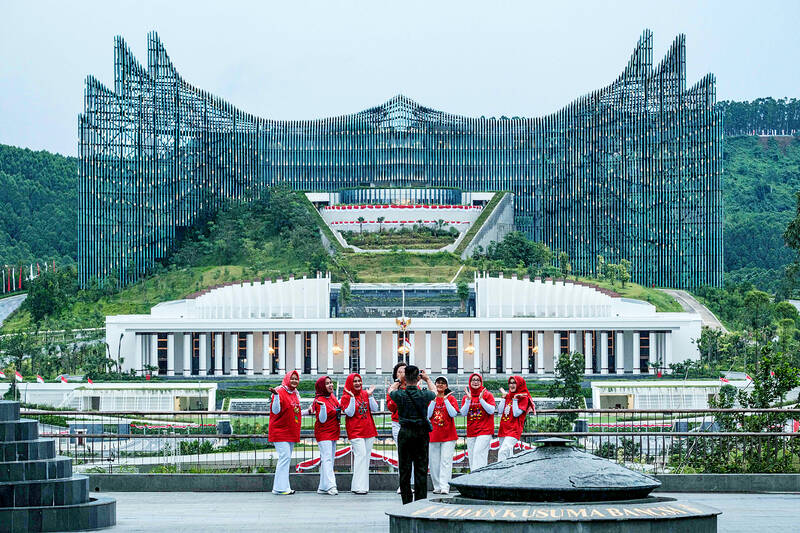
Photo: AFP
Indonesian President Prabowo Subianto “is clearly putting his chips on welfare instead.”
Only more than 1,000 city authority employees live in Nusantara, along with a few hundred more ministry workers and service and medical employees. That is far short of Jakarta’s 12 million residents, and the new city’s goal of 2 million inhabitants by 2045.
Prabowo mentioned IKN just once in his first state of the nation speech and has slashed funding for the project.
Official budgets show a cut from 43.4 trillion rupiah (US$2.64 billion) last year to just 6.3 trillion rupiah next year. The authority had requested more than 21 trillion rupiah for next year’s budget. Significant foreign funding has also proved elusive despite overtures to allies in the Middle East and Asia.
“Prabowo feels that this is not his legacy. It’s not his big push, and he has more programs that he wants to push,” an official involved in the city’s construction told Agence France-Presse on condition of anonymity.
“I’m still 50-50 on it [being finished],” the official said, adding that the budget cuts mean “a lot of things will not be completed.”
The former president, known popularly as Jokowi, revived the long-proposed capital move when he won a second term in 2019. However, despite a rush to build, the city was not inaugurated as Indonesia’s new capital on Aug. 17 last year as expected.
“In Joko Widodo’s time it was very fast-moving, now in Prabowo’s time ... it’s not as fast,” said Sofian Sibarani, the city’s designer.
Only 800 of the planned 6,600 hectares of the core government area have been developed on or prepared for construction, he said.
Nusantara officials are undeterred and tout the city as Indonesia’s future power center.
City authority head Basuki Hadimuljono said that projects in a smaller executive area housing the palace and ministries in the government core were “already 97 to 98 percent” complete.
He said that Prabowo wanted to move in 2028 before the next presidential election, once the legislative and judicial areas are finished.
As president-elect, Prabowo said he wanted to “continue, if possible finish” the capital move, but since taking office he has yet to express any plans to sign the presidential decree needed to shift from Jakarta.
“It would be signed after the legislative and judicial areas are completed” in 2028, Basuki said.
“If you do not want to move here, or you have a doubt, it is your loss,” he added.
Some government employees have expressed reservations about moving to an unfinished jungle city, about 1,200km from Jakarta.
However, city employee Helena, who like many Indonesians goes by one name, insisted her unfinished tower block offers “an amazing level of comfort.”
“And the facilities we get are more than enough,” the 45-year-old said.
The city now has three functioning hospitals, coffee shops, a toll road to nearby Balikpapan city and an airport waiting for commercial flight approval.
A planned shopping mall and cinema remain unbuilt.
Outside the palace in the ceremonial plaza, dozens of tourists were taking in the promised new capital with gusto.
“I am happy and proud... IKN is really cool,” said Ronald Telaumbanua, 38, who traveled from Sulawesi island.
The striking presidential palace, modeled after the mythical Garuda bird, is a draw for photographs, but the city’s lush green centerpiece offers little else.
Businesses counting on a boom of arrivals say they are struggling.
“During the Jokowi era, there were many workers, and there were numerous visits. Almost every day was busy,” said Abduh Rajab, 57, a snack seller near the developed city center.
“My earnings have dropped significantly, by almost 60 percent, but I have to stay optimistic. I hope the construction will continue,” Abduh said.
Prabowo was likely to remain focused on flagship policies, such as offering free meals to children and pregnant women, Dedi said.
“That means IKN will not see breakneck development anytime soon,” he said. “Without strong momentum, it risks drifting into white elephant territory.”

SPEAKING OUT: After Siranudh Scott’s allegations surfaced, celebrities and public figures took to social media to share their own experiences of sexual misconduct and abuse A high-profile alleged sexual abuse case within a wealthy Thai beer brewing family has prompted a wave of painful accounts from survivors of unconnected abuse in the conservative nation. Siranudh Scott, a member of the billionaire Thai family that founded the ubiquitous Singha beer brand, posted an emotional video this month accusing his elder brother Sunit of repeatedly abusing him when he was a teenager. Sunit, who is in his 30s, later denied the allegations in a video posted online, but Singha parent Boonrawd dismissed him from his executive role with the company on Tuesday last week. “I felt I needed to speak

SEEKING ORDER: Rodrigo Paz said that ‘anyone who wants to destroy the nation will have to deal with this president and the full force of the constitution’ Bolivian President Rodrigo Paz on Wednesday said that the nation was at a “breaking point” after nearly a month of protests that have caused shortages of food, fuel and medicine. Paz, who took office six months ago amid the worst economic crisis there in four decades, is battling a groundswell of fury over his policies. The political capital, La Paz, has been besieged by low-income workers and members of the indigenous majority calling for his resignation. “The country needs order and is reaching breaking point,” the 58-year-old said at a public event in La Paz, renewing his appeal for dialogue. On Tuesday, the Bolivian

A Hong Kong astronaut is to join a Chinese space mission for the first time as part of a three-person crew launching today, as Beijing edges closer to its goal of landing people on the moon. The Tiangong space station — crewed by teams of three astronauts that are typically rotated every six months — is the crown jewel of China’s space program, boosted by billions in state investment in a bid to catch up with the US and Russia. The Shenzhou-23 mission is to blast off at 11:08pm from the Jiuquan Satellite Launch Center in northwestern China, carrying three astronauts to
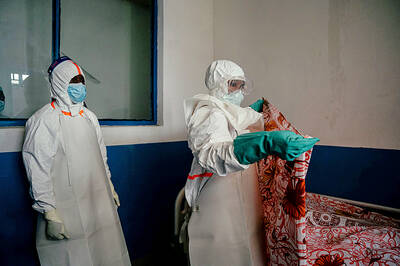
UPGRADED ALERT: The risk inside DR Congo is now considered ‘very high,’ while neighboring countries face a ‘high’ threat as the outbreak continues, the WHO said Ebola is spreading faster than responders can track it in eastern Congo, where health workers managed to follow up with barely one in five identified contacts in a single day. Authorities in the Democratic Republic of the Congo (DR Congo) reported 83 confirmed infections, 746 suspected cases and 1,603 identified contacts as of Thursday, but health workers were able to follow up on only 342 contacts that day — about 21 percent of the total under monitoring — data released by the DR Congo Ministry of Public Health on Friday showed. The figures suggest the response is falling behind the outbreak itself,


 RSS
RSS