


The FBI on Wednesday accused North Korea of being behind the theft of US$1.5 billion of digital assets last week, the largest crypto heist in history.
Dubai, United Arab Emirates-based cryptocurrency exchange Bybit reported last week that it had been robbed of 400,000 in cryptocurrency ethereum.
The company said that attackers exploited security protocols during a transaction, enabling them to transfer the assets to an unidentified address.
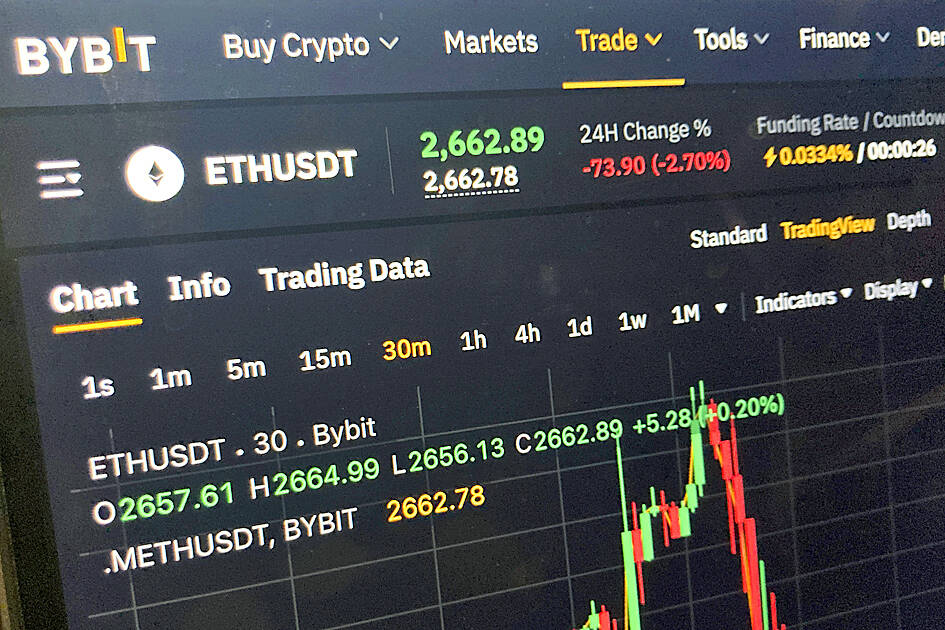
Photo: AP
The US government has pointed the finger at Pyongyang.
“[North Korea] was responsible for the theft of approximately US$1.5 billion in virtual assets from cryptocurrency exchange, Bybit,” the FBI said in a public service announcement.
The bureau said a group called TraderTraitor, also known as the Lazarus Group, are behind the theft. It said they were “proceeding rapidly and have converted some of the stolen assets to bitcoin and other virtual assets dispersed across thousands of addresses on multiple blockchains.”
“It is expected these assets will be further laundered and eventually converted to fiat currency,” the FBI added.
Lazarus Group gained notoriety a decade ago when it was accused of hacking into Sony Pictures as revenge for The Interview, a film that mocked North Korean leader Kim Jong-un.
It was also allegedly behind the 2022 US$620 million heist of ethereum and USD coin from the Ronin Network in 2022, previously the biggest crypto theft in history.
In December last year, the US and Japan blamed it for the theft of more than US$300 million of ryptocurrency from the Japan-based exchange DMM Bitcoin.
North Korea’s cyberwarfare program dates back to at least the mid-1990s, and the country has been dubbed “the world’s most prolific cyberthief” by a cybersecurity firm.
Pyongyang’s program has grown to a 6,000-strong cyberwarfare unit known as Bureau 121 that operates from several countries, a 2020 US military report said.
A UN panel on North Korea’s evasion of sanctions last year estimated the nation has stolen more than US$3 billion in cryptocurrency since 2017.
Much of the hacking activity is reportedly directed by Pyongyang’s Reconnaissance General Bureau, its primary foreign intelligence agency.
Money stolen helps to fund the country’s nuclear weapons program, the panel said.


Through the noise of rushing papers and whirring belts at a print factory in Kyoto, two creators watch their photo essay come to life in broadsheet form — part of an effort to win new audiences in the age of artificial intelligence (AI). Despite the decline of the publishing industry, self-publication and handmade “zine” magazines are growing in popularity in Japan, reflecting the nation’s enduring love of paper in the digital era. While speaking to Agence France-Presse at the plant, his hands black with ink, one of the creators, Kazuma Obara, said: “I think [paper] is a medium that engages all five
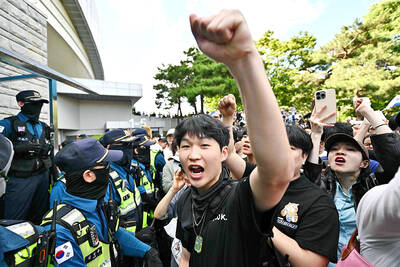
‘ABSURD MISTAKE’: The election commission said that there had been a failure to anticipate turnout after 14 polling stations ran short of ballot papers South Korean riot police yesterday cleared protesters from a Seoul polling station after a 35-hour blockade sparked by a shortage of ballot papers during local elections earlier this week. Wednesday’s election was the first nationwide vote since South Korean President Lee Jae-myung took office following the ouster of Yoon Suk-yeol over his short-lived martial law declaration. Lee’s ruling Democratic Party swept most races, but failed to flip the crucial Seoul mayoral seat. The South Korean National Election Commission apologized, blaming a failure to anticipate turnout after 14 polling stations in Seoul ran short of ballot papers. Some polling stations stayed open until 10pm to

France experienced its hottest spring on record, the French weather service said on Tuesday, after an exceptional early heat wave that also broke highs for the season in England and Wales. Meteo-France said the average nationwide temperature over March to May was 13.8°C — about 1.7°C above the norm, and surpassing records set in 2011 and 2020. “The warmest spring since records began in 1900,” it said in a bulletin. All three months were warmer than average, but the onset of an “unprecedented heatwave” late last month pushed the mercury to highs typically seen at the height of the summer. “Our country had never

A Sherpa guide was found crawling to base camp on Mount Everest a week after he went missing and was reunited with his family, who had given up hope he would return. Dawa Sherpa was last seen on Friday last week descending the mountain, but he did not reach base camp even though his client did. The pair were among the last climbers on the mountain as the climbing season came to an end and the route was dismantled. Dawa was located by a cleaning crew on Thursday morning as he was crawling down the snowy slopes around the Khumbu Icefall, just above


 RSS
RSS