


US President Joe Biden notified the US Congress of his intent to lift the US designation of Cuba as a state sponsor of terrorism, the White House announced, as part of a deal facilitated by the Catholic Church to free political prisoners on the island.
Senior US administration officials, who previewed the announcement on the condition of anonymity, said “many dozens” of political prisoners and others considered by the US to be unjustly detained would be released by the end of the Biden administration at noon on Monday next week.
The US would also ease some economic pressure on Cuba, as well as a 2017 memorandum issued by then-US president Donald Trump toughening US posture toward Cuba.
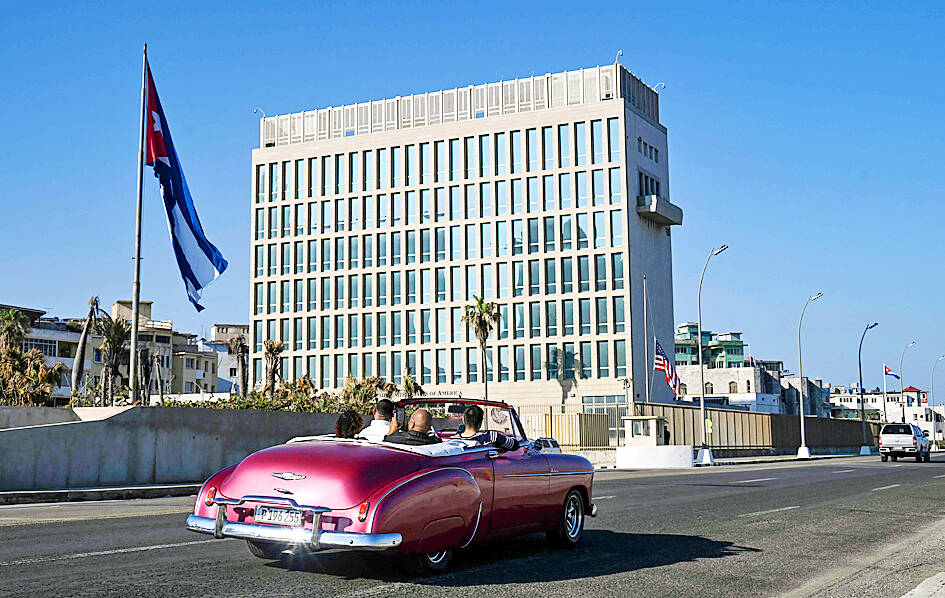
Photo: AFP
The determination by the outgoing one-term Democrat is likely to be reversed as early as next week after Trump takes office and US secretary of state-designate Marco Rubio assumes the position of the nation’s top diplomat.
Rubio, whose family left Cuba in the 1950s before the communist revolution that brought Fidel Castro to power, has long been a proponent of sanctions on the communist island.
Trump has also appointed Mauricio Claver-Carone, a former White House National Security Council aide and strong supporter of sanctions against Cuba, to be his special envoy to Latin America.
In the final days of Trump’s first administration, on Jan. 11, 2021, the White House reinstated the designation, which had been reversed during the period of rapprochement between Cuba and the US during former US president Barack Obama’s second term in office. In doing so, the Trump administration cited Cuba’s support for Venezuela’s leader, Nicolas Maduro, and its refusal to extradite Colombian rebels to Colombia, among other issues, including its continued harboring of wanted Americans.
The move to designate Cuba by Trump was one of several foreign policy moves he made in the final days of his first term.
About six months after Trump designated Cuba as terror sponsor, the Biden administration levied new sanctions on island officials and the national revolutionary police after hundreds of Cubans were arrested during demonstrations in Havana and other cities to protest shortages, power outages and government policies.
Human rights groups and activists, including the US Conference of Catholic Bishops, have been pressing the Biden administration to lift the designation to ease the suffering of Cuban people who feel the impact of Cuba’s economic isolation.
US Congress and the incoming Trump administration would have the opportunity to review and potentially reverse Biden’s actions, although the senior US administration officials said the Biden administration had determined there was “no credible evidence” that Cuba was currently engaged in supporting international terrorism.
US Senator Ted Cruz quickly denounced the Biden administration move.
“Today’s decision is unacceptable on its merits,” Cruz said in a statement. “The terrorism advanced by the Cuban regime has not ceased. I will work with President Trump and my colleagues to immediately reverse and limit the damage from the decision.”
US Representative Carlos Gimenez, a Florida Republican, criticized the move and predicted that Trump would quickly reverse Biden’s decision.
“President Biden is a pathetic coward,” Gimenez posted on X. “Come January 20th, there will be a NEW SHERIFF in town & President Trump alongside Secretary of State @SenMarcoRubio will not only put #Cuba BACK on the list but PULVERIZE the regime once & for all!”
‘GROSS NEGLIGENCE?’ Despite a spleen typically being significantly smaller than a liver, the surgeon said he believed Bryan’s spleen was ‘double the size of what is normal’ A Florida surgeon who is facing criminal charges after allegedly removing a patient’s liver instead of his spleen has said he is “forever traumatized” by that person’s death. In a deposition from November last year that was recently obtained by NBC, 44-year-old Thomas Shaknovsky described the death of 70-year-old William Bryan as an “incredibly unfortunate event that I regret deeply.” Bryan died after the botched surgery; and last month, a grand jury in Tallahassee indicted Shaknovsky on a charge of manslaughter. “I’m forever traumatized by it and hurt by it,” Shaknovsky added, also saying that wrong-site surgeries can happen “during
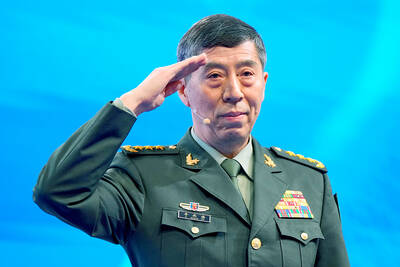
Former Chinese ministers of national defense Wei Fenghe(魏鳳和) and Li Shangfu (李尚福) were both sentenced to death with a two-year reprieve over graft charges, state news agency Xinhua reported on Thursday, underscoring the severity of the purge in the military. The armed forces have been one of the main targets of a broad corruption crackdown ordered by Chinese President Xi Jinping (習近平) after coming to power in 2012. The purges reached the elite Rocket Force, which oversees nuclear weapons as well as conventional missiles, in 2023. Earlier this year they escalated further, resulting in the removal of the top general in

New Zealand is open to expanding its frigate fleet beyond its current two vessels, with New Zealand Minister of Defence Chris Penk saying “no options are off the table” as the government weighs buying new warships from Japan or the UK. The government yesterday said it is looking to replace its two aging Anzac-class frigates, which were both commissioned almost 30 years ago. The UK’s Type 31 and Japan’s Mogami-class warships are the options under consideration. Speaking in an interview, Penk said there is potential to increase the number of frigates the nation purchases. “We need a certain amount of capability as a

The Philippine Coast Guard yesterday said it deployed aircraft to issue radio warnings to a Chinese research ship in a disputed area of the South China Sea “swarming” with vessels from Beijing’s so-called maritime militia. The research vessel Xiang Yang Hong 33 (向陽紅33), which is capable of supporting submersible craft, was operating near a reef in the contested Spratly Islands (Nansha Islands, 南沙群島), which Taiwan also claims, the Philippine Coast Guard said. The Chinese ship was deploying a service boat toward the Spratly’s Iroquois Reef on Wednesday when it was spotted by a coast guard plane, “confirming ongoing unauthorized [marine scientific research]


 RSS
RSS