


Protests worsened overnight across major cities of Indonesia, far beyond the capital, Jakarta, as demonstrators defied Indonesian President Prabowo Subianto’s call for calm.
The most serious unrest was seen in the eastern city of Makassar, while protests also unfolded in Bandung, Surabaya, Solo and Yogyakarta. By yesterday morning, crowds had dispersed in Jakarta. Troops patrolled the streets with tactical vehicles and helped civilians clear trash, although smoke was still rising in various protest sites.
Three people died and five were injured in Makassar when protesters set fire to the regional parliament building during a plenary session on Friday evening, according to a report by CNN Indonesia.
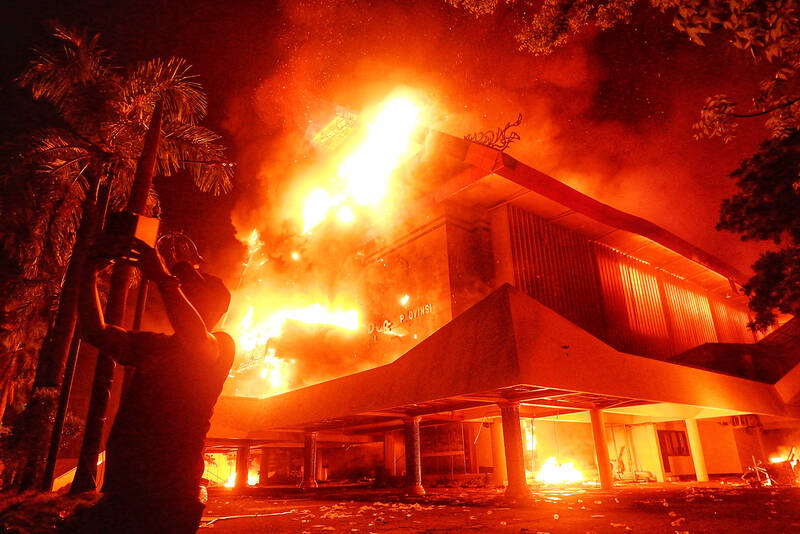
Photo: AFP
The mayor and other top officials were evacuated, it said.
A number of people were also injured in Bandung, about 2.5 hours by car from the capital, Mayor Muhammad Farhan said in a text message yesterday.
Four buildings, including a legislative guest house, were completely destroyed after people burnt them down, he added.
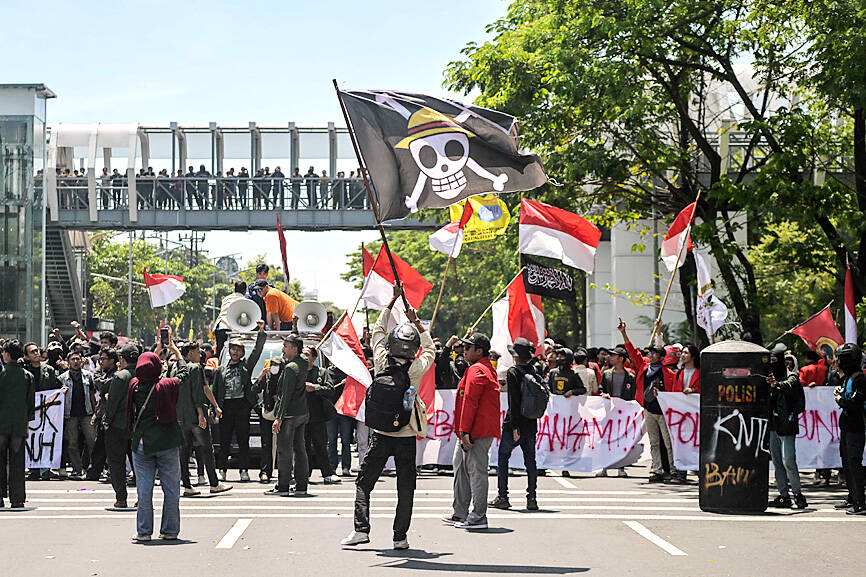
Photo: AFP
In Jakarta, several police stations were targeted by crowds, with one in the city’s east pelted with Molotov cocktails, according to a report by Detik.
Graffiti also filled the walls and sidewalks surrounding the Jakarta police headquarters, situated next to the Indonesian Stock Exchange in the central business district.
Portions of Jakarta’s inner city toll road remained shut yesterday after seven toll gates, including those near the national parliament’s headquarters, were burned. The Transjakarta citywide bus services were also completely shut after seven stops were burned overnight. Several subway stations were closed as a safety precaution.
Police posts were burned in Indonesia’s second-largest city of Surabaya, while demonstrations were held in front of police offices in Yogyakarta and Solo, local media reported.
At least 600 protesters have been arrested, reports said.
The unrest in Indonesia comes in a week of political tumult for the broader region after a Thai court ousted Prime Minister Paetongtarn Shinawatra for ethics violations. Indonesia’s Prabowo, who came to power 10 months ago, now faces a major test as he attempts to execute his agenda to supercharge growth in Southeast Asia’s largest economy.
The protests began on Monday due to rising discontent over jobs and wages, especially when contrasted with the perceived wealth of his lawmaker allies. The death of a motorcycle taxi driver, crushed by a police armored vehicle on Thursday evening, further fueled anger.
The president called for calm on Friday and urged the public to be vigilant against “elements that always want to cause unrest and chaos.”
Prabowo also criticized the police’s response, promised to hold officers accountable for the death of driver Affan Kurniawan and visited his family home on Friday night to offer his condolences.
Amnesty International called for a thorough and independent investigation of the police crackdown and the killing of Kurniawan to “ensure that all perpetrators, including those at command level, face fair trials publicly, and not mere internal or administrative sanctions,” the group said in a statement on Friday.

SPEAKING OUT: After Siranudh Scott’s allegations surfaced, celebrities and public figures took to social media to share their own experiences of sexual misconduct and abuse A high-profile alleged sexual abuse case within a wealthy Thai beer brewing family has prompted a wave of painful accounts from survivors of unconnected abuse in the conservative nation. Siranudh Scott, a member of the billionaire Thai family that founded the ubiquitous Singha beer brand, posted an emotional video this month accusing his elder brother Sunit of repeatedly abusing him when he was a teenager. Sunit, who is in his 30s, later denied the allegations in a video posted online, but Singha parent Boonrawd dismissed him from his executive role with the company on Tuesday last week. “I felt I needed to speak

A Hong Kong astronaut is to join a Chinese space mission for the first time as part of a three-person crew launching today, as Beijing edges closer to its goal of landing people on the moon. The Tiangong space station — crewed by teams of three astronauts that are typically rotated every six months — is the crown jewel of China’s space program, boosted by billions in state investment in a bid to catch up with the US and Russia. The Shenzhou-23 mission is to blast off at 11:08pm from the Jiuquan Satellite Launch Center in northwestern China, carrying three astronauts to
UPGRADED ALERT: The risk inside DR Congo is now considered ‘very high,’ while neighboring countries face a ‘high’ threat as the outbreak continues, the WHO said Ebola is spreading faster than responders can track it in eastern Congo, where health workers managed to follow up with barely one in five identified contacts in a single day. Authorities in the Democratic Republic of the Congo (DR Congo) reported 83 confirmed infections, 746 suspected cases and 1,603 identified contacts as of Thursday, but health workers were able to follow up on only 342 contacts that day — about 21 percent of the total under monitoring — data released by the DR Congo Ministry of Public Health on Friday showed. The figures suggest the response is falling behind the outbreak itself,

SEEKING ORDER: Rodrigo Paz said that ‘anyone who wants to destroy the nation will have to deal with this president and the full force of the constitution’ Bolivian President Rodrigo Paz on Wednesday said that the nation was at a “breaking point” after nearly a month of protests that have caused shortages of food, fuel and medicine. Paz, who took office six months ago amid the worst economic crisis there in four decades, is battling a groundswell of fury over his policies. The political capital, La Paz, has been besieged by low-income workers and members of the indigenous majority calling for his resignation. “The country needs order and is reaching breaking point,” the 58-year-old said at a public event in La Paz, renewing his appeal for dialogue. On Tuesday, the Bolivian


 RSS
RSS