


China’s Shenzhou-20 crewed spacecraft has delayed its return mission to Earth after the vessel was possibly hit by tiny bits of space debris, the country’s human spaceflight agency said yesterday, an unusual situation that could disrupt the operation of the country’s space station Tiangong.
An impact analysis and risk assessment are underway, the China Manned Space Agency (CMSA) said in a statement, without providing a new schedule for the return mission, which was originally set to land in northern China yesterday.
The delay highlights the danger to space travel posed by increasing amounts of debris, such as discarded launch vehicles or vessel parts that float around in space hundreds of miles above the Earth, risking collisions with countries’ active assets.
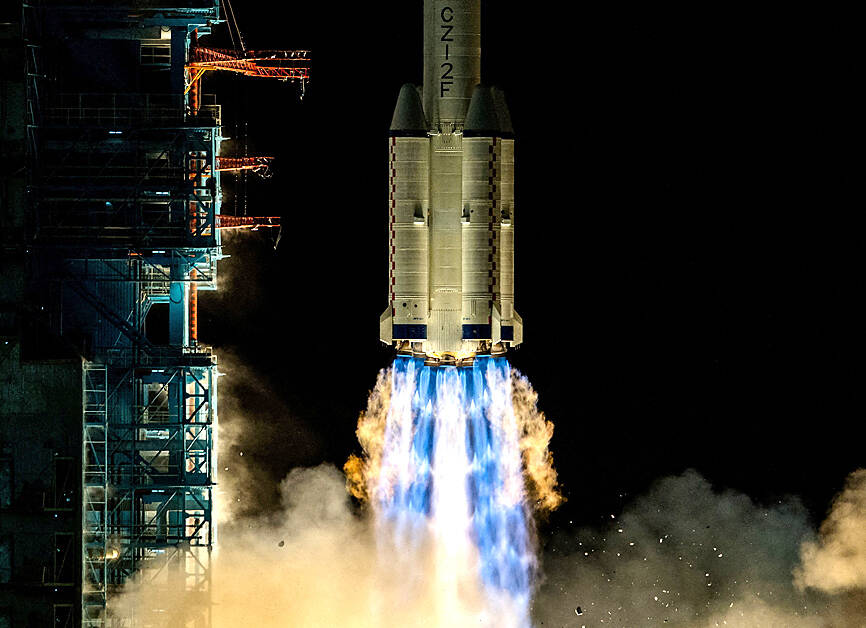
Photo: Reuters
The Shenzhou program takes trios of Chinese astronauts to and from Tiangong for six-month stays where they perform tasks such as repairing damage to the station caused by debris impact.
The Shenzhou-19 crew’s return mission in April was delayed by one day due to weather conditions at the landing site, but this is the first time that a return mission has been delayed by space debris.
The CMSA did not say whether Shenzhou-20 was hit by debris mid-flight or while it was still aboard Tiangong, where the Shenzhou-21 is also docked after arriving last week. The crews of both vessels are in a handover period of several days. The statement did not mention Tiangong or Shenzhou-21.
According to well-established protocols, if the damage to Shenzhou-20 cannot be repaired aboard Tiangong, Shenzhou-21 would be used to transport the previous crew back to Earth. In the event both vessels are damaged beyond repair, a backup Shenzhou spacecraft would be sent from the Jiuquan Satellite Launch Center in northwest China.
A backup Long March-2F rocket and Shenzhou spacecraft are always on standby at the launch center in the event of an in-orbit emergency.

‘CROSSING THE LINE’: China’s embassy in Seoul criticized US Forces Korea Commander General Xavier Brunson, asking if his ‘hostile’ remarks were authorized by Washington South Korea and the US are in talks over recent public remarks by the commander of US Forces Korea, Seoul’s presidential office said yesterday, after the comments drew sharp criticism from China. In a recent podcast interview, US Forces Korea Commander General Xavier Brunson described South Korea as “the dagger in the heart of Asia” from China’s east coast, prompting the Chinese embassy in Seoul to say that he had “truly crossed the line.” The interview came amid growing speculation that Washington might seek to expand the role of US Forces Korea in countering the growing regional influence of China, a key

SEEKING ORDER: Rodrigo Paz said that ‘anyone who wants to destroy the nation will have to deal with this president and the full force of the constitution’ Bolivian President Rodrigo Paz on Wednesday said that the nation was at a “breaking point” after nearly a month of protests that have caused shortages of food, fuel and medicine. Paz, who took office six months ago amid the worst economic crisis there in four decades, is battling a groundswell of fury over his policies. The political capital, La Paz, has been besieged by low-income workers and members of the indigenous majority calling for his resignation. “The country needs order and is reaching breaking point,” the 58-year-old said at a public event in La Paz, renewing his appeal for dialogue. On Tuesday, the Bolivian

Forecasters in Europe yesterday warned of exceptional heat as record temperatures driven by a “heat dome” push temperatures well above seasonal norms across the continent. The surge follows a record-breaking Monday, with France logging its hottest day in the month of May on record, its weather agency said, and the UK also posting unprecedented highs. A so-called “heat dome” of warm air from northern Africa trapped under a high-pressure system over western Europe is behind the high temperatures not usually seen until high summer. Restrictions on outdoor work were imposed in parts of Italy, beaches in southwest France filled earlier than usual and

Australian researchers have trained lab-grown brain cells on a silicon computer chip to play the 1990s shooter game Doom and said they are just scratching the surface of what the neurons could be capable of doing. It is the science-fiction work of biotech boffins at Cortical Labs, who researched and developed the technology that harnesses the workings of the brain’s networking system. Each so-called “biological computer” contains about 200,000 living human brain cells, grown from stem cells that were harvested from blood donations. Having mastered the simple computer game Pong, where a paddle is moved up and down to send a ball


 RSS
RSS