


On their last day at work, Hong Kong’s lawmakers — the first batch chosen under Beijing’s mantra of “patriots administering Hong Kong” — posed for group pictures, celebrating a job well done after four years of opposition-free politics.
However, despite their smiles, about one-third of the Legislative Council will not seek another term in next month’s election, with the self-described non-establishment figure Tik Chi-yuen (狄志遠) being among those bowing out.
“It used to be that [the legislature] had the benefit of free expression... Now it is more uniform. There are multiple voices, but they are not diverse enough,” Tik said, comparing it with his experience as a rookie lawmaker in the 1990s.
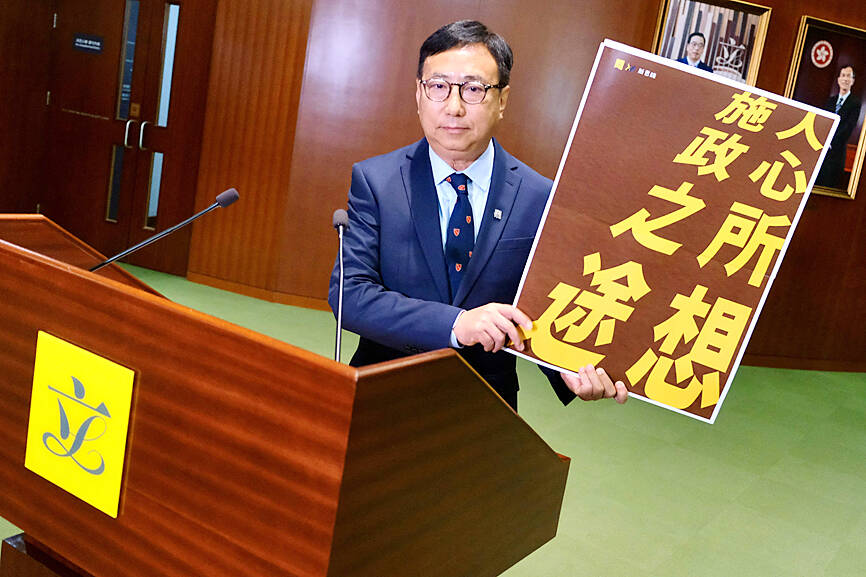
Photo: AFP
Tik and some of his fellow departing lawmakers reflect how Hong Kong no longer tolerates even mild dissent in the legislative chamber, and that attempts to change the system from within have failed, academics and observers said.
Hong Kong had two decades of spirited opposition politics, which took off in the final years of British colonial rule and grew into a pro-democracy coalition in the 2010s before being wiped out.
“[Nowadays] a lot of the speeches have an echo chamber effect... The culture is monotonous, and those who are relatively lively have given up re-election,” said Kenneth Chan (陳家洛), a political scientist at Hong Kong Baptist University.
Departing legislators have cited reasons such as age and party strategy.
More than a dozen lawmakers declined to be interviewed.
Hong Kong Chief Executive John Lee (李家超) last week criticized those who “intentionally distorted” the changes in candidate lineups, adding it was natural for Beijing authorities to “express their care” on electoral issues.
‘PATRIOTS’
Beijing overhauled Hong Kong’s electoral system in 2021 to ensure only “patriots” could hold office, following the huge and sometimes violent pro-democracy protests two years prior.
Before he started his four-year term, Tik vowed to get fellow lawmakers to debate the hot-button issue of universal suffrage to elect Hong Kong’s leader.
“I very much regret that I was unable to propose that motion,” he said, adding that he had been too optimistic about having room to maneuver.
Asked if he felt he could go against Beijing’s wishes on certain bills, Tik replied: “There are red lines after the imposition of the National Security Law [in 2020]. Whether you like it or not, that’s the reality.”
However, veteran lawmaker Lo Wai-kwok (盧偉國), 72, said he preferred the new model over the filibuster tactics adopted by opposition “saboteurs” during the 2010s when he was first elected.
“We have become more efficient in reviewing the government’s proposals, funding applications and bills,” Lo said.
In terms of the number of bills passed, the latest cohort was the most productive since 2004.
Andrew Leung (梁君彥), the outgoing president of the legislature, did not agree that the institution had become a rubber stamp.
“If we are rubber stamp, we will not propose so many comments,” Leung said, referring to the approval of a homegrown national security law last year.
A non-governmental organization-affiliated policy researcher, who spoke on condition of anonymity, said lawmakers were “passive” and that led to weaker government accountability.
“Overall, the lawmakers asked far fewer questions. This affected the transparency of various public policies,” the source said, referring to the vetting of government budgets.
A September survey showed that only 30 percent were satisfied with the legislature, while 50 percent said they were not, a local think tank said.
TIME TO ‘MOBILIZE’
The first election held after Beijing’s 2021 overhaul — which involved national security vetting and higher nomination thresholds for candidates — had a record low turnout of 30 percent.
It also saw the rise of candidates with little local experience, but strong ties to the Chinese state, nicknamed “national team” politicians, a trend expected to continue.
“Traditionally, more than half of Hong Kong voters supported pro-democracy parties. It is hard to imagine they felt closely connected to the legislature created in 2021,” Chan said.
Next month’s race will once again be devoid of the two largest pro-democracy parties: The Civic Party disbanded in 2023 and the Democratic Party is winding down.
Chan said Hong Kong officials were pulling all the stops to get people to vote.
“When every candidate is a patriot, and many of them belong to the ‘national team’... Then the [turnout] reflects the government’s ability to mobilize, and not the public’s level of interest,” he said.

SPEAKING OUT: After Siranudh Scott’s allegations surfaced, celebrities and public figures took to social media to share their own experiences of sexual misconduct and abuse A high-profile alleged sexual abuse case within a wealthy Thai beer brewing family has prompted a wave of painful accounts from survivors of unconnected abuse in the conservative nation. Siranudh Scott, a member of the billionaire Thai family that founded the ubiquitous Singha beer brand, posted an emotional video this month accusing his elder brother Sunit of repeatedly abusing him when he was a teenager. Sunit, who is in his 30s, later denied the allegations in a video posted online, but Singha parent Boonrawd dismissed him from his executive role with the company on Tuesday last week. “I felt I needed to speak

SEEKING ORDER: Rodrigo Paz said that ‘anyone who wants to destroy the nation will have to deal with this president and the full force of the constitution’ Bolivian President Rodrigo Paz on Wednesday said that the nation was at a “breaking point” after nearly a month of protests that have caused shortages of food, fuel and medicine. Paz, who took office six months ago amid the worst economic crisis there in four decades, is battling a groundswell of fury over his policies. The political capital, La Paz, has been besieged by low-income workers and members of the indigenous majority calling for his resignation. “The country needs order and is reaching breaking point,” the 58-year-old said at a public event in La Paz, renewing his appeal for dialogue. On Tuesday, the Bolivian

A Hong Kong astronaut is to join a Chinese space mission for the first time as part of a three-person crew launching today, as Beijing edges closer to its goal of landing people on the moon. The Tiangong space station — crewed by teams of three astronauts that are typically rotated every six months — is the crown jewel of China’s space program, boosted by billions in state investment in a bid to catch up with the US and Russia. The Shenzhou-23 mission is to blast off at 11:08pm from the Jiuquan Satellite Launch Center in northwestern China, carrying three astronauts to

UPGRADED ALERT: The risk inside DR Congo is now considered ‘very high,’ while neighboring countries face a ‘high’ threat as the outbreak continues, the WHO said Ebola is spreading faster than responders can track it in eastern Congo, where health workers managed to follow up with barely one in five identified contacts in a single day. Authorities in the Democratic Republic of the Congo (DR Congo) reported 83 confirmed infections, 746 suspected cases and 1,603 identified contacts as of Thursday, but health workers were able to follow up on only 342 contacts that day — about 21 percent of the total under monitoring — data released by the DR Congo Ministry of Public Health on Friday showed. The figures suggest the response is falling behind the outbreak itself,


 RSS
RSS