


The gunman accused of killing former Japanese prime minister Shinzo Abe yesterday pleaded guilty, three years after the assassination in broad daylight shocked the world.
The slaying forced a reckoning in a nation with little experience of gun violence, and ignited scrutiny of alleged ties between prominent conservative lawmakers and a secretive sect, the Unification Church.
“Everything is true,” Tetsuya Yamagami said at a court in the western city of Nara, admitting to murdering the nation’s longest-serving leader in July 2022.
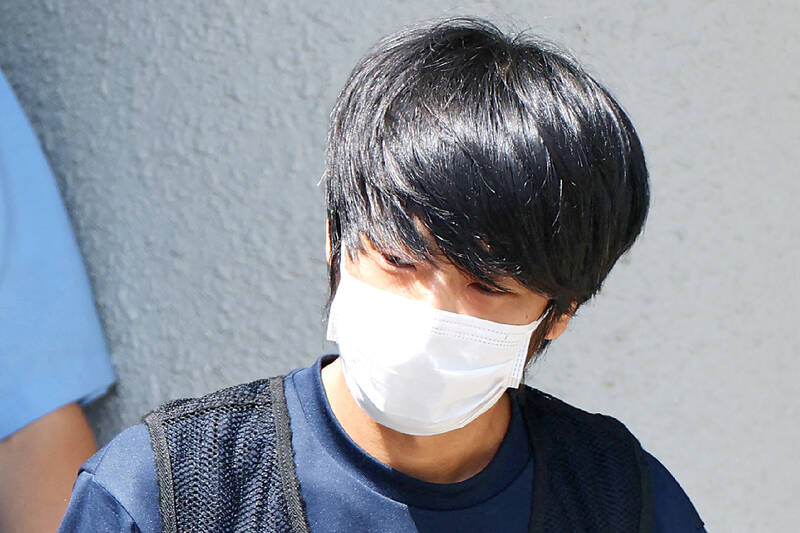
Photo: AFP
The 45-year-old was led into the room by four security officials. When the judge asked him to state his name, Yamagami, who was wearing a black T-shirt and had his long hair tied at the back, replied in a barely audible voice.
However, his lawyer said they would contest certain charges, including contraventions of arms control laws for allegedly using a handmade weapon.
Yamagami’s trial had been a long time coming after the discovery of a suspicious item — later found to be harmless — caused its last-minute cancelation and the evacuation of the Nara court building in 2023.
One issue central to the case was whether extenuating circumstances applied due to “religious abuse” in Yamagami’s childhood stemming from his mother’s extreme devotion to the Unification Church, local media reported.
Yamagami reportedly resented Abe for his perceived ties to the church, which was established in South Korea in 1954 and whose members are nicknamed “Moonies” after its founder Sun Myung Moon.
The church has been accused of fomenting child neglect among its members and financially exploiting them, claims it denies.
Yamagami was said to have held a grudge against the church for bankrupting his family after his mother donated about ¥100 million (US$660,0000) as proof of her faith.
Investigations after Abe’s murder led to cascading revelations about close ties between the church and many conservative lawmakers in the ruling Liberal Democratic Party, prompting four ministers to resign.
The Tokyo District Court earlier this year issued a dissolution order for the church’s Japanese arm, saying it caused “unprecedented damage” to society.
The assassination was also a wake-up call for a nation with some of the world’s strictest gun controls.
Gun violence is so rare in Japan that security officials at the scene failed to immediately identify the sound made by the first shot and came to Abe’s rescue too late, a police report after the attack said.
The debacle prompted lawmakers last year to pass a bill further strengthening arms controls to prevent people from making homemade guns.
Under the new rules, uploading tutorial videos on making firearms and propagating information about gun sales on social media can result in a fine or imprisonment of up to one year.
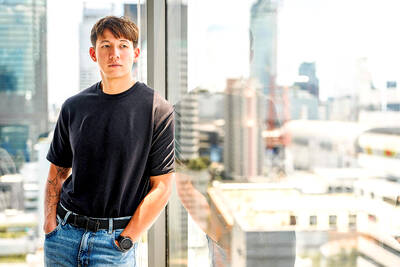
SPEAKING OUT: After Siranudh Scott’s allegations surfaced, celebrities and public figures took to social media to share their own experiences of sexual misconduct and abuse A high-profile alleged sexual abuse case within a wealthy Thai beer brewing family has prompted a wave of painful accounts from survivors of unconnected abuse in the conservative nation. Siranudh Scott, a member of the billionaire Thai family that founded the ubiquitous Singha beer brand, posted an emotional video this month accusing his elder brother Sunit of repeatedly abusing him when he was a teenager. Sunit, who is in his 30s, later denied the allegations in a video posted online, but Singha parent Boonrawd dismissed him from his executive role with the company on Tuesday last week. “I felt I needed to speak

A Hong Kong astronaut is to join a Chinese space mission for the first time as part of a three-person crew launching today, as Beijing edges closer to its goal of landing people on the moon. The Tiangong space station — crewed by teams of three astronauts that are typically rotated every six months — is the crown jewel of China’s space program, boosted by billions in state investment in a bid to catch up with the US and Russia. The Shenzhou-23 mission is to blast off at 11:08pm from the Jiuquan Satellite Launch Center in northwestern China, carrying three astronauts to
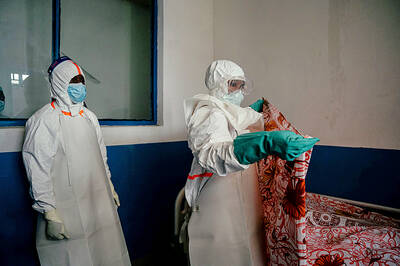
UPGRADED ALERT: The risk inside DR Congo is now considered ‘very high,’ while neighboring countries face a ‘high’ threat as the outbreak continues, the WHO said Ebola is spreading faster than responders can track it in eastern Congo, where health workers managed to follow up with barely one in five identified contacts in a single day. Authorities in the Democratic Republic of the Congo (DR Congo) reported 83 confirmed infections, 746 suspected cases and 1,603 identified contacts as of Thursday, but health workers were able to follow up on only 342 contacts that day — about 21 percent of the total under monitoring — data released by the DR Congo Ministry of Public Health on Friday showed. The figures suggest the response is falling behind the outbreak itself,

SEEKING ORDER: Rodrigo Paz said that ‘anyone who wants to destroy the nation will have to deal with this president and the full force of the constitution’ Bolivian President Rodrigo Paz on Wednesday said that the nation was at a “breaking point” after nearly a month of protests that have caused shortages of food, fuel and medicine. Paz, who took office six months ago amid the worst economic crisis there in four decades, is battling a groundswell of fury over his policies. The political capital, La Paz, has been besieged by low-income workers and members of the indigenous majority calling for his resignation. “The country needs order and is reaching breaking point,” the 58-year-old said at a public event in La Paz, renewing his appeal for dialogue. On Tuesday, the Bolivian


 RSS
RSS