


Venezuelan Acting President Delcy Rodriguez on Friday announced an amnesty bill that could lead to the release of hundreds of prisoners, including opposition leaders, journalists and human rights activists detained for political reasons.
The measure had long been sought by the US-backed opposition.
It is the latest concession Rodriguez has made since taking the reins of the country on Jan. 3 after the brazen seizure of then-Venezuelan president Nicolas Maduro.
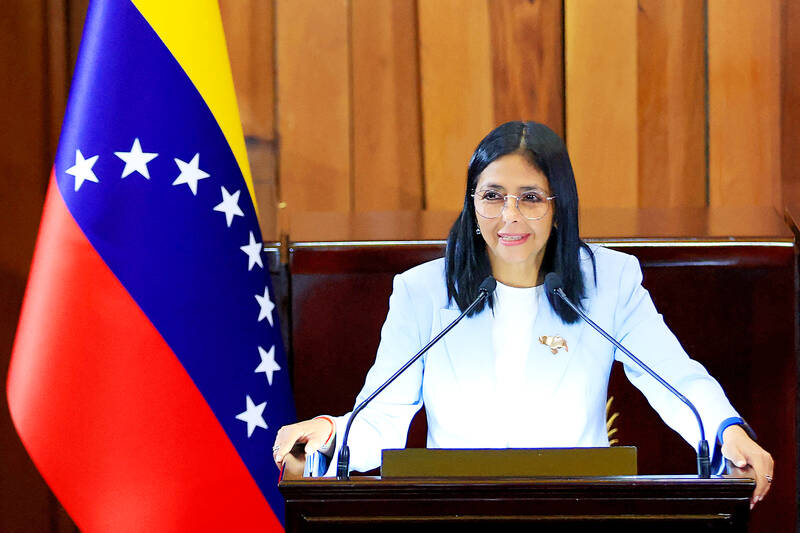
Photo: Efrain Gonzalez, AFP, Venezuelan Presidency
Rodriguez told a gathering of justices, magistrates, ministers, military brass and other government leaders that the ruling party-controlled Venezuelan National Assembly would take up the bill with urgency.
Rodriguez also announced the shutdown of Helicoide, a prison in Caracas where torture and other human rights abuses have been repeatedly documented by independent organizations.
The facility would be transformed into a sports, social and cultural center for police and surrounding neighborhoods, she said.
The Venezuelan-based prisoners’ rights group Foro Penal estimated that 711 people are in detention facilities across the South American country for their political activities. Of those, 183 have been sentenced.
The government did not release the text of the bill, leaving unclear the specific criteria that would be used to determine who qualifies for amnesty.
The “general amnesty law” would cover the “entire period of political violence from 1999 to the present,” Rodriguez said, adding that people convicted of murder, drug trafficking, corruption or human rights violations would not qualify for relief.
Rodriguez’s government earlier this month announced plans to release a significant number of prisoners in a goodwill gesture, but relatives of those detained have condemned the slow pace of the releases.
“A general amnesty is welcome as long as its elements and conditions include all of civil society, without discrimination, that it does not become a cloak of impunity, and that it contributes to dismantling the repressive apparatus of political persecution,” Foro Penal president Alfredo Romero said.
The organization has tallied 302 releases since the Jan. 8 announcement.
The human rights group Provea in a statement called out the lack of transparency and “trickle” pace of prisoner releases.
While the freeing of those still detained “is urgent, the announcement of an amnesty should not be conceived, under any circumstances, as a pardon or act of clemency on the part of the State,” it said.
“We recall that these people were arbitrarily imprisoned for exercising rights protected by international human rights instruments, the National Constitution and Venezuelan laws,” Provea said.
Outside another detention facility in Caracas, Edward Ocariz, who was detained for more than five months after the 2024 election, joined prisoners’ relatives in demanding their loved ones’ swift release.
“We, Venezuelans, have all endured so much, all unjust, merciless and trampling on our dignity. No one deserves this,” Ocariz said. “And today, the guilty continue to govern Venezuela.”

An American scientist convicted of lying to US authorities about payments from China while he was at Harvard University has rebuilt his research lab in Shenzhen, China, to pursue technology the Chinese government has identified as a national priority: embedding electronics into the human brain. Charles Lieber, 67, is among the world’s leading researchers in brain-computer interfaces. The technology has shown promise in treating conditions such as amyotrophic lateral sclerosis and restoring movement in paralyzed people. It also has potential military applications: Scientists at the Chinese People’s Liberation Army have investigated brain interfaces as a way to engineer super soldiers by boosting
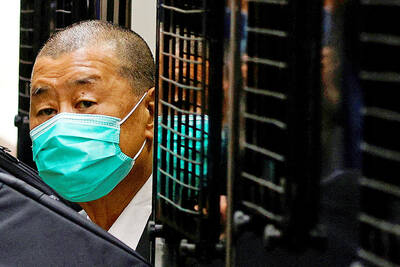
Jailed media entrepreneur Jimmy Lai (黎智英) has been awarded Deutsche Welle’s (DW) freedom of speech award for his contribution to Hong Kong’s pro-democracy movement. The German public broadcaster on Thursday said Lai would be presented in absentia with the 12th iteration of the award on June 23 at the DW Global Media Forum in Bonn. Deutsche Welle director-general Barbara Massing praised the 78-year-old founder of the now-shuttered news outlet Apple Daily for standing “unwaveringly for press freedom in Hong Kong at great personal risk.” “With Apple Daily, he gave journalists a platform for free reporting and a voice to the democracy movement in
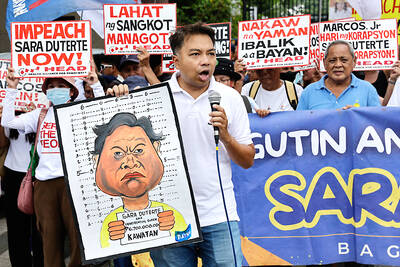
PHILIPPINE COMMITTEE: The head of the committee that made the decision said: ‘If there is nothing to hide, there is no reason to hide, there is no reason to obstruct’ A Philippine congressional committee on Wednesday ruled that there was “probable cause” to impeach Philippine Vice President Sara Duterte after hearing allegations of unexplained wealth, misuse of state funds and threats to have the president assassinated. The unanimous decision of the 53-member committee in the Philippine House of Representatives sends the two impeachment complaints to deliberations and voting by the entire lower chamber, which has more than 300 lawmakers. The complaints centered on Duterte’s alleged illegal use and mishandling of intelligence funds from the vice president’s office, and from her time as education secretary under Philippine President Ferdinand Marcos Jr. Duterte and the

Burmese President Min Aung Hlaing yesterday cut all prisoners’ sentences by one-sixth, a blanket measure that a source close to deposed leader Aung San Suu Kyi said would further shorten her detention. Aung San Suu Kyi has been sequestered since a 2021 military coup, but the senior member of her dissolved National League for Democracy (NLD) party said that while her term had been reduced, her remaining sentence is still unclear. “We also don’t know exactly how many years she has left,” the source told reporters, speaking on condition of anonymity for security reasons. The military toppled Aung San Suu Kyi’s elected government


 RSS
RSS