


Exiled Tibetans began a unique global election yesterday for a government representing a homeland many have never seen, as part of a democratic exercise voters say carries great weight.
From red-robed Buddhist monks in the snowy Himalayas, to political exiles in megacities across South Asia, to refugees in Australia, Europe and North America, voting takes place in 27 countries — but not China.
“Elections ... show that the struggle for Tibet’s freedom and independence continues from generation to generation,” said candidate Gyaltsen Chokye, 33, who is based in the Indian hill-town of Dharamsala, headquarters of the government-in-exile, the Central Tibetan Administration (CTA).
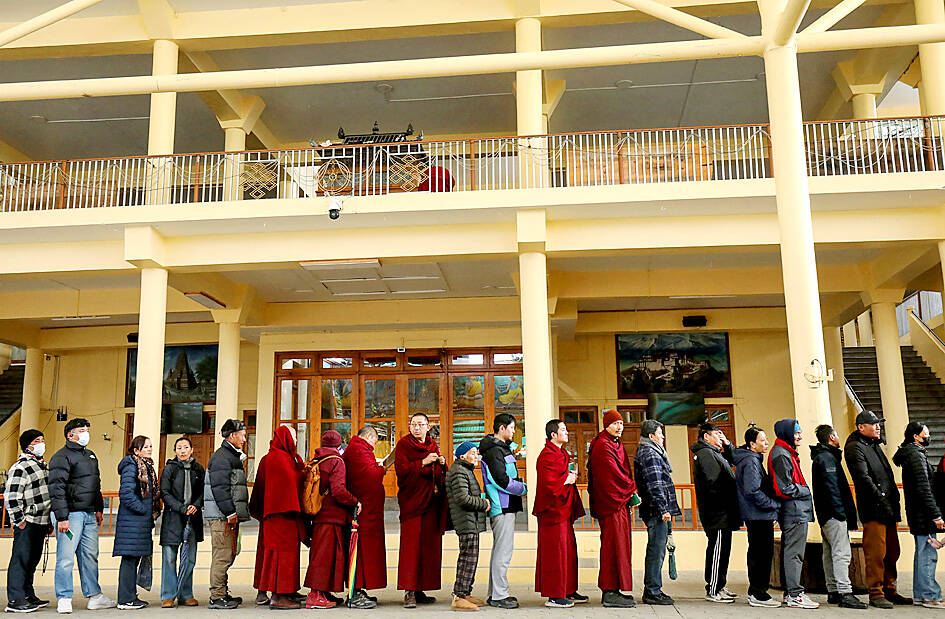
Photo: A
It is an electoral system unlike any other, a vote for a parliament without a state.
Beijing, which in 1950 sent troops to the vast high-altitude plateau it calls an integral part of China, condemned the elections as a “farce.”
“The so-called ‘Tibetan government-in-exile’ is nothing but a separatist political group,” China’s foreign ministry said in a statement. “It is an illegal organization that completely violates the Chinese constitution and laws.”
The 91,000 registered voters reject that view.
Many see the vote as the most consequential democratic moment for them since their revered Buddhist spiritual leader, the Dalai Lama — who celebrated his 90th birthday last year — fled Chinese rule in 1959.
“These elections show that political agency exists even without a state, especially when democratic participation is denied inside Tibet,” said Sonam Palmo, 38, from Switzerland’s University of Zurich, who helps run Smartvote Tibet, a Web site helping the diaspora select candidates. “They underscore the resilience and shared purpose of the exile community at a decisive moment.”
Exiled voters represent only a fraction of ethnic Tibetans — whom the CTA estimates at six million worldwide, compared with more than seven million China counted in its 2020 census.
The five-year parliament, which sits twice a year, has 45 members: 30 representing three traditional provinces, 10 representing five religious traditions and five representing the diaspora.
Yesterday’s vote was to select candidates ahead of a final round on April 26, with results due May 13.
Voters would cast paper ballots, with Election Commission chief Lobsang Yeshi alleging “past attempts by China to interfere with and disrupt Tibetan elections,” including “cyberespionage.”
It is a key institution for the exiles, especially after the Dalai Lama handed over political power in 2011.
The Nobel Peace Prize laureate insists he has many more years to live, but Tibetans are preparing for an inevitable future without him. China insists it would have the final say over who succeeds him.
“The advancing age of His Holiness is, without question, a matter of deep concern for all Tibetans,” said US-based Tenzin Namgyal Tethong, 78, a former Tibetan government leader. “The most important thing we can do during this time is to safeguard everything we have achieved under his guidance.”
Elections come as the diaspora community grapples with changing identities driven by generational shift and geographic dispersion, as well as geopolitical change.
While punishing US aid cuts last year were partially reversed, concerns about donor dependence persist, including reliance on host India and how this intersects with New Delhi’s relationship with China — once icy, now gradually easing.
“Given the shifting foreign policy priorities of the US administration, and China’s expanding influence in global affairs, there is little doubt that we may see major changes,” Namgyal said. “We cannot predict how harmful these shifts may be for the Tibetan cause.”
More than half of voters, about 56,000, live in India, Nepal and Bhutan. The remaining 34,000 are scattered around the world, including about 12,000 in North America, and 8,000 in Europe, including Paris, Geneva, Zurich and London.
“The stakes are too high to risk choosing ineffective leadership,” said Kunga Choekey, 24, a voter based in Dehradun, India.
Voters would also elect the government’s “sikyong,” or leader. Tibetan Sikyong Penpa Tsering is seeking a second term. Like many, he does not seek full independence for Tibet, in line with the Dalai Lama’s long-standing “Middle Way” policy seeking autonomy.
Australia-based lawmaker Doring Tenzin Phuntsok, 40, campaigning for re-election, wants the vote to send a message to Beijing.
“The election... forms a major counter to China’s autocratic one-party rule,” Phuntsok said. “It is part of the continual process of the freedom struggle.”

SPEAKING OUT: After Siranudh Scott’s allegations surfaced, celebrities and public figures took to social media to share their own experiences of sexual misconduct and abuse A high-profile alleged sexual abuse case within a wealthy Thai beer brewing family has prompted a wave of painful accounts from survivors of unconnected abuse in the conservative nation. Siranudh Scott, a member of the billionaire Thai family that founded the ubiquitous Singha beer brand, posted an emotional video this month accusing his elder brother Sunit of repeatedly abusing him when he was a teenager. Sunit, who is in his 30s, later denied the allegations in a video posted online, but Singha parent Boonrawd dismissed him from his executive role with the company on Tuesday last week. “I felt I needed to speak
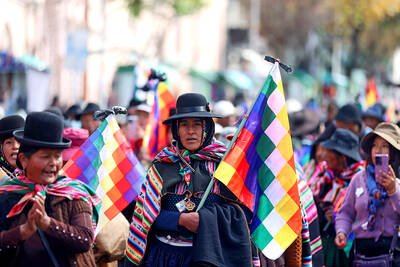
SEEKING ORDER: Rodrigo Paz said that ‘anyone who wants to destroy the nation will have to deal with this president and the full force of the constitution’ Bolivian President Rodrigo Paz on Wednesday said that the nation was at a “breaking point” after nearly a month of protests that have caused shortages of food, fuel and medicine. Paz, who took office six months ago amid the worst economic crisis there in four decades, is battling a groundswell of fury over his policies. The political capital, La Paz, has been besieged by low-income workers and members of the indigenous majority calling for his resignation. “The country needs order and is reaching breaking point,” the 58-year-old said at a public event in La Paz, renewing his appeal for dialogue. On Tuesday, the Bolivian
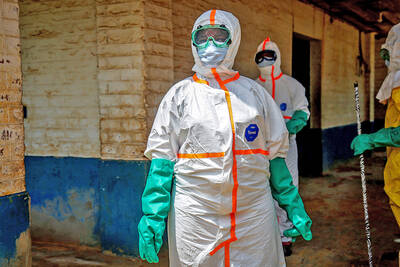
COMMUNITY CONFLICT: Concerns about disease spread from corpses has run up against friends and families’ desire to bury their dead as infection spreads in the area Angry residents of a town at the epicenter of the Ebola outbreak in the Democratic Republic of the Congo (DR Congo) attacked and burned a tent that was part of a health center where people are being treated for the virus, the staff there said Saturday. It was the second such attack in the region in a week. No one was hurt in the attack, according to reports but as patients ran out to escape the fire, 18 people with suspected Ebola infections fled the facility and are unaccounted for, a hospital director said. Angry residents arrived at the clinic in the
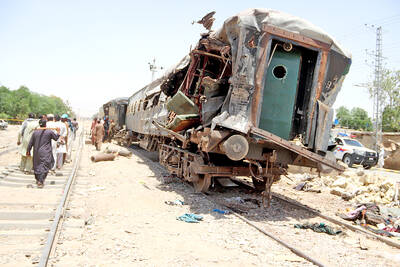
INSURGENT ACTION: A local independence movement in Balochistan, alleged by Pakistan’s government to be backed by India, claimed responsibility for the strike A suicide bomber detonated an vehicle-borne IED near a railway as a passenger train passed through the southwestern Pakistani city of Quetta yesterday, killing at least 23 people and wounding over 70, officials said. The explosion caused two of the train cars to overturn and catch fire, according to footage shared online. The attack happened in an area where security forces are usually stationed, badly damaging several nearby buildings and smashing more than a dozen vehicles parked along the road, according to witnesses and images circulating on social media. Doctors at local hospitals said they had received the wounded, with 20 in critical


 RSS
RSS